Gen Z, Gen Alpha won't learn the old way. Can India train teachers fast enough?
India has millions of graduates, but not enough well-trained teachers. In the era of AI and fast-paced learning, experts say India's teacher education system is struggling to produce classroom-ready educators at scale. The debate centres on whether continuous training, mentoring and classroom practice can improve teaching quality.
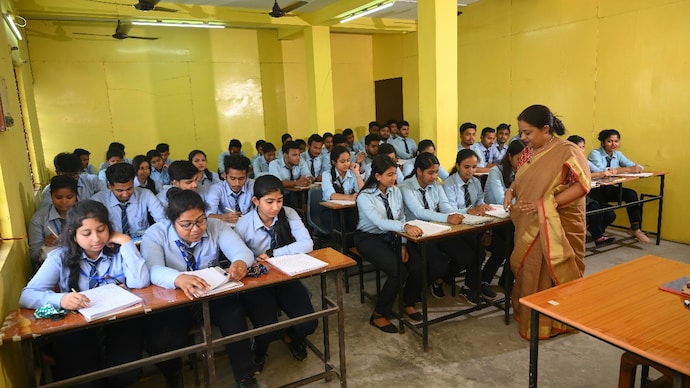
Walk into a typical classroom today and the shift is impossible to miss. Students are more distracted, attention spans are shorter, and the way they consume information has completely changed.
For many Gen Z and Gen Alpha learners, static lectures are no longer enough. They are used to fast, visual, interactive content, from short videos to gamified apps, and expect learning to feel just as engaging.
But most classrooms have not kept up.
In many regular schools, teaching still relies heavily on blackboards, textbooks and one-way instruction. Audio-visual tools, interactive learning, and gamified methods, now common in global education systems, remain limited or unevenly implemented.
And with the rise of artificial intelligence, a more uncomfortable question is emerging: if information is available instantly to everyone, what is the role of a teacher?
The answer lies in what technology cannot replace. Teachers bring context, empathy, judgement, and the ability to shape how students think, not just what they learn. But that also means the expectations from teachers have changed dramatically.
India produces millions of graduates every year. Yet, when it comes to building teachers who can meet this new classroom reality, the pipeline remains thin.
According to the Unified District Information System for Education Plus (UDISE+) 2023–24, India has over 1 crore school teachers, but continues to face gaps not just in numbers, but in teacher quality, classroom readiness, and subject expertise.
The National Education Policy (NEP) 2020 has already flagged teacher education as a “critical reform area”, pointing to a deeper structural issue.
At the same time, as international curricula and progressive schools expand, the demand for globally trained, adaptive educators is rising faster than the system can respond.
So where exactly is the gap?
For many experts, it begins with how teachers are trained, and whether that training reflects how students actually learn today.
CLASSROOMS HAVE CHANGED. HAVE TEACHERS?
The modern classroom is no longer just about delivering information. It is about holding attention, encouraging curiosity, and helping students make sense of an overload of content.
Studies across global education systems show that student attention spans have reduced significantly in digital-first environments, pushing educators towards more engaging, interactive teaching methods. In India too, the rise of edtech platforms, AI tools, and digital content has reshaped how students learn outside school.
Yet, inside classrooms, the shift is slower.
“Teachers must move from teaching information to cultivating questions,” says Syed Sultan Ahmed, Chairperson of TAISI. He explains that in a world where information is easily accessible, the real skill lies in helping students analyse, question, and think critically.
But most teacher training programmes are still catching up.
WHEN AI ENTERS THE CLASSROOM
Artificial intelligence is accelerating this shift.
Globally, reports suggest that over 60% of educators are already using or experimenting with AI tools in teaching, from personalised learning platforms to automated assessments. In India, AI-driven learning apps and tools are becoming increasingly accessible, especially in urban and private school ecosystems.
This creates both opportunity and pressure.
If AI can explain concepts, generate notes, and even assess performance, then what makes a teacher indispensable?
“Teaching is a deeply human profession,” says Manit Jain, Co-Founder of Heritage Xperiential Schools and I Am A Teacher (IAAT). “It is not just about content delivery but about relationships, reflection, and understanding learners.”
This is where teachers must evolve, not compete with technology, but complement it.
THE TRAINING GAP THAT PERSISTS
Despite these shifts, teacher preparation in India remains largely rooted in older models.
“Teacher education has often functioned as a credentialing pathway rather than developing the craft of teaching,” says Jain.
The gap is not just theoretical, it is structural.
Many teachers enter classrooms with limited exposure to:
Real classroom practice
Mentorship from experienced educators
Training in modern pedagogies like inquiry-based or experiential learning
Research supports this. Studies by education expert Linda Darling-Hammond show that teachers with extensive classroom practice and mentoring are far more effective in improving student learning outcomes. Yet, such models are not widespread.
Jain calls this a gap between knowing teaching and doing teaching.
He adds that teaching is not just a technical job. “Teaching is not only a technical profession. It is deeply human and relational,” he says. That means teachers need both skills and self-awareness.
GLOBAL MODELS, LOCAL CHALLENGES
International curricula offer a glimpse of what modern teaching looks like.
“Teachers in inquiry-led curricula act as facilitators of learning,” says Mahesh Balakrishnan from the International Baccalaureate. This involves designing open-ended questions, encouraging reflection, and building student agency.
But applying these methods in India’s diverse classrooms is not straightforward.
Faiza Mirza, COO of WACE India, echoes this concern. She says teachers today need skills in questioning, guiding discussions, designing projects, and integrating technology, but many are still transitioning from traditional teaching methods.
While these approaches are gaining ground, the transition from traditional teaching remains uneven.
WHY MOTIVATION MATTERS AS MUCH AS TRAINING
Even when training exists, sustained improvement depends on motivation.
Ramya Venkataraman, Founder and CEO of CENTA highlights that accreditation and career-linked growth pathways can drive continuous learning.
Her organisation’s data shows:
61% teachers improved classroom practices
73% reported better competencies
35 million microlearning engagements in a year
This suggests that teachers are willing to adapt — if systems support and recognise their growth.
CENTA also recorded 35 million microlearning engagements in 2025, showing that teachers are willing to learn, if given the right tools and incentives.
“Accreditation creates career pathways, which motivates teachers to keep improving,” Venkataraman adds.
CAN INDIA SCALE THIS TRANSFORMATION?
Scaling quality teaching in India is not just about adding more training institutes.
“Every good classroom should become a training ground,” says Jain, advocating for apprenticeship-style learning.
Technology can support this scale, through online learning, peer networks, and mentoring platforms, but it cannot replace the human core of teaching.
At the policy level, NEP 2020’s four-year integrated teacher education programme is a step forward. But implementation across states and institutions remains uneven.
THE REAL TEST: WHAT STUDENTS EXPERIENCE
In the end, the success of teacher education is visible in one place: the classroom.
Are students engaged?
Are they curious?
Are they thinking independently?
If the answer is no, then the system still has work to do.
India stands at a critical moment. The way students learn has already changed. Technology is reshaping education faster than ever before.
Now, the question is whether teachers, and the systems that prepare them, can keep up.
Because building world-class education will ultimately depend on building teachers who are ready for the classrooms of today, not yesterday.
Walk into a typical classroom today and the shift is impossible to miss. Students are more distracted, attention spans are shorter, and the way they consume information has completely changed.
For many Gen Z and Gen Alpha learners, static lectures are no longer enough. They are used to fast, visual, interactive content, from short videos to gamified apps, and expect learning to feel just as engaging.
But most classrooms have not kept up.
In many regular schools, teaching still relies heavily on blackboards, textbooks and one-way instruction. Audio-visual tools, interactive learning, and gamified methods, now common in global education systems, remain limited or unevenly implemented.
And with the rise of artificial intelligence, a more uncomfortable question is emerging: if information is available instantly to everyone, what is the role of a teacher?
The answer lies in what technology cannot replace. Teachers bring context, empathy, judgement, and the ability to shape how students think, not just what they learn. But that also means the expectations from teachers have changed dramatically.
India produces millions of graduates every year. Yet, when it comes to building teachers who can meet this new classroom reality, the pipeline remains thin.
According to the Unified District Information System for Education Plus (UDISE+) 2023–24, India has over 1 crore school teachers, but continues to face gaps not just in numbers, but in teacher quality, classroom readiness, and subject expertise.
The National Education Policy (NEP) 2020 has already flagged teacher education as a “critical reform area”, pointing to a deeper structural issue.
At the same time, as international curricula and progressive schools expand, the demand for globally trained, adaptive educators is rising faster than the system can respond.
So where exactly is the gap?
For many experts, it begins with how teachers are trained, and whether that training reflects how students actually learn today.
CLASSROOMS HAVE CHANGED. HAVE TEACHERS?
The modern classroom is no longer just about delivering information. It is about holding attention, encouraging curiosity, and helping students make sense of an overload of content.
Studies across global education systems show that student attention spans have reduced significantly in digital-first environments, pushing educators towards more engaging, interactive teaching methods. In India too, the rise of edtech platforms, AI tools, and digital content has reshaped how students learn outside school.
Yet, inside classrooms, the shift is slower.
“Teachers must move from teaching information to cultivating questions,” says Syed Sultan Ahmed, Chairperson of TAISI. He explains that in a world where information is easily accessible, the real skill lies in helping students analyse, question, and think critically.
But most teacher training programmes are still catching up.
WHEN AI ENTERS THE CLASSROOM
Artificial intelligence is accelerating this shift.
Globally, reports suggest that over 60% of educators are already using or experimenting with AI tools in teaching, from personalised learning platforms to automated assessments. In India, AI-driven learning apps and tools are becoming increasingly accessible, especially in urban and private school ecosystems.
This creates both opportunity and pressure.
If AI can explain concepts, generate notes, and even assess performance, then what makes a teacher indispensable?
“Teaching is a deeply human profession,” says Manit Jain, Co-Founder of Heritage Xperiential Schools and I Am A Teacher (IAAT). “It is not just about content delivery but about relationships, reflection, and understanding learners.”
This is where teachers must evolve, not compete with technology, but complement it.
THE TRAINING GAP THAT PERSISTS
Despite these shifts, teacher preparation in India remains largely rooted in older models.
“Teacher education has often functioned as a credentialing pathway rather than developing the craft of teaching,” says Jain.
The gap is not just theoretical, it is structural.
Many teachers enter classrooms with limited exposure to:
Real classroom practice
Mentorship from experienced educators
Training in modern pedagogies like inquiry-based or experiential learning
Research supports this. Studies by education expert Linda Darling-Hammond show that teachers with extensive classroom practice and mentoring are far more effective in improving student learning outcomes. Yet, such models are not widespread.
Jain calls this a gap between knowing teaching and doing teaching.
He adds that teaching is not just a technical job. “Teaching is not only a technical profession. It is deeply human and relational,” he says. That means teachers need both skills and self-awareness.
GLOBAL MODELS, LOCAL CHALLENGES
International curricula offer a glimpse of what modern teaching looks like.
“Teachers in inquiry-led curricula act as facilitators of learning,” says Mahesh Balakrishnan from the International Baccalaureate. This involves designing open-ended questions, encouraging reflection, and building student agency.
But applying these methods in India’s diverse classrooms is not straightforward.
Faiza Mirza, COO of WACE India, echoes this concern. She says teachers today need skills in questioning, guiding discussions, designing projects, and integrating technology, but many are still transitioning from traditional teaching methods.
While these approaches are gaining ground, the transition from traditional teaching remains uneven.
WHY MOTIVATION MATTERS AS MUCH AS TRAINING
Even when training exists, sustained improvement depends on motivation.
Ramya Venkataraman, Founder and CEO of CENTA highlights that accreditation and career-linked growth pathways can drive continuous learning.
Her organisation’s data shows:
61% teachers improved classroom practices
73% reported better competencies
35 million microlearning engagements in a year
This suggests that teachers are willing to adapt — if systems support and recognise their growth.
CENTA also recorded 35 million microlearning engagements in 2025, showing that teachers are willing to learn, if given the right tools and incentives.
“Accreditation creates career pathways, which motivates teachers to keep improving,” Venkataraman adds.
CAN INDIA SCALE THIS TRANSFORMATION?
Scaling quality teaching in India is not just about adding more training institutes.
“Every good classroom should become a training ground,” says Jain, advocating for apprenticeship-style learning.
Technology can support this scale, through online learning, peer networks, and mentoring platforms, but it cannot replace the human core of teaching.
At the policy level, NEP 2020’s four-year integrated teacher education programme is a step forward. But implementation across states and institutions remains uneven.
THE REAL TEST: WHAT STUDENTS EXPERIENCE
In the end, the success of teacher education is visible in one place: the classroom.
Are students engaged?
Are they curious?
Are they thinking independently?
If the answer is no, then the system still has work to do.
India stands at a critical moment. The way students learn has already changed. Technology is reshaping education faster than ever before.
Now, the question is whether teachers, and the systems that prepare them, can keep up.
Because building world-class education will ultimately depend on building teachers who are ready for the classrooms of today, not yesterday.

