How YouTuber's hate speech on Goa's patron saint Francis Xavier has BJP on backfoot
As street protests force Gautam Khattar's arrest, was his speech a calculated move to polarise majoritarian votes or a self-goal?
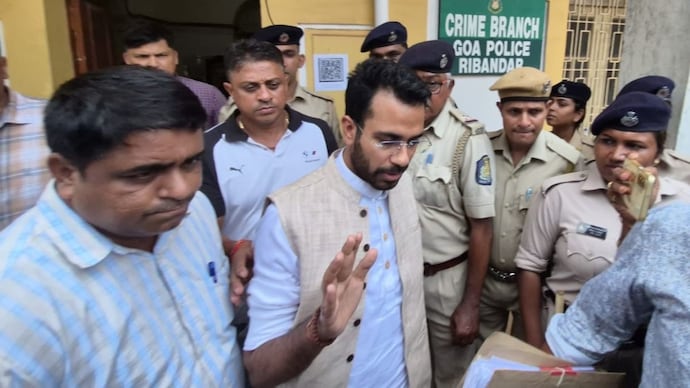
Khattar, founder of the Sanatan Mahasangh, describes himself as a “spiritual beat journalist” or “half journalist and half YouTuber (sic)”. He made objectionable remarks against the Spanish missionary at a ‘Parshuram Jayanti’ event in Vasco last month.
The statements triggered street protests after its video went viral. The Goa police have arrested Khattar. The issue has become an embarrassment for the BJP government, led by Dr Pramod Sawant, in the run-up to assembly elections in early 2027 as a minister and two MLAs from the ruling party were on stage at the Vasco event.
Revered as ‘Goencho Saib’, the mortal remains of Saint Francis Xavier, a nobleman from Navarre in Spain who arrived on the shores of Goa in 1542, are housed at the Basilica of Bom Jesus in Old Goa, the erstwhile capital of Portuguese India. The cathedral is one of the largest in Asia. Its construction was ordered in 1562 by the king of Portugal and the work was completed in 1605.
The Catholic Church described Khattar’s remarks as “derogatory and insulting”, and ministers and leaders from the BJP have scurried for damage control. Transport minister Mauvin Godinho and BJP MLAs Sankalp Amonkar and Krishna ‘Daji’ Salkar, who were present at the function, have clarified that they did not agree with Khattar; they also condemned his statements.
Chief minister Sawant, who also holds charge of the home portfolio, has said speakers from other states should not disturb Goa’s communal harmony. He added that Godinho should have stopped Khattar immediately, but may have found himself in a dilemma as the statements were made suddenly.
BJP minister Digambar Kamat and Rajya Sabha MP Sadanand Seth Tanavade too condemned Khattar’s remarks and expressed reverence for the saint, whose feast day on December 3 is marked as a state holiday.
However, leader of the Opposition Yuri Alemao of the Congress charged that “non-state actors” like Khattar were being brought to Goa to divide people on communal lines. The “shocking part” was the “chaotic silence” of the minister and MLAs were present, he said, and added that the people would teach them a “befitting lesson”.
Hindutva groups claimed that while the Goa police have acted with alacrity against Khattar, they have not shown similar mettle against Christians who made derogatory comments against Hindu deities. The controversial Sambhajirao Bhide Guruji of the Shivprathisthan Hindustan supported Khattar.
The matter is a slippery turf for the BJP. The party has grown in Goa with its outreach among Christians, who are estimated at a fourth of the population. In 2012, the BJP, under the late Manohar Parrikar, won 21 of 40 assembly seats largely due to the support of Christians and the clergy. The party had nominated 10 Catholics in the elections. Six of them were elected—Francis D’Souza from Mapusa, Michael Lobo from Calangute, Glenn Ticlo from Aldona, Jose Almeida from Vasco, Mathany Saldhana from Cuncolim and Nilesh Cabral from Curchorem.
Parrikar’s social engineering outreach and realpolitik had seen him admit that his move to scrap the Good Friday holiday, in his first stint as Goa chief minister in 2001, was a mistake. He had also cancelled the public holiday for the feast of Saint Francis Xavier, but had to withdraw these moves following an outcry.
Polarisation gone wrong?
Catholics form around 25 per cent of Goa’s population. They have strong numbers in the ‘Old Conquest’ region, which comprises Tiswadi, Bardez and Salcette. The politically-crucial Salcette taluka in south Goa accounts for eight of the 40 assembly segments. In the 2024 Lok Sabha polls, the Congress retained the South Goa Lok Sabha seat largely due to the consolidation of Catholics and Muslims.
BJP leaders admitted the Khattar controversy could affect the party as people across religious and sectarian lines felt emotionally connected with the saint. “The BJP wants to polarise the state’s politics but has been caught on the backfoot by the intense backlash. This will estrange Catholics from them,” noted a senior Catholic MLA from the state.
A senior BJP functionary said the controversy was working to the advantage of the Congress, which fancies its chances in the elections next year. “However, this (Khattar’s remarks) isn’t the official position of my party and has been condemned by us,” he added.
Political analyst Raju Nayak said the BJP risked losing the incremental votes of Christians. “This is a failure of the government. This narrative they are trying to create will backfire,” Nayak said.
An activist, speaking anonymously, said Sawant may be trying to cultivate the image of a Hindutva hardliner to polarise votes, but this was bound to hit a glass ceiling in Goa, where over a third of the population includes Christians and Muslims. “Backing such polarising narratives may be a sort of hara-kiri for the BJP,” he added, stating that a swing in the Catholic vote could also lead to Hindus following them in areas like Salcette.
The Sawant government has already been facing protests on issues such as protection of hills, agricultural lands, water bodies and villages from reclassification for development and urbanisation; the double-tracking of railway lines, and over the demand to remove casinos from the Mandovi river in capital Panjim.
Who was Saint Francis Xavier?
Francis Xavier was born on April 7, 1506 in the castle of Navarre to a noble family. Though he dreamt of growing up to become a powerful army commander, he eventually became a member of the Society of Jesus, and was ordained as a priest on June 24, 1537 at the age of 31. In 1539, he was chosen to go to India as an envoy of the church, and sailed to Goa on the flagship Santiago, braving sea-sickness. The fleet landed in Goa in May 1542.
The biography ‘Saint Francis Xavier: Apostle of India and Japan’, by John C. Reville, which was published in 1919, mentions that Xavier chose to spend the time he could spare from the work of preaching and catechising, hearing confessions, at the bedside of the sick, and “when night came on sultry, heavy and boisterous with half-barbaric mirth, he retired to the church and spent long hours in prayer before the Tabernacle”.
“A few days after he landed, Goa began to realise that a saint had come to India. There is no need to call upon the miracles which his biographers tell us took place at his command or in his behalf, to find out the secret of the success which soon crowned his labours. His life was a living miracle of charity, of patience, of angelic purity, of zeal, of abnegation and heroic self-forgetfulness and self-control,” mentions the book.
During his brief career a missionary leader, St Francis Xavier won a reputation as a priest of extraordinary ability. His crusades took him to Japan and China as well as to India, notes Edna Fernandes in her ‘Holy Warriors: A Journey Into the Heart of Indian Fundamentalism’. Xavier died in China on December 3, 1552.
Sections of the Hindu right-wing paint Xavier as anti-Hindu. In the run-up to the Goa Liberation Day in 2004, a row broke out over a documentary on the liberation struggle that put it in the context of the conversion campaigns of the Portuguese. Pictures of atrocities against Hindus were juxtaposed with the cross, “associating it with evil”, Fernandes points out. Incidentally, the documentary had been produced and distributed with the backing of the Parrikar government in the BJP’s pre-social engineering avatar.
However, despite its social fissures, Goan society is largely seen as syncretic and one which has a high degree of spatial integration and intermingling. Just as Hindus and sections of Muslims pray to Saint Xavier, Catholics also participate in worship at Hindu shrines, such as during the Devi Lairai jatra at Shirgao. In his ‘Asa Ha Gomantak’, editor and author Madhav Gadkari writes about how Christian families from Cortalim (Kushasthali), where the Shri Mangeshi temple was originally located, visit the shrine at Priol. It is here that the idol of Mangesha, considered to be a form of Lord Shiva, was shifted after the Portuguese destroyed the original temple in the 16th century.
Complex past and the way forward
It must be noted that while Xavier has a complex past in relation to the social and religious practices of Christians and neo-converts and also Hindus, he and his shrine have evolved over time as a symbol of syncretism. Despite their religious zeal, the Jesuits also had a deep impact on Goan and Indian society.
The polymath D.D. Kosambi says that Jesuit priests introduced grating on mangoes in the 16th century. This gave birth to the famous ‘Alphonso’ mango, which derives its name from the Portuguese general Alfonso de Albuquerque.
Father Thomas Stephens, who was an English Jesuit priest, wrote the beatific and stirring ‘Khrista Purana’ or the ‘Purana/ Story of Christ’ in Marathi in poetic meter. Stephens was also a linguist of Marathi and Konkani.
Moreover, in India’s complex history and series of historical memories, some of which may overlap with or even contradict each other, personalities and events cannot merely be viewed in terms of black and white. For instance, Khattar’s remarks came at a ‘Parshuram Jayanti’ event. Parshurama, the warrior Brahmin sage, is regarded as an incarnation of Lord Vishnu, and is said to have annihilated the Kshatriyas from the face of the earth for 21 times.
After donating the earth to the Brahmins to cleanse himself, Parshurama is said to have found that he had no place to retire to. Hence, he threw his axe in the sea and reclaimed the land, which is said to be the western coastline, till Kanyakumari. Hence, the Konkan and Goa are said to be ‘Parshurama Kshetra’ or Parshurama’s land. He is also said to be one of the ‘Chiranjeevis’ or immortals.
However, non-Brahmin activists led by Mahatma Jotiba Phule have decried Parshurama as a symbol of Brahmanical cruelty in his book ‘Ghulamgiri’ or slavery. Phule, who was deeply influenced by Thomas Paine’s ‘Rights of Man’ (1791), published an open letter (August 1, 1872) with his name and address in Pune, appealing to the sage, who is said to be “immortal as per the Brahmanical texts”, daring him to manifest himself and to “perform some miracles like before using the mantras from the Vedas and magic before the English, French, and other people”
In 2000, Pope John Paul II apologised for the mistakes of the Church, and many accept the excesses during the Inquisition. As Fernandes mentions in her book, the best way to deal with such a scenario is “open discussion of what went on and how to move forward. It was a dirty history, but one best dealt with in the Catholic tradition of confession, followed by absolution and penitence”. As a BJP leader from Goa with Sangh Parivar roots too underlines, peaceful coexistence is the way forward.
Subscribe to India Today Magazine
Khattar, founder of the Sanatan Mahasangh, describes himself as a “spiritual beat journalist” or “half journalist and half YouTuber (sic)”. He made objectionable remarks against the Spanish missionary at a ‘Parshuram Jayanti’ event in Vasco last month.
The statements triggered street protests after its video went viral. The Goa police have arrested Khattar. The issue has become an embarrassment for the BJP government, led by Dr Pramod Sawant, in the run-up to assembly elections in early 2027 as a minister and two MLAs from the ruling party were on stage at the Vasco event.
Revered as ‘Goencho Saib’, the mortal remains of Saint Francis Xavier, a nobleman from Navarre in Spain who arrived on the shores of Goa in 1542, are housed at the Basilica of Bom Jesus in Old Goa, the erstwhile capital of Portuguese India. The cathedral is one of the largest in Asia. Its construction was ordered in 1562 by the king of Portugal and the work was completed in 1605.
The Catholic Church described Khattar’s remarks as “derogatory and insulting”, and ministers and leaders from the BJP have scurried for damage control. Transport minister Mauvin Godinho and BJP MLAs Sankalp Amonkar and Krishna ‘Daji’ Salkar, who were present at the function, have clarified that they did not agree with Khattar; they also condemned his statements.
Chief minister Sawant, who also holds charge of the home portfolio, has said speakers from other states should not disturb Goa’s communal harmony. He added that Godinho should have stopped Khattar immediately, but may have found himself in a dilemma as the statements were made suddenly.
BJP minister Digambar Kamat and Rajya Sabha MP Sadanand Seth Tanavade too condemned Khattar’s remarks and expressed reverence for the saint, whose feast day on December 3 is marked as a state holiday.
However, leader of the Opposition Yuri Alemao of the Congress charged that “non-state actors” like Khattar were being brought to Goa to divide people on communal lines. The “shocking part” was the “chaotic silence” of the minister and MLAs were present, he said, and added that the people would teach them a “befitting lesson”.
Hindutva groups claimed that while the Goa police have acted with alacrity against Khattar, they have not shown similar mettle against Christians who made derogatory comments against Hindu deities. The controversial Sambhajirao Bhide Guruji of the Shivprathisthan Hindustan supported Khattar.
The matter is a slippery turf for the BJP. The party has grown in Goa with its outreach among Christians, who are estimated at a fourth of the population. In 2012, the BJP, under the late Manohar Parrikar, won 21 of 40 assembly seats largely due to the support of Christians and the clergy. The party had nominated 10 Catholics in the elections. Six of them were elected—Francis D’Souza from Mapusa, Michael Lobo from Calangute, Glenn Ticlo from Aldona, Jose Almeida from Vasco, Mathany Saldhana from Cuncolim and Nilesh Cabral from Curchorem.
Parrikar’s social engineering outreach and realpolitik had seen him admit that his move to scrap the Good Friday holiday, in his first stint as Goa chief minister in 2001, was a mistake. He had also cancelled the public holiday for the feast of Saint Francis Xavier, but had to withdraw these moves following an outcry.
Polarisation gone wrong?
Catholics form around 25 per cent of Goa’s population. They have strong numbers in the ‘Old Conquest’ region, which comprises Tiswadi, Bardez and Salcette. The politically-crucial Salcette taluka in south Goa accounts for eight of the 40 assembly segments. In the 2024 Lok Sabha polls, the Congress retained the South Goa Lok Sabha seat largely due to the consolidation of Catholics and Muslims.
BJP leaders admitted the Khattar controversy could affect the party as people across religious and sectarian lines felt emotionally connected with the saint. “The BJP wants to polarise the state’s politics but has been caught on the backfoot by the intense backlash. This will estrange Catholics from them,” noted a senior Catholic MLA from the state.
A senior BJP functionary said the controversy was working to the advantage of the Congress, which fancies its chances in the elections next year. “However, this (Khattar’s remarks) isn’t the official position of my party and has been condemned by us,” he added.
Political analyst Raju Nayak said the BJP risked losing the incremental votes of Christians. “This is a failure of the government. This narrative they are trying to create will backfire,” Nayak said.
An activist, speaking anonymously, said Sawant may be trying to cultivate the image of a Hindutva hardliner to polarise votes, but this was bound to hit a glass ceiling in Goa, where over a third of the population includes Christians and Muslims. “Backing such polarising narratives may be a sort of hara-kiri for the BJP,” he added, stating that a swing in the Catholic vote could also lead to Hindus following them in areas like Salcette.
The Sawant government has already been facing protests on issues such as protection of hills, agricultural lands, water bodies and villages from reclassification for development and urbanisation; the double-tracking of railway lines, and over the demand to remove casinos from the Mandovi river in capital Panjim.
Who was Saint Francis Xavier?
Francis Xavier was born on April 7, 1506 in the castle of Navarre to a noble family. Though he dreamt of growing up to become a powerful army commander, he eventually became a member of the Society of Jesus, and was ordained as a priest on June 24, 1537 at the age of 31. In 1539, he was chosen to go to India as an envoy of the church, and sailed to Goa on the flagship Santiago, braving sea-sickness. The fleet landed in Goa in May 1542.
The biography ‘Saint Francis Xavier: Apostle of India and Japan’, by John C. Reville, which was published in 1919, mentions that Xavier chose to spend the time he could spare from the work of preaching and catechising, hearing confessions, at the bedside of the sick, and “when night came on sultry, heavy and boisterous with half-barbaric mirth, he retired to the church and spent long hours in prayer before the Tabernacle”.
“A few days after he landed, Goa began to realise that a saint had come to India. There is no need to call upon the miracles which his biographers tell us took place at his command or in his behalf, to find out the secret of the success which soon crowned his labours. His life was a living miracle of charity, of patience, of angelic purity, of zeal, of abnegation and heroic self-forgetfulness and self-control,” mentions the book.
During his brief career a missionary leader, St Francis Xavier won a reputation as a priest of extraordinary ability. His crusades took him to Japan and China as well as to India, notes Edna Fernandes in her ‘Holy Warriors: A Journey Into the Heart of Indian Fundamentalism’. Xavier died in China on December 3, 1552.
Sections of the Hindu right-wing paint Xavier as anti-Hindu. In the run-up to the Goa Liberation Day in 2004, a row broke out over a documentary on the liberation struggle that put it in the context of the conversion campaigns of the Portuguese. Pictures of atrocities against Hindus were juxtaposed with the cross, “associating it with evil”, Fernandes points out. Incidentally, the documentary had been produced and distributed with the backing of the Parrikar government in the BJP’s pre-social engineering avatar.
However, despite its social fissures, Goan society is largely seen as syncretic and one which has a high degree of spatial integration and intermingling. Just as Hindus and sections of Muslims pray to Saint Xavier, Catholics also participate in worship at Hindu shrines, such as during the Devi Lairai jatra at Shirgao. In his ‘Asa Ha Gomantak’, editor and author Madhav Gadkari writes about how Christian families from Cortalim (Kushasthali), where the Shri Mangeshi temple was originally located, visit the shrine at Priol. It is here that the idol of Mangesha, considered to be a form of Lord Shiva, was shifted after the Portuguese destroyed the original temple in the 16th century.
Complex past and the way forward
It must be noted that while Xavier has a complex past in relation to the social and religious practices of Christians and neo-converts and also Hindus, he and his shrine have evolved over time as a symbol of syncretism. Despite their religious zeal, the Jesuits also had a deep impact on Goan and Indian society.
The polymath D.D. Kosambi says that Jesuit priests introduced grating on mangoes in the 16th century. This gave birth to the famous ‘Alphonso’ mango, which derives its name from the Portuguese general Alfonso de Albuquerque.
Father Thomas Stephens, who was an English Jesuit priest, wrote the beatific and stirring ‘Khrista Purana’ or the ‘Purana/ Story of Christ’ in Marathi in poetic meter. Stephens was also a linguist of Marathi and Konkani.
Moreover, in India’s complex history and series of historical memories, some of which may overlap with or even contradict each other, personalities and events cannot merely be viewed in terms of black and white. For instance, Khattar’s remarks came at a ‘Parshuram Jayanti’ event. Parshurama, the warrior Brahmin sage, is regarded as an incarnation of Lord Vishnu, and is said to have annihilated the Kshatriyas from the face of the earth for 21 times.
After donating the earth to the Brahmins to cleanse himself, Parshurama is said to have found that he had no place to retire to. Hence, he threw his axe in the sea and reclaimed the land, which is said to be the western coastline, till Kanyakumari. Hence, the Konkan and Goa are said to be ‘Parshurama Kshetra’ or Parshurama’s land. He is also said to be one of the ‘Chiranjeevis’ or immortals.
However, non-Brahmin activists led by Mahatma Jotiba Phule have decried Parshurama as a symbol of Brahmanical cruelty in his book ‘Ghulamgiri’ or slavery. Phule, who was deeply influenced by Thomas Paine’s ‘Rights of Man’ (1791), published an open letter (August 1, 1872) with his name and address in Pune, appealing to the sage, who is said to be “immortal as per the Brahmanical texts”, daring him to manifest himself and to “perform some miracles like before using the mantras from the Vedas and magic before the English, French, and other people”
In 2000, Pope John Paul II apologised for the mistakes of the Church, and many accept the excesses during the Inquisition. As Fernandes mentions in her book, the best way to deal with such a scenario is “open discussion of what went on and how to move forward. It was a dirty history, but one best dealt with in the Catholic tradition of confession, followed by absolution and penitence”. As a BJP leader from Goa with Sangh Parivar roots too underlines, peaceful coexistence is the way forward.
Subscribe to India Today Magazine

