India commissions stealth frigate INS Taragiri in major boost to naval strength
India commissioned the indigenously built stealth frigate INS Taragiri in Visakhapatnam, with Defence Minister Rajnath Singh hailing it as a symbol of the country's growing naval strength, self-reliance, and maritime security capabilities.
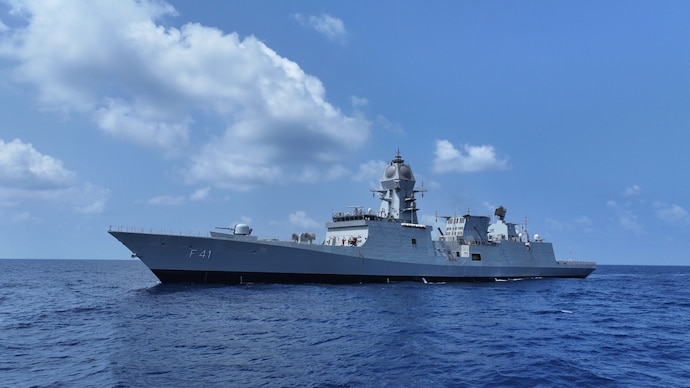
India on Monday commissioned INS Taragiri, an indigenously built advanced stealth frigate, in Visakhapatnam, marking a significant boost to the country’s maritime capabilities.
The warship, inducted in the presence of Defence Minister Rajnath Singh, is equipped with advanced stealth features and modern radar, sonar and missile systems and is capable of undertaking multi-role operations, including combat missions, maritime security, and anti-piracy patrols.
Describing the vessel, the fourth frigate of the Project 17A class, as a symbol of India’s growing technological prowess, self-reliance, and formidable naval capabilities, Singh said building a strong and capable Navy is “an absolute necessity in today’s times.”
Defence Minister Rajnath Singh described the warship as a symbol of India’s growing technological strength, self-reliance, and formidable naval power.
NS Taragiri, the fourth ship of the Project 17A class, has been designed by the Navy’s Warship Design Bureau and built by Mazagon Dock Shipbuilders Limited with significant participation from MSMEs. With a displacement of around 6,670 tonnes and more than 75 per cent indigenous content, the warship underscores India’s expanding domestic defence manufacturing ecosystem.
Equipped with advanced stealth features that reduce its radar signature, the frigate is designed for multi-role operations across a spectrum of missions. It can undertake high-intensity combat, maritime security, anti-piracy patrols, coastal surveillance, and humanitarian assistance.
“This ship is capable of high-speed transit and can remain deployed at sea for extended periods. It is equipped with modern radar, sonar and missile systems, including BrahMos and surface-to-air missiles, enabling it to monitor threats and respond swiftly when required,” Singh said.
Highlighting India’s strategic dependence on the seas, the Defence Minister noted that nearly 95 per cent of the country’s trade is conducted through maritime routes, while energy security is also closely tied to the oceans. With a coastline of over 11,000 kilometres, he stressed that India’s development cannot be viewed in isolation from maritime security.
Amid evolving global uncertainties, Singh said the Indian Navy maintains a constant presence across the Indian Ocean Region, securing critical sea lanes and choke points to ensure uninterrupted movement of goods. “Whenever tensions escalate, the Navy steps in to safeguard commercial vessels and oil tankers, reinforcing India’s role as a responsible maritime power,” he added.
He also underscored the importance of safeguarding undersea digital infrastructure, noting that a majority of global data flows through subsea internet cables. Calling for a broader, future-ready approach to maritime security, Singh said the Navy is actively engaged in protecting not just coastlines but also critical maritime and digital assets.
According to Singh, there has been a sharp rise in defence exports, from around Rs 1,200 crore over a decade ago to Rs 38,424 crore in 2025-26, as evidence of this transformation.
With its induction into the Eastern Fleet, INS Taragiri is expected to enhance India’s operational readiness in the Indo-Pacific, while signalling the country’s capability to design, build, and deploy complex warships indigenously.
India on Monday commissioned INS Taragiri, an indigenously built advanced stealth frigate, in Visakhapatnam, marking a significant boost to the country’s maritime capabilities.
The warship, inducted in the presence of Defence Minister Rajnath Singh, is equipped with advanced stealth features and modern radar, sonar and missile systems and is capable of undertaking multi-role operations, including combat missions, maritime security, and anti-piracy patrols.
Describing the vessel, the fourth frigate of the Project 17A class, as a symbol of India’s growing technological prowess, self-reliance, and formidable naval capabilities, Singh said building a strong and capable Navy is “an absolute necessity in today’s times.”
Defence Minister Rajnath Singh described the warship as a symbol of India’s growing technological strength, self-reliance, and formidable naval power.
NS Taragiri, the fourth ship of the Project 17A class, has been designed by the Navy’s Warship Design Bureau and built by Mazagon Dock Shipbuilders Limited with significant participation from MSMEs. With a displacement of around 6,670 tonnes and more than 75 per cent indigenous content, the warship underscores India’s expanding domestic defence manufacturing ecosystem.
Equipped with advanced stealth features that reduce its radar signature, the frigate is designed for multi-role operations across a spectrum of missions. It can undertake high-intensity combat, maritime security, anti-piracy patrols, coastal surveillance, and humanitarian assistance.
“This ship is capable of high-speed transit and can remain deployed at sea for extended periods. It is equipped with modern radar, sonar and missile systems, including BrahMos and surface-to-air missiles, enabling it to monitor threats and respond swiftly when required,” Singh said.
Highlighting India’s strategic dependence on the seas, the Defence Minister noted that nearly 95 per cent of the country’s trade is conducted through maritime routes, while energy security is also closely tied to the oceans. With a coastline of over 11,000 kilometres, he stressed that India’s development cannot be viewed in isolation from maritime security.
Amid evolving global uncertainties, Singh said the Indian Navy maintains a constant presence across the Indian Ocean Region, securing critical sea lanes and choke points to ensure uninterrupted movement of goods. “Whenever tensions escalate, the Navy steps in to safeguard commercial vessels and oil tankers, reinforcing India’s role as a responsible maritime power,” he added.
He also underscored the importance of safeguarding undersea digital infrastructure, noting that a majority of global data flows through subsea internet cables. Calling for a broader, future-ready approach to maritime security, Singh said the Navy is actively engaged in protecting not just coastlines but also critical maritime and digital assets.
According to Singh, there has been a sharp rise in defence exports, from around Rs 1,200 crore over a decade ago to Rs 38,424 crore in 2025-26, as evidence of this transformation.
With its induction into the Eastern Fleet, INS Taragiri is expected to enhance India’s operational readiness in the Indo-Pacific, while signalling the country’s capability to design, build, and deploy complex warships indigenously.

