Nitish Kumar turns page on Bihar chapter, enters Rajya Sabha
Sources tell India Today that Samrat Chaudhary is the favourite to succeed Nitish Kumar as the Bihar CM.
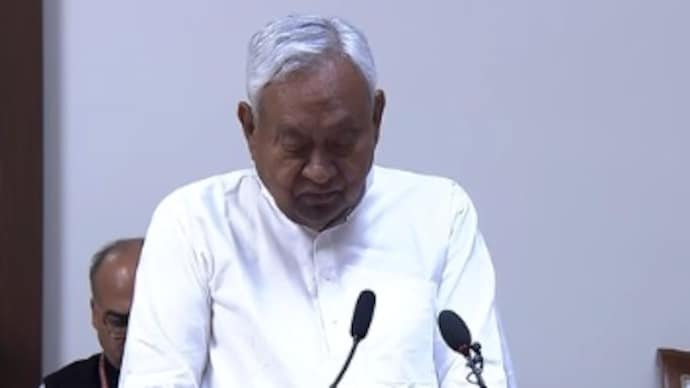
Bihar Chief Minister Nitish Kumar took oath as a Rajya Sabha MP on Friday, the final step before he formally hands over the reins of Bihar to his successor.
Sources tell India Today that Kumar won't be joining the Union Cabinet and will focus on guiding the incoming government in Bihar. He is also likely to spend most of his time in the state, expect when the Parliament is in session.
While Kumar will return to Patna today following the oath-taking formalities, the focus now shifts to the government formation process in Bihar.
Top leaders of the Bharatiya Janata Party, which is set to get its first-ever Chief Minister in the state, will meet in New Delhi today to discuss the formation of the next government in Bihar.
Senior state BJP leaders Samrat Choudhary and Vijay Kumar Sinha, both of whom serve as Kumar's deputy, are already in the national capital to meet the party's central leadership.
The BJP's central leadership is also expected to hold discussions with several other prominent leaders and party functionaries before making the formal announcement on this matter.
Meanwhile, sources tell India Today that Kumar is likely to resign as Bihar's Chief Minister on April 14, when the NDA legislative party is expected to elect the next chief minister.
Sources also tell India Today that Chaudhary is the favourite to succeed the JD(U) veteran as the Bihar CM.
Kumar began the process of relocating to New Delhi on March 30, when he resigned as a member of the Bihar Legislative Council.
The 10-term CM won his Rajya Sabha seat, along with four other National Democratic Alliance (NDA) candidates, on March 17.
Kumar filed his nomination papers for the election on March 5, after announcing his decision to quit as the Bihar CM to fulfil his long-held "desire to become a member of both Houses of the Bihar Legislature and both Houses of Parliament."
The announcement came barely months after he had led the NDA to a commanding electoral victory in the state, reaffirming his relevance in a political landscape he had shaped for over two decades.
Bihar Chief Minister Nitish Kumar took oath as a Rajya Sabha MP on Friday, the final step before he formally hands over the reins of Bihar to his successor.
Sources tell India Today that Kumar won't be joining the Union Cabinet and will focus on guiding the incoming government in Bihar. He is also likely to spend most of his time in the state, expect when the Parliament is in session.
While Kumar will return to Patna today following the oath-taking formalities, the focus now shifts to the government formation process in Bihar.
Top leaders of the Bharatiya Janata Party, which is set to get its first-ever Chief Minister in the state, will meet in New Delhi today to discuss the formation of the next government in Bihar.
Senior state BJP leaders Samrat Choudhary and Vijay Kumar Sinha, both of whom serve as Kumar's deputy, are already in the national capital to meet the party's central leadership.
The BJP's central leadership is also expected to hold discussions with several other prominent leaders and party functionaries before making the formal announcement on this matter.
Meanwhile, sources tell India Today that Kumar is likely to resign as Bihar's Chief Minister on April 14, when the NDA legislative party is expected to elect the next chief minister.
Sources also tell India Today that Chaudhary is the favourite to succeed the JD(U) veteran as the Bihar CM.
Kumar began the process of relocating to New Delhi on March 30, when he resigned as a member of the Bihar Legislative Council.
The 10-term CM won his Rajya Sabha seat, along with four other National Democratic Alliance (NDA) candidates, on March 17.
Kumar filed his nomination papers for the election on March 5, after announcing his decision to quit as the Bihar CM to fulfil his long-held "desire to become a member of both Houses of the Bihar Legislature and both Houses of Parliament."
The announcement came barely months after he had led the NDA to a commanding electoral victory in the state, reaffirming his relevance in a political landscape he had shaped for over two decades.

