No locus standi: India rejects China-Pak joint references to J&K projects
The sharp response came amid renewed references to the Kashmir issue and the China-Pakistan Economic Corridor (CPEC) in the joint statement issued by Beijing and Islamabad.


India on Tuesday strongly rejected references to Jammu and Kashmir in a joint statement issued by China and Pakistan, asserting that the Union Territories of Jammu & Kashmir and Ladakh "have been, are and will always remain integral and inalienable parts of India."
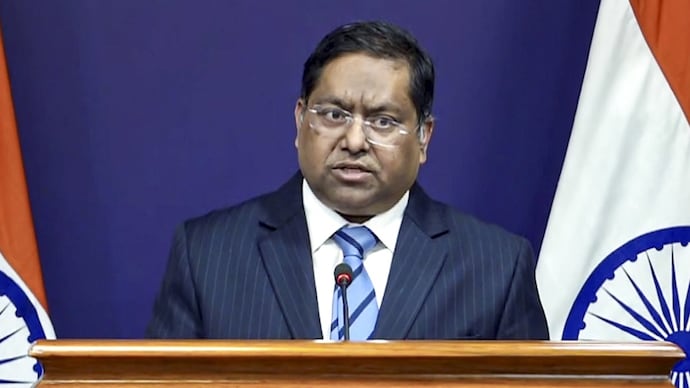
Responding to media queries, Ministry of External Affairs spokesperson Randhir Jaiswal said India "categorically rejects unwarranted references" to Jammu and Kashmir made in the China-Pakistan joint statement.
"India’s position is consistent and well known to the concerned parties," Jaiswal said.
Calling Jammu & Kashmir and Ladakh integral and inalienable parts of India, Jaiswal added, "No other country has the locus standi to comment on the same."
'OPPOSE CPEC PROJECTS'
The sharp response came amid renewed references to the Kashmir issue and the China-Pakistan Economic Corridor (CPEC) in the joint statement issued by Beijing and Islamabad, after Pakistani Prime Minister Shehbaz Sharif concluded his visit to Beijing.
India reiterated its opposition to CPEC projects passing through Pakistan-occupied territories, saying such moves infringe upon India’s sovereignty and territorial integrity.
"As regards the so-called China-Pakistan Economic Corridor projects, some of which are in India’s sovereign territory, we resolutely oppose and reject any moves by other countries to reinforce or legitimise Pakistan’s illegal and forcible occupation of these territories," Jaiswal said.
The MEA spokesperson noted that India’s concerns over the corridor had been conveyed to both Chinese and Pakistani authorities "several times."
'PAK-CHINA DON'T SHARE BOUNDARY'
Jaiswal also dismissed references in the joint statement to "trans-boundary water resources cooperation" between China and Pakistan.
"As the two countries do not share any boundary, the question of so-called ‘trans-boundary water resources cooperation’ does not arise," he said.
India further reiterated that it has never recognised the so-called 1963 boundary agreement between China and Pakistan involving territories claimed by India.
The so-called treaty between China and Pakistan established the boundary between China's Xinjiang region and Gilgit–Baltistan. Under this pact, Pakistan illegally ceded approximately 5,180 square kilometers of the Shaksgam Valley (Trans-Karakoram Tract) to China.
'NEW BROAD CONSENSUS'
Meanwhile, China and Pakistan on Tuesday agreed on a “new broad consensus” to deepen strategic ties and accelerate development of the China–Pakistan Economic Corridor (CPEC), including plans to position Gwadar port as a regional connectivity hub.
Both sides said they welcomed third-party participation in CPEC projects under an already agreed framework. The statement followed Sharif’s meetings with Chinese President Xi Jinping and Premier Li Qiang.
They also agreed to promote “high-quality” development of CPEC, a flagship Belt and Road Initiative project, expand the development of Gwadar port, and strengthen connectivity through road and port infrastructure.
The plans include upgrades to the Khunjerab Pass and the Karakoram Highway, the key overland route linking China and Pakistan-occupied Kashmir.
Pakistan also pledged enhanced security measures and closer cooperation to ensure the safety of Chinese workers and investments, a major concern for Beijing following repeated militant attacks targeting Chinese nationals and projects in the country.
India on Tuesday strongly rejected references to Jammu and Kashmir in a joint statement issued by China and Pakistan, asserting that the Union Territories of Jammu & Kashmir and Ladakh "have been, are and will always remain integral and inalienable parts of India."
Responding to media queries, Ministry of External Affairs spokesperson Randhir Jaiswal said India "categorically rejects unwarranted references" to Jammu and Kashmir made in the China-Pakistan joint statement.
"India’s position is consistent and well known to the concerned parties," Jaiswal said.
Calling Jammu & Kashmir and Ladakh integral and inalienable parts of India, Jaiswal added, "No other country has the locus standi to comment on the same."
'OPPOSE CPEC PROJECTS'
The sharp response came amid renewed references to the Kashmir issue and the China-Pakistan Economic Corridor (CPEC) in the joint statement issued by Beijing and Islamabad, after Pakistani Prime Minister Shehbaz Sharif concluded his visit to Beijing.
India reiterated its opposition to CPEC projects passing through Pakistan-occupied territories, saying such moves infringe upon India’s sovereignty and territorial integrity.
"As regards the so-called China-Pakistan Economic Corridor projects, some of which are in India’s sovereign territory, we resolutely oppose and reject any moves by other countries to reinforce or legitimise Pakistan’s illegal and forcible occupation of these territories," Jaiswal said.
The MEA spokesperson noted that India’s concerns over the corridor had been conveyed to both Chinese and Pakistani authorities "several times."
'PAK-CHINA DON'T SHARE BOUNDARY'
Jaiswal also dismissed references in the joint statement to "trans-boundary water resources cooperation" between China and Pakistan.
"As the two countries do not share any boundary, the question of so-called ‘trans-boundary water resources cooperation’ does not arise," he said.
India further reiterated that it has never recognised the so-called 1963 boundary agreement between China and Pakistan involving territories claimed by India.
The so-called treaty between China and Pakistan established the boundary between China's Xinjiang region and Gilgit–Baltistan. Under this pact, Pakistan illegally ceded approximately 5,180 square kilometers of the Shaksgam Valley (Trans-Karakoram Tract) to China.
'NEW BROAD CONSENSUS'
Meanwhile, China and Pakistan on Tuesday agreed on a “new broad consensus” to deepen strategic ties and accelerate development of the China–Pakistan Economic Corridor (CPEC), including plans to position Gwadar port as a regional connectivity hub.
Both sides said they welcomed third-party participation in CPEC projects under an already agreed framework. The statement followed Sharif’s meetings with Chinese President Xi Jinping and Premier Li Qiang.
They also agreed to promote “high-quality” development of CPEC, a flagship Belt and Road Initiative project, expand the development of Gwadar port, and strengthen connectivity through road and port infrastructure.
The plans include upgrades to the Khunjerab Pass and the Karakoram Highway, the key overland route linking China and Pakistan-occupied Kashmir.
Pakistan also pledged enhanced security measures and closer cooperation to ensure the safety of Chinese workers and investments, a major concern for Beijing following repeated militant attacks targeting Chinese nationals and projects in the country.

