Indian workers wear cameras to train AI on their jobs? Viral clips spark fear of AI takeover in factories
Viral videos of Indian factory workers wearing head-mounted cameras have sparked fears that companies may be using real human labour to train AI systems. The clips have triggered a wider debate around job security, ethics, and the future of automation.
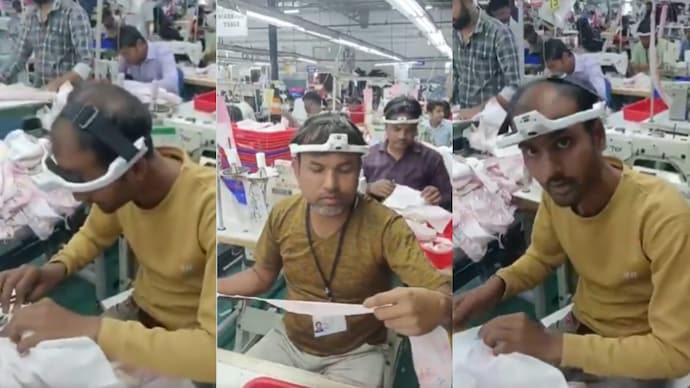
A set of viral videos showing factory workers with cameras strapped to their heads has quietly turned into a larger conversation about the future of jobs. At first, the clips look ordinary — workers sitting in long rows, focused on stitching and handling fabric inside garment units. But the moment you notice the small cameras mounted on their heads, the entire scene starts to feel different. These are not staged setups or lab experiments. This is real factory work, captured from the worker's own point of view. And that is exactly what has caught people's attention. As these clips began circulating online, people started wondering - why would factories need to record such detailed, first-person footage of routine manual work? While India Today Tech couldn't verify whether this was the case and where it was happening, one theory has quickly taken over the discussion.
Many are speculating on X that this footage could be used to train AI systems. Since the cameras capture exactly what the worker sees — including hand movements, coordination, and task execution — it creates a rich dataset for machines to learn from. Instead of relying on expensive motion-capture tools, companies could use this "human-eye view" to teach robots how to perform complex actions by simply observing and copying.
If that turns out to be true, it changes how people look at these videos. What seems like documentation today could become training data for automation tomorrow. That is where the discomfort begins. Several users online have pointed out that workers may not fully understand how this data could be used in the long run. The concern is not just about cameras in the workplace, but about what those recordings might enable in the future. If machines learn fast enough, could they eventually take over the same jobs?
At the same time, there is another side to this argument. Some people feel that this is just another phase of technological change. Industries have always evolved, and automation has been part of that journey for years. From this point of view, resisting it may not be practical. Instead, workers may need to adjust, learn new skills, and find ways to work alongside technology rather than against it.
Still, the ethical questions refuse to go away. Are workers being told why they are being recorded? Do they have the option to refuse? Are they being compensated if their work is being used to build future technologies? These are not small concerns, especially in sectors where workers already have limited bargaining power.
For many critics, the issue is not just about technology but about fairness. Some reactions online have been blunt, with people arguing that workers could be unknowingly contributing to systems that may one day replace them. Others have highlighted the reality that for many workers, saying no may not even be an option if their livelihood depends on the job.
Amazon already using robots for work, plans to automate 75 percent of its operations
This entire discussion becomes even more relevant when you look at how automation is already unfolding globally. Companies like Amazon have spent years building robotic systems inside warehouses. The company revealed in October 2025 that it has deployed over one million robots across its operations network. These machines handle tasks such as sorting, packing, and moving items, reducing the need for repetitive manual work.
Amazon maintains that these systems are designed to assist workers and improve efficiency. But even with that explanation, the impact is hard to ignore. When machines take over repetitive tasks, the demand for certain types of human labour naturally begins to change.
A report by The Wall Street Journal adds more weight to this concern. It states, "At facilities designed for superfast deliveries, Amazon is trying to create warehouses that employ few humans at all. And documents show that Amazon's robotics team has an ultimate goal to automate 75 percent of its operations."
The report also notes, "Amazon’s US work force has more than tripled since 2018 to almost 1.2 million. But Amazon’s automation team expects the company can avoid hiring more than 160,000 people in the United States it would otherwise need by 2027."
When you connect these developments with the viral factory clips, the bigger picture becomes clearer. The fear is not just about cameras or one set of factories, it is about where all of this is heading. Right now, there is no confirmed explanation behind these specific videos.
A set of viral videos showing factory workers with cameras strapped to their heads has quietly turned into a larger conversation about the future of jobs. At first, the clips look ordinary — workers sitting in long rows, focused on stitching and handling fabric inside garment units. But the moment you notice the small cameras mounted on their heads, the entire scene starts to feel different. These are not staged setups or lab experiments. This is real factory work, captured from the worker's own point of view. And that is exactly what has caught people's attention. As these clips began circulating online, people started wondering - why would factories need to record such detailed, first-person footage of routine manual work? While India Today Tech couldn't verify whether this was the case and where it was happening, one theory has quickly taken over the discussion.
Many are speculating on X that this footage could be used to train AI systems. Since the cameras capture exactly what the worker sees — including hand movements, coordination, and task execution — it creates a rich dataset for machines to learn from. Instead of relying on expensive motion-capture tools, companies could use this "human-eye view" to teach robots how to perform complex actions by simply observing and copying.
If that turns out to be true, it changes how people look at these videos. What seems like documentation today could become training data for automation tomorrow. That is where the discomfort begins. Several users online have pointed out that workers may not fully understand how this data could be used in the long run. The concern is not just about cameras in the workplace, but about what those recordings might enable in the future. If machines learn fast enough, could they eventually take over the same jobs?
At the same time, there is another side to this argument. Some people feel that this is just another phase of technological change. Industries have always evolved, and automation has been part of that journey for years. From this point of view, resisting it may not be practical. Instead, workers may need to adjust, learn new skills, and find ways to work alongside technology rather than against it.
Still, the ethical questions refuse to go away. Are workers being told why they are being recorded? Do they have the option to refuse? Are they being compensated if their work is being used to build future technologies? These are not small concerns, especially in sectors where workers already have limited bargaining power.
For many critics, the issue is not just about technology but about fairness. Some reactions online have been blunt, with people arguing that workers could be unknowingly contributing to systems that may one day replace them. Others have highlighted the reality that for many workers, saying no may not even be an option if their livelihood depends on the job.
Amazon already using robots for work, plans to automate 75 percent of its operations
This entire discussion becomes even more relevant when you look at how automation is already unfolding globally. Companies like Amazon have spent years building robotic systems inside warehouses. The company revealed in October 2025 that it has deployed over one million robots across its operations network. These machines handle tasks such as sorting, packing, and moving items, reducing the need for repetitive manual work.
Amazon maintains that these systems are designed to assist workers and improve efficiency. But even with that explanation, the impact is hard to ignore. When machines take over repetitive tasks, the demand for certain types of human labour naturally begins to change.
A report by The Wall Street Journal adds more weight to this concern. It states, "At facilities designed for superfast deliveries, Amazon is trying to create warehouses that employ few humans at all. And documents show that Amazon's robotics team has an ultimate goal to automate 75 percent of its operations."
The report also notes, "Amazon’s US work force has more than tripled since 2018 to almost 1.2 million. But Amazon’s automation team expects the company can avoid hiring more than 160,000 people in the United States it would otherwise need by 2027."
When you connect these developments with the viral factory clips, the bigger picture becomes clearer. The fear is not just about cameras or one set of factories, it is about where all of this is heading. Right now, there is no confirmed explanation behind these specific videos.

