Assam | A stage set for Sarma
The hugely popular chief minister has covered all bases: a great record in infrastructure and jobs, layers of welfare schemes and polarisation of voters through the 'Miya' scare
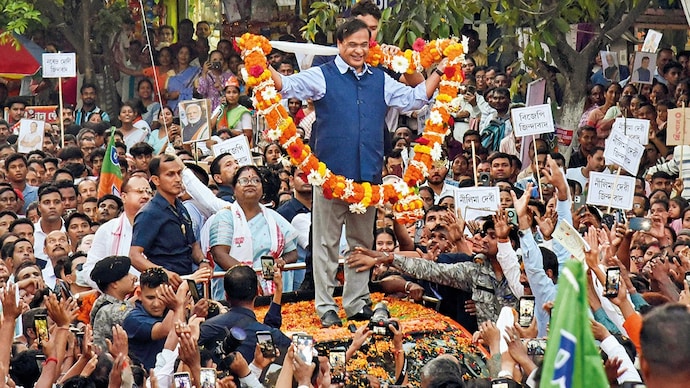
For more than 15 years, Himanta Biswa Sarma has been the most reliable electoral engine in Assam, winning assembly seats, Lok Sabha contests and even Rajya Sabha numbers when arithmetic alone fell short. He delivered for the Congress. He delivered for the BJP after switching in 2015. But April 9, 2026, is different. For the first time, Sarma enters an Assam election not as kingmaker but as king—the sitting chief minister. “This is his election,” says one of his close confidants. “He is the product he is selling this time, not another chief ministerial face. So, the return must be higher.”
For more than 15 years, Himanta Biswa Sarma has been the most reliable electoral engine in Assam, winning assembly seats, Lok Sabha contests and even Rajya Sabha numbers when arithmetic alone fell short. He delivered for the Congress. He delivered for the BJP after switching in 2015. But April 9, 2026, is different. For the first time, Sarma enters an Assam election not as kingmaker but as king—the sitting chief minister. “This is his election,” says one of his close confidants. “He is the product he is selling this time, not another chief ministerial face. So, the return must be higher.”
For Sarma, winning is not enough; he wants to win bigger. The BJP first came to power in Assam in 2016 with 60 seats in the 126-member assembly, four short of the halfway mark of 64. Backed by allies, the NDA’s combined tally stood at 86, and Sarbananda Sonowal became chief minister. In 2021, the BJP held its 60 seats and lifted its vote share from 29 to 33 per cent. The NDA’s overall count, however, shrank by 11 seats, partly because ally Asom Gana Parishad (AGP) slid from 14 seats to nine.
This time, Sarma seeks to prove that he has been the best chief minister Assam never had, until now. He wants the NDA’s collective tally to surge past 90, with the BJP alone clearing 70—that would approach, though fall short of, the 78 seats the Congress won in 2011, the highest by any single party this century, and a victory Sarma himself was the prime architect of. April 9 will also be a referendum on his model of governance: unapologetic Hindu assertion, positioning himself as the architect of socio-economic growth through infrastructure and industrial investment and the careful cultivation of a massive beneficiary vote bank.
The challenge is formidable in a state where Muslims constitute, unofficially, over 40 per cent of the population—34 per cent according to the 2011 Census—and have historically backed the Congress or the All India United Democratic Front (AIUDF). That challenge is compounded by Sarma’s own provocations: his campaign has been built on explicit utterances against ‘Miyas’, a term often used as a slur for Muslims of Bangladeshi-immigrant origin, declaring that he doesn’t need their votes, urging indigenous communities to “harass” them, and promising to “break their backbone” in his next tenure after having “broken their hands and legs” in this one.
REWRITING GEOGRAPHY
His strategy to expand the BJP’s footprint began in 2023, when Assam’s assembly constituencies were redrawn, with a heavy impact on Muslim-dominated areas. Where Muslim voters once had influence over 35 seats, delimitation has compressed them to 22. These constituencies have historically delivered for the Congress and AIUDF. Their alliance in 2021 had helped Congress capture 30 per cent of the vote, compared to the BJP’s 33 per cent, yet converted that share into only 29 seats drawn from just 13 of Assam’s 35 districts. With Muslim demography squeezed into fewer seats, the already poor vote-to-seat conversion rate is likely to deteriorate further. Without a Congress-AIUDF alliance, the two parties’ core vote banks will split.
Meanwhile, the AGP is fielding 13 Muslim candidates, several of them turncoats from the AIUDF. In multi-cornered contests across these constituencies, Muslim votes are primed to fragment, hurting the Congress and its allies.
Four additional forces are working in the BJP’s favour: Sarma’s personal popularity, his government’s visible infrastructure record, an expansive architecture of welfare schemes and sustained polarisation over illegal immigration from Bangladesh. Sarma’s popularity is, by any measure, a political phenomenon. Ordinary citizens are drawn to the image of a man who delivers on his promises, an image built across two decades.
Delivery, under his watch this tenure, acquired both speed and scale. The CM runs a near–round-the-clock operation, and is hands-on and detail-obsessed. His day begins at 7 am on the phone with bureaucrats and political aides and often stretches till 3 am, with officials summoned past midnight to clear files. When travelling, directives move over WhatsApp. “He avoids inter-departmental file ping-pong, often calling multiple secretaries to clear coordinated projects in one go,” says a bureaucrat. Adds another: “He has a photographic memory and tracks minor details with weekly reviews. That’s what drives the speed.”
DELIVERY ON PROMISES
If Sarma’s government held transparent recruitment examinations for government jobs, he also delivered over 100,000 government jobs, as promised. In his next term, he vows to double the number of jobs. The road network has expanded, flyovers and bridges have been built in record time, industrial investment, including semiconductor units, has been brought to the state. According to RBI data, Assam is India’s fastest growing state, clocking 45 per cent growth between FY20 and FY25, above the national average of 29 per cent.
There are other achievements too. The Sarma government’s welfare schemes reach about six–seven million households or around 25 to 30 million people. This means around 75–85 per cent of Assam’s 35 million population is covered by at least one scheme. Between 2021 and 2026, the government is estimated to have spent Rs 30,000–Rs 35,000 crore on these schemes.
The Congress and BJP manifestos reflect two divergent electoral philosophies—one anchored in performance-led continuity and development, the other in direct welfare guarantees. The BJP’s Sankalp Patra, with 31 detailed pledges across 75 pages, include a Rs 5 lakh crore infrastructure push, a Rs 18,000 crore flood-proofing mission, 200,000 government jobs, hikes in the Orunodoi scheme (a poverty alleviation initiative) and self-employment support for one million people. Congress’s counter are five promises aimed at women, the elderly, indigenous groups and Gen Z: unconditional monthly cash transfers of Rs 50,000 to women to start businesses, Rs 25 lakh health cover, a Rs 1,250 monthly pension and a dedicated ministry for senior citizens, land rights for one million indigenous people, and justice for Assam’s deceased musical icon Zubeen Garg within 100 days.
And then there is the immigration question. The spectre of demographic change, of Bangladeshi encroachment eroding Assamese language and culture, is among the most emotionally charged issues in the state. In the manifesto, the BJP offers identity-protection tools—Uniform Civil Code, action against ‘love jihad’ and ‘land jihad’, implementation of the Immigrants (Expulsion from Assam) Act. Sarma’s constant invocations of ‘Miyas’ have stoked anxiety among indigenous voters and worked to arrest the fragmentation of Hindu and tribal votes along ethnic lines.
Layered over Sarma’s personal appeal is the organisational machinery of the BJP-RSS and the party’s financial muscle, which carries its four-pillar narrative to every prospective voter. The Congress remains weak at the booth level even as the BJP’s grassroots penetration has deepened with every election cycle.
THE FIGHTBACK
Buoyed by his surprise Lok Sabha victory in 2024, despite an intense campaign mounted by Sarma and his cabinet colleagues, the Congress appointed 43-year-old Gaurav Gogoi as state unit president in May last year, less than a year before the election. The compressed timeline, combined with the discomfort of veteran Congressmen with a leader a generation younger, has made his position precarious.
Yet Gaurav has stitched together a six-party Congress-led alliance, including Asom Sonmilito Morcha (ASM) comprising Akhil Gogoi’s Raijor Dal and Lurinjyoti Gogoi’s Asom Jatiya Parishad (AJP), with Gaurav himself declared as the CM candidate. Among anti-BJP voters, there is genuine hope that the convergence of the three Gogois will consolidate the Ahom vote in upper Assam, a region of 27 seats. Sarma’s identity as a Brahmin from lower Assam is a friction point in upper Assam, where Ahom voters generated significant swings in at least eight assembly seats in previous elections.
The Opposition’s current narrative rests on two pillars: alleged corruption involving Sarma and his wife, and the chief minister’s sustained communal campaign against Muslims. For much of his political career, Sarma has faced corruption charges tied to his family’s expanding portfolio—media houses, tea estates, schools, and other businesses. The electoral impact of this, however, has been negligible.
The Opposition also promises Bor Asom, an inclusive Assam where every community finds dignified belonging. It also proposes to counter the BJP’s communal politics through legal means, including measures to criminalise the targeting of any community on religious or ethnic grounds. Sarma’s response is to reframe that vision as a Congress project to build an Assam for Bangladeshi immigrants.
April 9 will reveal whether Sarma’s carefully engineered dominance can translate into an undisputed mandate, or whether Assam still retains the capacity to surprise its most confident architect.

