Puducherry | A fine balance
With strained alliances on both sides in Puducherry, the NDA faces off against the Congress-DMK, hoping to capitalise on CM N. Rangasamy's personal connect with voters
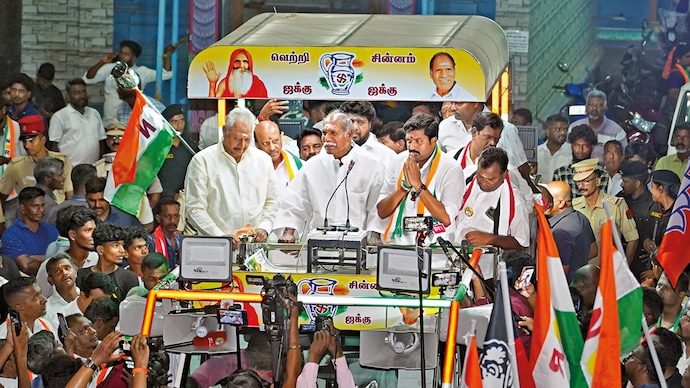
Puducherry’s relatively small 30-member assembly is not going to face the straight fight expected of it on April 9, when voters in the Union Territory face an unsteady triangle and candidates visibly disgruntled with seat-sharing arrangements. On one side is the National Democratic Alliance (NDA); on the other the Congress and Dravida Munnetra Kazhagam (DMK), and in between, the Tamilaga Vettri Kazhagam (TVK), which may not have enough heft to be in the reckoning but can nibble away crucial votes from either side and ruin everyone’s mood. In such a small territory, sweeping mandates are rare, so wins come down to hundreds of votes. With such fractious alliances in contest, victory will depend on whom voters trust to work together.
Puducherry’s relatively small 30-member assembly is not going to face the straight fight expected of it on April 9, when voters in the Union Territory face an unsteady triangle and candidates visibly disgruntled with seat-sharing arrangements. On one side is the National Democratic Alliance (NDA); on the other the Congress and Dravida Munnetra Kazhagam (DMK), and in between, the Tamilaga Vettri Kazhagam (TVK), which may not have enough heft to be in the reckoning but can nibble away crucial votes from either side and ruin everyone’s mood. In such a small territory, sweeping mandates are rare, so wins come down to hundreds of votes. With such fractious alliances in contest, victory will depend on whom voters trust to work together.
The NDA, led by chief minister N. Rangasamy’s All India N.R. Congress (AINRC), is pinning much hope on the stalwart. His personal connect with voters obviating any electoral arithmetic, he has survived multiple political realignments for over three decades. Partnered with the Bharatiya Janata Party (BJP), the All India Anna Dravida Munnetra Kazhagam (AIADMK) and the green Latchiya Jananayaga Katchi (LJK) floated by a lottery baron’s son, the alliance saw considerable noise due to the BJP’s insistence on bringing in the LJK, which complicated an already fraught seat-sharing. The alliance held together in the end, but it took work, and the strains are not entirely invisible.
The Opposition, if anything, has had a rougher time. The Congress-DMK arrangement, with the former contesting 16 seats and the latter 13, was finalised only at the last minute, and the process left bruises. The Viduthalai Chiruthaigal Katchi (VCK) walked out altogether, citing seat disputes, and will contest three seats on its own. Inside the Congress, the mood turned fractious when former chief minister V. Narayanasamy was denied a ticket on the final day of nominations. Six rebel Congress candidates were suspended for filing nominations in seats meant for alliance partners, but five are running the race anyway. In a 30-seat assembly, such leakage is hard to absorb—the alliance needs them to lose badly.
The most-watched contest will likely be in Thattanchavady, where Rangasamy faces Congress state president V. Vaithilingam. The latter is also a sitting Lok Sabha MP, and a man who has himself been chief minister twice. It is, in effect, a contest between two versions of what Puducherry’s political leadership should look like: Rangasamy’s brand of hands-on, accessible governance versus Vaithilingam’s claim to experience and institutional credibility. The dilemma between a reset and business-as-usual is also something that actor Vijay’s TVK is banking on, focusing its energies in all 30 seats on young voters fed up of the old faces. In constituencies where the winning margin in the 2021 assembly election was narrow, even a modest TVK vote share could scramble the outcome.
“This is advantage Rangasamy,” explains Mudhalvan, a Puducherry-based political analyst. “The Congress has been losing ground on more counts than one. The party has failed to build effective leadership, and lacks leaders that will help with caste votes. The party also did not treat VCK, a trusted ally in Tamil Nadu, with respect.” With all players in this three-way contest seeking to woo the dominant Vanniyars, the more marginalised OBCs as well as Dalits, besides the Muslim and Christian minorities, the outcome will depend on who can convince voters that a frosty alliance doesn’t always mature into a brittle government.

