Tamil Nadu | Biggest test for Stalin
The DMK supremo's pursuit of a second term is challenged by a resurgent AIADMK headed by E.P.S. and the disruptive debut of actor Vijay's TVK
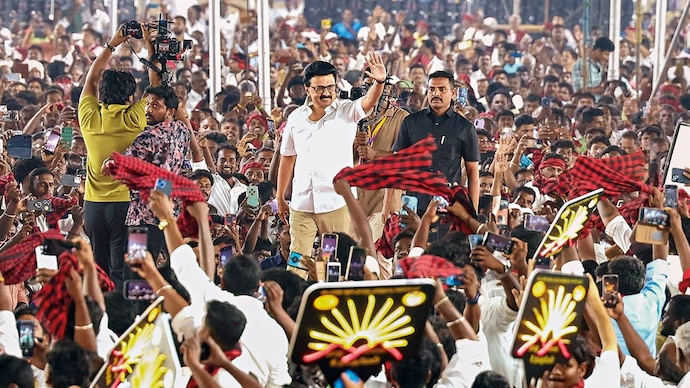
For decades leading up to 2021, Tamil Nadu chief minister M.K. Stalin was seen as a leader-in-waiting, biding his time under the shadow of his father, the late Dravida Munnetra Kazhagam (DMK) titan, M. Karunanidhi. The 2026 assembly election, then, marks a distinct and more personal milestone for him and the DMK. The 73-year-old CM has completed his first term, and his bid to secure a second one places Stalin and his record in office under direct scrutiny.
For decades leading up to 2021, Tamil Nadu chief minister M.K. Stalin was seen as a leader-in-waiting, biding his time under the shadow of his father, the late Dravida Munnetra Kazhagam (DMK) titan, M. Karunanidhi. The 2026 assembly election, then, marks a distinct and more personal milestone for him and the DMK. The 73-year-old CM has completed his first term, and his bid to secure a second one places Stalin and his record in office under direct scrutiny.
Till 2021, the DMK had spent a decade in the wilderness when the All India Anna Dravida Munnetra Kazhagam (AIADMK) ruled the roost. It was also a time of transition: Karunanidhi passed away in 2018, and Stalin inherited not just the party leadership but also a complex set of electoral and organisational challenges. He triumphed over them: the DMK got 133 seats in the 234-member house in 2021; the Secular Progressive Alliance won 159 overall. The AIADMK was reduced to 66 seats.
Five years on, the shift is evident, even if the rhetoric signals continuity. Stalin had enshrined the ‘Dravidian model’ in governance, a formulation that combines welfare delivery, social justice and an assertive federal stand. The 2026 manifesto reprises this as ‘Dravidian Model 2.0’, with the emphasis now on scale and reach.
DRAVIDIAN MODEL 2.0
Flagship programmes introduced or expanded since 2021 form the backbone of the DMK’s narrative. These include the Kalaignar Magalir Urimai Thogai scheme, which provides direct cash benefit (DBT) transfers to women who head the household; free bus travel for women; the CM’s breakfast scheme for schoolchildren; the Pudhumai Penn initiative supporting girls’ education; the Naan Mudhalvan programme focused on youth skill development; and a doorstep healthcare initiative named Makkalai Thedi Maruthuvam. These schemes are designed to create a broad coalition of beneficiaries across caste and class lines.
The DMK regime says some 13.1 million women have benefited from the DBT scheme. It also cites a growth rate of 11.2 per cent in 2024-25—a 14-year high and nearly double the national average—as evidence that welfare expansion has not come at the cost of economic performance. Sources say particular attention is being paid to funnel welfare into segments where victory margins were narrow in 2021.
ONE BATTLE AFTER ANOTHER
At the same time, the DMK has framed this election as part of a broader contest over Centre-state relations. Here, the Dravidian party positions itself as a defender of Tamil Nadu’s autonomy within India’s federal framework.
Federalism remains a key pillar of Stalin’s political messaging. The DMK has reiterated demands for greater fiscal devolution, including an increased share of Goods and Services Tax (GST) revenues for states. It has also opposed proposals such as ‘One Nation, One Election’, the NEP (National Education Policy) and called for the removal of centralised entrance tests such as NEET in higher education. In fact, the party continues to advocate for moving education back to the state list and maintains its long-standing opposition to the imposition of Hindi.
While these positions are not new, their renewed emphasis serves a strategic purpose. By framing the election as one between “Tamil Nadu and Delhi”, the DMK seeks to consolidate regional identity while countering the expansion efforts of the BJP in the state. In fact, Stalin's son and deputy CM Udhayanidhi Stalin has gone so far as to call the election “a contest between our CM and Prime Minister Narendra Modi”.
The principal challenger is its old rival, the AIADMK. Under former CM Edappadi K. Palaniswami (EPS), it has had frosty ties with the BJP. After tactically opting to return to the National Democratic Alliance (NDA) umbrella a year ago, it has laboured to retain the sense of being its dominant constituent. It has not been immune to coalition woes either. The late Vijayakant’s Desiya Murpokku Dravida Kazhagam (DMDK) has moved to the DMK fold as has the rebellious ex-CM, O. Panneerselvam (OPS). V.K. Sasikala, the former all-powerful aide of late CM J. Jayalalithaa, has launched her own political outfit and aligned with Pattali Makkal Katchi (PMK) founder S. Ramadoss, who finds himself set adrift by a faction led by his son Anbumani Ramadoss. The latter remains with the AIADMK-led alliance, which has allocated him 18 seats, second only to the BJP’s 27. Sasikala’s estranged nephew T.T.V. Dinakaran and his Amma Makkal Munnetra Kazhagam (AMMK) also extend their lodging within the NDA and will contest 11 seats.
Notably, smaller parties within the AIADMK alliance are contesting under the BJP’s lotus symbol—an unusual move that may signal evolving political alignments. Many of them also defer to the BJP more than they do to the AIADMK. The saffron party has also stoked this perception, with their top national leaders avoiding naming EPS as the NDA’s chief ministerial candidate. So it’s easy to see why the AIADMK chief has repeatedly faced taunts that he has made the party subservient to the ‘northern’ BJP, what CM Stalin caustically calls “adimai sasanam (a slavery charter)”.
Beyond the DMK-AIADMK binary, the one party that looks set to significantly influence voteshare dynamics is actor Vijay’s Tamilaga Vettri Kazhagam (TVK). Some surveys suggest that it could secure a double-digit vote share—which would be an astonishing feat. Senior journalist and political commentator Priyan Srinivasan, though, says the political movement surrounding Vijay is inherently unpredictable.
The key question now is which party Vijay will damage most. “We only know massive crowds are following him everywhere. Will it take away the anti-DMK votes that go to the AIADMK? Will it take the minority votes that go to the DMK? Or will it take the youth votes that went to Seeman’s Naam Tamilar Katchi (in 2021, the NTK had secured 6.6 per cent)? We don’t know,” notes Srinivasan.
EMERGING VARIABLES
Tamil Nadu’s electoral politics continues to be shaped more by caste coalitions, regional alignments and welfare access than by religious polarisation. The DMK alliance traditionally draws support from the backward classes, Scheduled Castes, minorities and Periyarist segments of the urban voters.
Meanwhile, in western Tamil Nadu, the Kongu Vellala Gounders have historically backed the AIADMK. The region has become a critical battleground with recent inroads made by the DMK, but the AIADMK has a guarantee here with the presence of EPS, a Gounder. However, this identification complicates matters in the southern districts, where the Thevars, traditionally pro-AIADMK, look askance at their diminution in a “Gounder-centric” leadership. The tie-up with the AMMK, a heavily Thevar-based party, is meant to minimise that alienation. In the north, the Vanniyars hew close to the PMK; its split potentially fragments that.
Another emerging variable is the youth: the under-30 brigade account for one in five of all voters in Tamil Nadu (20.7 per cent or 11.7 million) and are a high energy cohort who tend to vote atypically. Last time around, they were swayed by the NTK’s Tamil nationalist rhetoric; it could be Vijay who receives their benefaction this time.
Which is why political parties are putting in a lot of effort to expand their digital outreach. CM Stalin even has a Instagram-friendly reel programme, ‘Vibe with MKS’, where he has informal, non-political conversations with Gen Z representatives such as students, sportspersons and others. The DMK has also launched a grassroots campaign, ‘Oraniyil Tamil Nadu’, to enrol new voters.
Meanwhile, pre-election routines remain the same in the state. Both the DMK and AIADMK have tried to outbid the other in the freebies-for-voters game, starting from fridges to cash doles and vouchers to loan waivers and extensive subsidies. The Opposition parties have also made law and order, including the increasing cases of police malfeasance, a central campaign plank.
The 2026 election holds transitional potential for Tamil Nadu. The Dravidian parties still dominate, but new players and a national party are slowly muscling in. For the DMK-led alliance, the challenge is to ensure the ‘Dravidian model’ continues to resonate electorally; for the AIADMK-led side, it is to consolidate the anti-incumbency sentiment. And all parties must brace for whatever disruption Vijay’s TVK brings. Whichever way the cards fall, the 2026 verdict is sure to shape the trajectory of Tamil Nadu’s politics for years to come.

