West Bengal | The Mamata quest for a quad
Seeking a fourth term as CM, Mamata Banerjee faces a new threat: a contested revision of voter rolls that could trim her core base. Meanwhile, the BJP is sharpening its ideological and electoral pitch
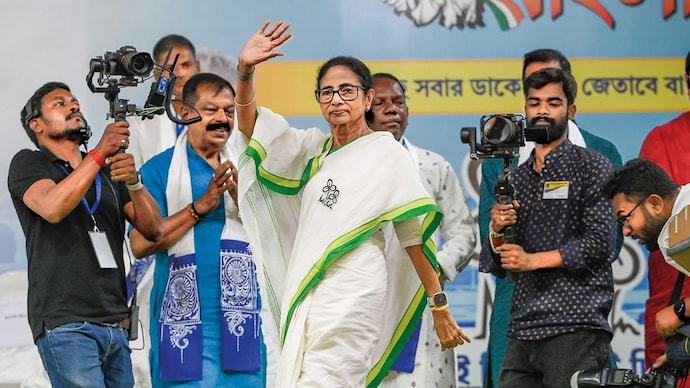
On March 26, the scorching sky over Laudoha village in West Bengal’s Pandabeswar shimmered before the chop-chop sound of the copter blades grew louder. As the helicopter carrying chief minister Mamata Banerjee landed, the vast crowds that had gathered to listen to her broke out into the Trinamool Congress (TMC) war cry: ‘Jotoi Koro Hamla, Abar Jitbe Bangla (No matter how much you attack, Bengal will win again)’. Having served as CM for a consecutive 15 years, the doughty Mamata is gunning for a fourth term. She frames her adversary as no longer just the Bharatiya Janata Party (BJP) but also the Election Commission of India (ECI), whose Special Intensive Revision (SIR) of voter rolls is trimming Bengal’s 76.6 million electorate by about 11 per cent. Mamata alleges the deletions target voters likely to back the TMC, tilting the balance in the BJP’s favour.
On March 26, the scorching sky over Laudoha village in West Bengal’s Pandabeswar shimmered before the chop-chop sound of the copter blades grew louder. As the helicopter carrying chief minister Mamata Banerjee landed, the vast crowds that had gathered to listen to her broke out into the Trinamool Congress (TMC) war cry: ‘Jotoi Koro Hamla, Abar Jitbe Bangla (No matter how much you attack, Bengal will win again)’. Having served as CM for a consecutive 15 years, the doughty Mamata is gunning for a fourth term. She frames her adversary as no longer just the Bharatiya Janata Party (BJP) but also the Election Commission of India (ECI), whose Special Intensive Revision (SIR) of voter rolls is trimming Bengal’s 76.6 million electorate by about 11 per cent. Mamata alleges the deletions target voters likely to back the TMC, tilting the balance in the BJP’s favour.
West Bengal is heading for a two-phase voting—on April 23 and 29—amidst that deeply contested administrative process, which has introduced an unprecedented layer of uncertainty. For the first time, a major election is off the blocks while the voter list remains unsettled. The SIR has thrown up numbers that have become the TMC’s political ammunition. After the erasure of 6.36 million names, another six million-plus names went into adjudication. Over 4.96 million of these have been scrutinised; early indications suggest around 45 per cent deletions. Hence Mamata’s rechristening of chief election commissioner Gyanesh Kumar as ‘Vanish Kumar’.
Despite the SIR setbacks, Abhishek Banerjee, Mamata’s nephew and TMC national general secretary, claims the party will surpass its 2021 tally of 215. However, inside the TMC, there is quiet unease. Party estimates suggest that if this deletion pattern continues, outcomes in 20 seats could be affected, bringing their tally down to roughly 195. Of the 6.06 million names that went into adjudication, nearly 2.8 million are women, Mamata’s core voters. Even before adjudication began, more than 3.1 million women had been deleted under various categories, compared with about 2.7 million men.
WELFARE DIVIDEND
That sense of a core constituency relates directly to how she has crafted her long-running welfare apparatus. Under Lakshmir Bhandar, launched in February 2021, 22.1 million women receive financial support.The monthly allowance now stands at Rs 1,500 for the general category and Rs 1,700 for Scheduled Castes (SC) and Scheduled Tribes (ST) households. Similarly, under Rupashree, over 2.20 million women have received Rs 25,000 each for marriage assistance. No wonder, at the Laudoha rally, Mamata did not have to prompt the women in the crowd to performululu, the ritualistic sound that has become a signature of her meetings. It erupted spontaneously, punctuating her speech.
The welfare ecosystem extends to a broad spectrum of vulnerable groups and occupational categories. The Karmasathi (Parijayee Shramik) scheme safeguards migrant workers, while Shramashree promises Rs 5,000 monthly support to 3.18 million returning workers until they find employment—both touted as achievements in addressing labour vulnerability. Pension schemes like Jai Johar and Taposili Bandhu have disbursed Rs 9,108.45 crore to 1.46 million SC and ST senior citizens. Farmers have received Rs 27,016 crore under Krishak Bandhu, and crop insurance under Bangla Shasya Bima has protected 11.3 million farmers, with claims worth Rs 3,938 crore settled. The outreach also targets younger voters. Under the Banglar Yuba Sathi scheme, unemployed youth are provided a monthly allowance of Rs 1,500.
The party’s poll manifesto, titled ‘Didir 10 Protigya’, is an extension of an already tested welfare model rather than a fresh set of promises. At its core is Duare Chikitsa, a proposal to deliver healthcare to people’s doorsteps through annual camps across the state, based on the Duare Sarkar model. The manifesto also promises an expanded welfare net, including a promise to continue Lakshmir Bhandar as long as there is a TMC government, a Rs 30,000 crore agriculture push, universal housing and piped drinking water, besides expansion of pensions and education infrastructure. Alongside this, it outlines an economic vision to double Bengal’s current economy of Rs 20 lakh crore by linking welfare delivery with growth, and to make the state a trade gateway for eastern India. “Mamata’s schemes and her network of beneficiaries are very strong in rural Bengal, which is where her votes come from. Anti-incumbency against her is sharper in urban areas,” says political analyst Biswajit Bhattacharya.
TWIN OFFENSIVE
The BJP pins its campaign on two broad allegations: that the TMC government is steeped in corruption and that it is ‘anti-Hindu’. On March 28, Union home minister Amit Shah released a chargesheet in Kolkata listing the Mamata government’s alleged ‘failures’ across 14 sectors, including corruption, lawlessness and security lapses, casting the upcoming election as a choice between “fear and trust”. The chargesheet also flagged concerns over women’s safety, healthcare, education and administrative efficiency. The BJP has even fielded Ratna Debnath, mother of the R.G. Kar Medical College and Hospital doctor whose rape and murder in August 2024 had sparked wide outrage. State BJP president Samik Bhattacharya believes this time his party will finally fulfil its long dream of capturing Bengal, saying, “The people have made up their minds. Trinamool will go, Trinamool is going. Trinamool is already gone. No force on earth can keep them in power.”
Even without a formal manifesto, the BJP has promised an Annapurna Bhandar—its counter to Mamata’s Lakshmir Bhandar—with higher cash transfers, along with a commitment to implement the 7th Pay Commission and release the long-pending dues to state employees within 45 days of coming to power. It has also pledged to allocate land for border fencing within the same time-frame, directly feeding into its anti-illegal immigration plank, while repeatedly invoking the idea of an ‘appeasement-free’ and ‘corruption-free’ government to contrast with the ruling regime. On employment, the BJP is promising a five-year age relaxation for government job aspirants affected by recruitment scams, along with filling all vacant posts through transparent processes.
The BJP’s vote share has grown phenomenally in the past two assembly elections, with the Congress and the Left Front experiencing a total collapse. It rose from 10 per cent in 2016 to 37.9 per cent in 2021, though still about 10 percentage points short of the TMC’s 48 per cent. While party sources believe that their prospects of coming to power have risen significantly, it has much catching-up to do.
Suvendu Adhikari, the leader of the Opposition and a former TMC leader who defected to the BJP in 2021, remains key to the saffron party’s poll strategy. In 2021, he defeated Mamata in Nandigram by 1,956 votes, forcing her to seek election in Bhabanipur. This time, he is chasing Mamata down on her home turf of Bhabanipur to make a point, while also defending Nandigram against his former aide Pabitra Kar, now with the TMC. While Suvendu functions as the Hindutva poster boy, Samik, lauded for his oratory skills, has been positioned to woo the bhadralok—the educated class of Bengalis.
The Congress and the Left add another layer of uncertainty to an already fragmented electoral landscape. This time, the two are contesting separately, breaking from past tactical alliances and effectively turning the contest into a multi-cornered fight. In districts such as Murshidabad, Malda and Uttar Dinajpur, where the Congress retains a residual organisational base, even a modest vote runoff can prove decisive. The 2021 results showed how a split in minority votes between the TMC and Congress allowed the BJP to win two seats despite being less endowed in terms of a base. But this time, the BJP may have to bear the fallout of the alleged persecution of Bengali speakers—especially Muslims—across the country in the name of evicting illegal Bangladeshis, an issue the TMC has weaponised. With the voter pool itself now under stress, the presence of Congress and Left candidates could once again fragment votes just enough to alter outcomes in closely-fought seats.
More than anything else, the 2026 election in West Bengal won’t be a contest about anti-incumbency and welfare alone, it will hinge as much on who gets to vote. If the SIR reshapes the electorate, it could alter outcomes beyond the reach of campaigns.

