Delhi's EV policy | The EV ultimatum
Delhi's draft EV Policy 2.0 proposes a hard shift from petrol two-wheelers alongside wider electrification mandates. But poor charging infrastructure comes in the way of its good intentions
Delhi’s roads are already handling more traffic than they were built for. The National Capital Territory has 8.76 million active registered vehicles—more than 500 for every 1,000 residents—and that figure excludes the steady inflow from neighbouring districts each day. In winter, the consequences of this vehicular overload become visible in Delhi’s air: vehicular emissions account for 23 per cent of its pollution, the single-largest contributor, according to a January 2026 report submitted to the Supreme Court by the Commission for Air Quality Management. What gets added next to this already saturated traffic ecosystem is now the central question shaping the Delhi government’s draft Electric Vehicle (EV) Policy 2.0 for 2026–2030.
Delhi’s roads are already handling more traffic than they were built for. The National Capital Territory has 8.76 million active registered vehicles—more than 500 for every 1,000 residents—and that figure excludes the steady inflow from neighbouring districts each day. In winter, the consequences of this vehicular overload become visible in Delhi’s air: vehicular emissions account for 23 per cent of its pollution, the single-largest contributor, according to a January 2026 report submitted to the Supreme Court by the Commission for Air Quality Management. What gets added next to this already saturated traffic ecosystem is now the central question shaping the Delhi government’s draft Electric Vehicle (EV) Policy 2.0 for 2026–2030.
At present, the shift has only begun. Six years after the original EV policy was unveiled in August 2020, Delhi has 470,104 registered EVs—just over 5 per cent of the total vehicles. The draft policy aims to accelerate this share, combining bans with time-bound incentives. From April 1, 2028, petrol two-wheelers will no longer be registered in Delhi. That is, if the policy gets adopted as such. Commercial operators have a shorter runway: aggregators may add BS-VI two-wheelers—those compliant with India’s most stringent emission standards—only until the end of 2026. (Such a ban on the induction of any new petrol/ diesel car or small cargo vehicle by aggregators has been in place since January 1 this year.) Similarly, for three-wheelers, new registrations turn electric-only from January 1, 2027. “We have a mandate to fight pollution and encourage people to shift to cleaner modes of transport, and that’s what the policy is doing,” says a senior government official linked to the policy formulation. “We believe the incentives proposed in the policy, including the subsidies, will help people make the choice to switch more easily.”
The incentives are weighted towards early movers. Buyers of electric two-wheelers can claim subsidies of up to Rs 30,000 in the first year, which get reduced to Rs 20,000 in the second and Rs 10,000 in the third. Electric autos and small cargo vehicles are eligible for higher support (see Decoding the Proposed EV Policy 2.0). Scrappage incentives add another layer: retire a Delhi-registered BS-IV or older vehicle at an authorised facility and purchase an EV within six months, and there is an additional payout. Road tax and registration fees are waived, with a few exceptions.
Government departments are to transition to EVs, including those hired or leased, within six months of the policy’s notification. All new buses inducted by the Delhi Transport Corporation are to be electric from that point. Schools will also have to electrify their fleets in a phased manner. “If India has to meet its net-zero emission target by 2070, Delhi must lead and achieve it by at least 2050,” says Gaurav Vangaal, associate director for light vehicle production forecast (Indian Subcontinent) at S&P Global Mobility. “To do that, by 2035, the government should start paving the way for only EVs in Delhi.”
Two-wheelers sit at the centre of this transition. At 5.93 million, they account for 67 per cent of Delhi’s active vehicles and are used intensively, from daily commuting to last-mile delivery, making this segment the quickest lever for accelerating EV adoption and delivering visible gains in air quality. Scrappage incentives for cars, too, address legacy pollution rather than simply adding cleaner vehicles. At present, in Delhi, petrol vehicles are permitted to ply for 15 years and diesel ones for 10 years, after which they must be deregistered.
The Society of Indian Automobile Manufacturers (SIAM), the apex body representing the country’s vehicle and engine makers, has described the draft policy as “mission-oriented” while raising concerns about its over-reliance on mandates. “We at SIAM believe that enablers are the best way to promote EV adoption, not mandates,” says SIAM president Shailesh Chandra. The industry body is preparing a response to the draft policy to address these concerns.
THE LIMITS OF THE SWITCH
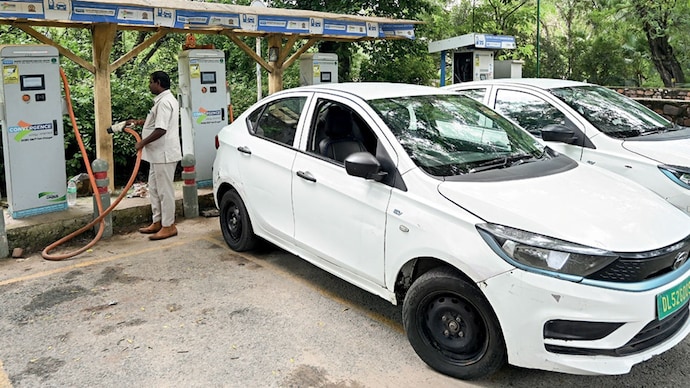
For buyers, the transition increasingly turns on one factor: charging. The case for electric two-wheelers has strengthened, but it rests less on upfront cost and more on whether charging is dependable, accessible and quick. On this front, the policy’s outline appears thinner than the scale of the shift it seeks to enable. Delhi Transco Limited has been tasked with planning and deploying public charging and battery-swapping infrastructure, alongside a proposed single-window clearance system for charging station operators. EV dealers will be required to instal at least one public charging station, with a minimum of three charging points for two- and three-wheelers as well as two for cars. But the draft policy is silent on the timelines.
Delhi has roughly 3,100 EV charging stations—that together host fewer than 10,000 charging points—and about 893 battery swapping stations. Against a stated target of 18,000 charging points, this leaves a shortfall of at least 8,000. Moreover, availability and reliability remain uneven. “There are too few chargers and many of them don’t work when you need them,” says Radheshyam Prasad, a Sangam Vihar resident who works as a delivery agent for a food aggregator and also plies his electric bike for a ride-share platform. Prasad needs to access a charger “quite a few times a day” and often worries about getting “stuck without charge in an area that has no charger”. However, Pradeep Jalan, a CR Park resident who drives a high-end BYD electric sedan, reports little difficulty. “Most charging happens at home overnight, and at my office in the day. On the off chance that I need a public charger, Delhi has enough.”
Beyond infrastructure, broader questions remain about what electrification can—and cannot—solve. “While EVs are all good from a local pollution reduction perspective, more personal vehicles—cars especially—mean the problem of congestion and health concerns do not get addressed,” says Geetam Tiwari, TRIPP (Transportation Research and Injury Prevention Centre) chair professor at IIT Delhi. “And at a larger level, unless we switch to cleaner electricity, more EVs in India only add to emissions from coal-based power plants.” More fundamentally, electrification changes what powers vehicles, not how many are on the road. While the policy includes steps to electrify buses, it does not shift commuters away from personal vehicles. Tiwari’s conclusion is unambiguous: “Switching to cars is not the long-term solution. Switching to public transport is.”
Compared with other states, Delhi’s approach is more directive, relying on phased bans without setting a clear adoption target. Maharashtra’s 2025–2030 policy aims for 30 per cent EV penetration by 2030 and leans on incentives rather than restrictions on new internal combustion engine (ICE) vehicle registrations. Karnataka, an early mover on road tax exemptions, has introduced a graded lifetime tax on EVs from April 2026. In Norway, often cited as a benchmark, incentives are being scaled back as adoption matures rather than giving way to bans. By contrast, Delhi plans to remove the petrol option in phases and expects the market to adjust. The approach can accelerate change, but unevenly—a proposition likely to be tested in ongoing deliberations over the draft policy.
Graphic by Tanmoy Chakraborty

