Delhi's art mile | Delhi's Defence Colony
Galleries converge in New Delhi's Defence Colony, reshaping how the capital discovers, views and collects art
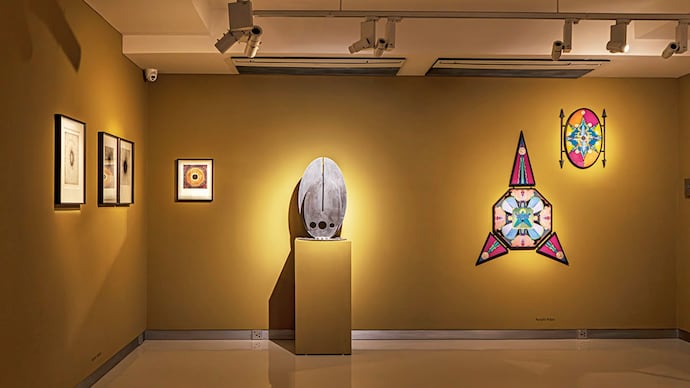
After Mumbai’s Kala Ghoda, there’s a new address to go on a gallery crawl—Delhi’s Defence Colony. This posh south Delhi neighbourhood, once entirely inhabited by the genteel Indian military folk who were granted plots in the 1950s, is now home to abuzzing art scene.
After Mumbai’s Kala Ghoda, there’s a new address to go on a gallery crawl—Delhi’s Defence Colony. This posh south Delhi neighbourhood, once entirely inhabited by the genteel Indian military folk who were granted plots in the 1950s, is now home to abuzzing art scene.
Def Col (as it’s colloquially called) doesn’t boast of wide-open spaces to flaunt larger-than-life murals like Lodhi Colony, or the randomness and whimsy of Chennai’s Kannagi; and unlike Kala Ghoda—an increasingly gentrified public district—remains essentially a well-heeled residential colony. In that sense, Def Col is more lived-in and intimate. Roshini Vadehra is a little too familiar with it, as her father, Arun Vadehra, was among the first gallerists to move in, long before it was fashionable to be here. It’s where his workspace was when, in 1987, Vadehra senior decided to open their first gallery, when an art scene barely existed. “I joined the gallery in 2004, which is when our contemporary gallery space was initially in Okhla,” Roshini says. Three years later, in 2007, she shifted this gallery to Defence Colony and built twin spaces. “I realised location does play a key role in bringing in audiences, and this neighbourhood is so conveniently located that it’s perfect,” she says.
Arjun Bahl agrees. Co-founder of Gallery XXL, which shut its operations in Mumbai’s Colaba after a successful one-and-a-half-year-long run and moved base to Defence Colony in October 2025, Bahl says the reason for this move was almost entirely logistical. “The art district in Lodhi Colony, on which we have been working for the last 10 years (with St+Art India Foundation), is very close. Secondly, we wanted to add to the already existing art ecosystem in Defence Colony,” he says. Internationally, galleries are often built in clusters to foster an environment conducive to dialogues on art.
“This was our learning from the art district, that when you create some possibilities close to each other, people will end up visiting multiple places at once. So, even if they are visiting the Lodhi Art District, they might go to Defence Colony to visit the galleries because it’s close by, and vice versa,” Bahl explains.
As of today, nearly a dozen such galleries in the neighbourhood have consolidated Defence Colony’s position on the country’s cultural map. Besides the longstanding establishments by Vadehra, Akar Prakar and Shrine Empire, the newer wave between 2024 and 2026 saw a spate of reopenings, with Galerie Mirchandani + Steinruecke setting up shop in late 2024. But the most intriguing venture has been Galleryske and Photoink moving into a shared space last year, inaugurating it with joint programming and continuing their collaborative model under one roof.
This was followed by Mumbai’s Method, Gallery XXL, Latitude 28 and Gallery Dotwalk, forming an agglomeration that forms a walkable viewing route, which Delhi had been missing all along. Maybe what truly sets it apart is its lack of institutional rigidity. “It also already has a culture of movement, where people are used to walking, stopping, and spending time,” says Bhavna Kakar-Saxena, founder of Latitude 28. “Unlike Lutyens’s Delhi, which can often feel formal and appointment-driven, or Lodhi Colony, which has a strong public-art identity, Defence Colony has the potential to evolve into something more porous,” she says.
For over 15 years, Kakar-Saxena nurtured her gallery in the quaint southern neighbourhood of Lado Sarai, where a young, more eclectic cohort was drawn to the space’s improvisational nature. However, over time, especially after COVID, its limitations became apparent, particularly in terms of accessibility and scale. “What was once considered central, like Lado Sarai and even Saket, began to feel increasingly peripheral. The infrastructure had a role to play too—the ‘urban village’ no longer felt as charming during the monsoon,” the gallerist says. In comparison, the Art Deco-inspired building in Defence Colony allowed her to rethink how art is presented, appealing more to veterans and even international travellers staying in nearby luxury hotels.
The reasons were the same even a decade ago for Anahita Taneja, co-founder and director, Shrine Empire, who saw potential in Defence Colony as early as 2017, when she had only two other galleries for company. For a space showcasing art, it’s rather unique to be set in a basement, which doesn’t offer the height a white cube requires. With Shrine Empire, Taneja broke the white cube mould and tinkered with depth, materiality and intimacy.
In hindsight, moving to Defence Colony proved to be a rather lucrative and timely decision for Shrine Empire. And as of April 2026, the gallery is reopening in a different spot within the same neighbourhood to expand the purview of its offerings, which now include a “reading salon” and a collaboration with a coffee brand.
Defence Colony might just be the gift that keeps giving—and some gallerists’ best-kept secret that the larger community is only just waking up to.

