Assam | Hurricane Himanta
Behind the BJP's third straight victory lies Chief Minister Himanta Biswa Sarma's welfare expansion, constituency redrawing and identity consolidation, which have tilted Assam's politics in his favour
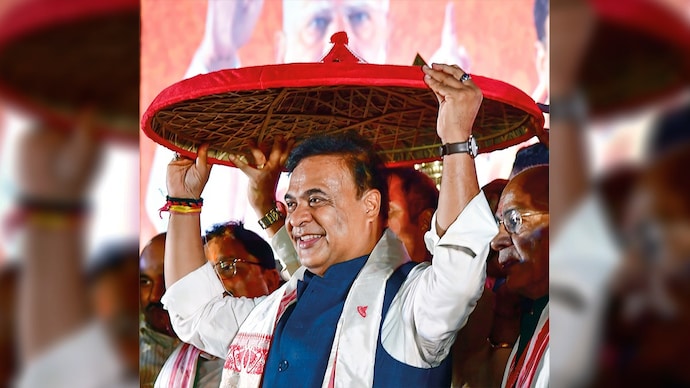
On a humid afternoon in March, in Nalbari, Himanta Biswa Sarma stood atop an open jeep for 14 hours. Since 8.30 am, he had been waving at a sea of people lining the streets. Thousands jostled to touch him, kiss him, and hand him water bottles, home-cooked food, fruit, framed portraits, a shampoo bottle and a face wash. He drank from strangers’ bottles, ate food handed up to him and ignored every protocol attached to a Z-Plus protectee.
On a humid afternoon in March, in Nalbari, Himanta Biswa Sarma stood atop an open jeep for 14 hours. Since 8.30 am, he had been waving at a sea of people lining the streets. Thousands jostled to touch him, kiss him, and hand him water bottles, home-cooked food, fruit, framed portraits, a shampoo bottle and a face wash. He drank from strangers’ bottles, ate food handed up to him and ignored every protocol attached to a Z-Plus protectee.
Someone passed up a written application. He read it, photographed it on WhatsApp and sent instructions to the relevant officer, with barely a pause in his campaign demeanour. The road march ended at 10.30 pm. Ten hours later, it was to begin again.
On May 4, Assam returned its verdict. The Bharatiya Janata Party (BJP) won 82 seats in the 126-member assembly, not only breaching the majority mark of 64, but also its best-ever performance. With its allies, the Asom Gana Parishad (AGP) and the Bodoland People’s Front, winning 10 seats each, the National Democratic Alliance (NDA) crossed the 100-seat mark. The Congress-led six-party Asom Sonmilito Morcha, with Gaurav Gogoi as its chief ministerial candidate, was reduced to 21 seats, with the Congress itself dropping 10—from 29 to 19.
For Sarma, winning was never enough; his victory had to be emphatic. The BJP’s 2026 tally is the third-largest mandate any winning party has secured in Assam’s history. In 2011, when the Congress won 78 seats, Sarma had been the architect of that victory, though he had to share credit with the then-CM Tarun Gogoi, father of Gaurav Gogoi. That year, Sarma had pushed for the CM’s post. The Congress high command was unconvinced and Sarma crossed over to the BJP in August 2015.
He had been the principal architect of the BJP’s victories in 2016 and 2021, too, but neither result was credited to him alone. That changed in 2026, 25 years after he entered the assembly as a 32-year-old lawyer on a Congress ticket. Sarma was the face of the campaign this time. He could not have asked for a better silver jubilee gift.
THE METHOD MAN
Sarma’s work began the day he took office as CM on May 10, 2021, and started building a state in which his defeat would become structurally difficult. The construction had several pieces: the man, his welfare architecture, a redrawn map and the identity weld. “The BJP has transformed itself into a system characterised by a top-down organisational structure, a cult around Sarma, and an ideological pursuit anchored in Hindu civilisational discourse,” says Vikas Tripathi, who teaches political science at Gauhati University. “This systemic dominance has made the electoral space increasingly disadvantageous for Opposition parties in Assam.”
Sarma is a politician without an off-switch. He wakes by 7 am and first reaches for his phone, which he describes as his primary tool of governance. Bureaucrats are routinely summoned to his home past midnight to clear files. His day does not end before 3 am. He survives on fruit, sprouts, tea and biscuits, and Diet Coke, with one substantial Assamese thali, fish included, around 6 pm. A teetotaller, he recites Bhakti-era saint-scholar Srimanta Sankardev’s prayers every morning, reads whenever he has time, and prefers walking and badminton for recreation.
To break gridlocks in governance, he calls multiple secretaries simultaneously rather than letting files get stuck in transit. When a stalemate arose over relocating workers from two dysfunctional central government paper mills that had been sold to private players, he summoned all involved departments and the workers to a single meeting at 5.30 pm and forged a consensus by 6 am. “He has elephantine memory and tracks even minor details with weekly reviews,” says a bureaucrat. “If he is sitting in an adda, make no mistake, he is gathering information,” adds another.
Alongside the state’s feedback systems, Sarma has built his own—a direct finger on Assam's pulse. He calls up farmers, tea-garden workers, teachers, students, doctors, civil servants, businessmen, academics and party workers, asking simple questions on a range of issues. He reads almost every WhatsApp message that reaches him. His Cotton College alumni network has produced loyalists across social and political systems and networks.
Sarma’s long stint as health minister in the Congress and BJP governments helped him establish the image of a politician who delivers welfare. He expanded access to healthcare by mandating rural service for doctors, increasing medical colleges, adding speciality services and responding quickly to public demands. Later, as education minister, he introduced transparent recruitment examinations for teachers, giving thousands of young people confidence that jobs could be secured on merit.
None of this would matter politically without the other face of the machine: his willingness to fight without retreat. “People appreciate brave and decisive leaders,” Sarma says. “I have always taken bold decisions at critical moments.” In 2010, when the Tarun Gogoi government came under attack from activists over big dams, Sarma, then a minister, took the front line in its defence. When the Sarbananda Sonowal government was cornered over the Citizenship (Amendment) Act in 2020, he moved forward again. During COVID-19, while most public figures sheltered, Sarma, as health minister, entered hospitals and isolation wards in PPE, inspecting facilities and interacting with patients.
But when cornered, Sarma also has the skill to shift the narrative rather than be left defending dodgy turf. The death of singer Zubeen Garg in Singapore in September 2025 could have been a political grenade. Singapore’s coroner ruled it an accidental drowning; Opposition leaders focused the heat lamp on event manager Shyamkanu Mahanta. It had political bite: the Mahantas were not strangers to Sarma’s corridors. Shyamkanu’s elder brother had been Assam’s director general of police until 2023 and then chief information commissioner until November 2025. Another brother is the sitting vice-chancellor of Gauhati University. That proximity became the basis for the case against the CM. Publicly, Sarma didn’t blanch, declaring in the assembly that Zubeen had been murdered, contradicting Singapore’s ruling. His police, meanwhile, arrested Mahanta and others, deflating the Opposition’s prosecutorial energies.
ENGINEERING ADVANTAGE
If the man and method explain the politics, the welfare architecture secures the mandate. Between May 2021 and March 2026, Sarma’s government ran more than 40 distinct beneficiary schemes, reaching 75 per cent of Assam’s population. The centrepiece is Orunodoi, the monthly cash transfer to women, now covering 3.8-4 million households. Launched under Sonowal at Rs 830 a month, it rose under Sarma to Rs 1,000 in 2021, Rs 1,250 in 2022 and Rs 1,500 from January 2026. In February 2026, weeks before the polls, every beneficiary received an advance of Rs 9,000, combining four months of pending payments with a Rs 3,000 Bohag Bihu bonus.
Besides the cash transfers, Sarma delivered visible, fast-paced development. Rural roads lengthened. Bridges and flyovers came up, often before deadlines. A semiconductor unit came to Morigaon. More than 100,000 transparent government jobs were delivered as promised, with another 200,000 pledged for the next term. According to RBI data, Assam’s GSDP (Gross State Domestic Product) grew 45 per cent between FY20 and FY25, against the national average of 29 per cent, the fastest expansion of any state in that period. Massive police operations curbed drug trafficking. Rhino poaching, a chronic embarrassment for decades, was ended.
Then, the maps shrunk his grey areas. In 2023, Assam’s constituencies were redrawn. Muslim voters once had meaningful influence over roughly 35 seats. That was compressed to 22, giving the BJP 13 more seats to fight for—it ended up gaining 18 overall. The Congress was hit hard. Its 30 per cent vote share, mostly among Muslims, was intact. But its concentration in fewer seats resulted in a drop of 10 seats.
This was tied to his identity plank, where Sarma broke ground in ways no one in his party had in Assam. For the past four decades, the Assamese sub-nationalist tradition—built around opposition to illegal immigrants from Bangladesh—was religion-neutral even though most of these immigrants are Muslims. Where Sonowal spoke of jati, mati and bheti (community, land and home), Sarma fused that grammar with the harder vocabulary of religious self-defence. He made Hindu, Assamese and tribal identity feel like one political category.
The fusion was visible across his tenure. He led aggressive eviction drives against immigrant-origin Muslims, consolidating indigenous opinion. He pushed bans on polygamy and child marriage, which found silent resonance even among Muslim women. He called for indigenous communities to “harass” Miyas, the local term for Muslims of Bangladeshi-immigrant origin. On May 4, the result was a Hindu consolidation Assam had never seen before.
Around this stood the ideological absorption machine. Of the 90 candidates the BJP fielded, at least 30 were imports from the Congress, AGP and smaller regional and tribal formations. The most important defections were not the most arithmetically valuable. Former Congress president Bhupen Bora had last won in 2011. Two-time MP Pradyut Bordoloi had lost his last assembly contest in Margherita in 2016. Sarma recast both as stalwarts, branded them “the last Hindu leaders” of the Congress and blamed their exits not on Gaurav, but on senior Muslim Congress leader Rakibul Hussain. Both won this time, under Sarma.
RIVALS RECEDING
Inside Assam, the mandate leaves Sarma without a serious challenger. Gaurav, a three-term Lok Sabha MP and the poll campaign’s most credible alternative, lost. So did Debabrata Saikia, the outgoing leader of the Opposition, and Ripun Bora, former state Congress president. The only visible Opposition leader left in the assembly is Akhil Gogoi of the Raijor Dal. Beyond Akhil personally, his party has no foothold in the indigenous Assamese imagination, from which any future challenge to Sarma could emerge. The composition of Assam’s new Opposition—22 of its 24 MLAs are Muslim—only reinforces Sarma’s core argument that the Opposition stands on the other side of the religious divide. Of the Congress’s 19 seats, 18 were won by Muslims in Muslim-majority constituencies.
Nationally, a larger shift is under way. Alongside Devendra Fadnavis in Maharashtra and Yogi Adityanath in Uttar Pradesh, Sarma has emerged as one of the BJP’s most consequential CMs. He has built this profile through strong Hindu consolidation in a state with a significant Muslim population, constant visibility on Hindi media, and rhetoric that often stretches beyond the party’s limits, too. His second term will test whether the BJP sees him as a contender in a post-Modi-Shah order. He has five years to make that case.

