Puducherry | One-man show delivers
N. Rangasamy's great connect with voters helps NDA smash the fragmented congress-led challenge
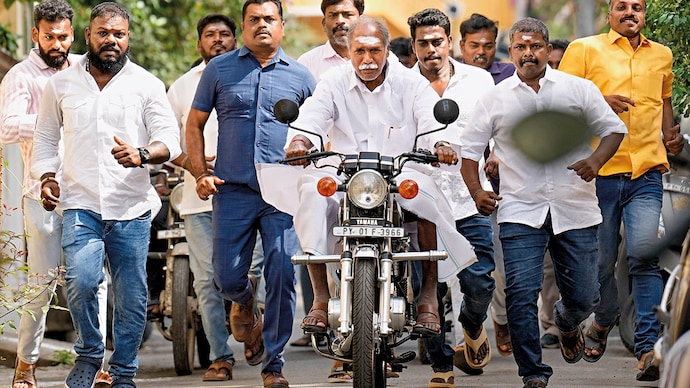
Natesan Rangasamy is set to return as Puducherry chief minister for a remarkable fifth term. His All India N.R. Congress (AINRC) won 12 seats, the BJP four, while the AIADMK and LJK (Latchiya Jananayaga Katchi) won a seat each, taking the NDA tally to 18 in the 30-member assembly, handsomely defeating the Congress-DMK alliance, which got only six. Despite expectations of a closer contest driven by anti-incumbency and alliance arithmetic, Rangasamy’s popularity again proved stronger than the Opposition’s fragmented campaign.
Natesan Rangasamy is set to return as Puducherry chief minister for a remarkable fifth term. His All India N.R. Congress (AINRC) won 12 seats, the BJP four, while the AIADMK and LJK (Latchiya Jananayaga Katchi) won a seat each, taking the NDA tally to 18 in the 30-member assembly, handsomely defeating the Congress-DMK alliance, which got only six. Despite expectations of a closer contest driven by anti-incumbency and alliance arithmetic, Rangasamy’s popularity again proved stronger than the Opposition’s fragmented campaign.
More than ideology or party structure, the election was a reaffirmation of Rangasamy’s political brand, built for over two decades on accessibility, simplicity and welfare governance. “The results were on expected lines, unlike in Tamil Nadu,” explains Mudhalvan, a political observer. “The Opposition was fumbling from the beginning and while the new entrants did make some impact, it was not as big as it was in Tamil Nadu.”
In Puducherry politics, personal credibility remains decisive. The NDA campaign benefited enormously from projecting Rangasamy as the unquestioned face of governance and continuity. The BJP also appeared content to let Rangasamy dominate the campaign narrative, which helped the alliance enormously.
LACK OF COHESION
he Congress-DMK alliance suffered from the opposite problem. It hoped to capitalise on anti-incumbency, economic dissatisfaction and concerns about governance. But internal divisions weakened its campaign. Seat-sharing disagreements, overlapping ambitions and reports of poor coordination between cadres created confusion on the ground. While it criticised the government on development and administrative issues, it struggled to answer a larger question: why should voters replace Rangasamy? The absence of a clear chief ministerial face—someone matching Rangasamy’s emotional connect with voters—further weakened the campaign.
For the Congress, which could win only one seat out of the 22 it contested, the result reflected its long-term decline in Puducherry. Its ally, the DMK, fared better, winning five of the 13 seats it contested.
Smaller parties, independents and newer entrants like TVK (Tamilaga Vettri Kazhagam) and NMK (Neyam Makkal Kazhagam) attempted to position themselves as alternatives, particularly among younger and urban voters, but lacked the organisational depth necessary for electoral success. Their presence also contributed to splitting anti-incumbent votes. However, the TVK won two seats and the NMK one.
Ultimately, the 2026 Puducherry verdict was about perceived stability. Voters chose a leadership model they already understood over an Opposition that appeared divided and uncertain.

