The opposition | INDIA in retreat
A coalition that can still hold the line in Parliament is steadily losing ground across the states. Its shrinking map exposes fractures in strategy, leadership and identity
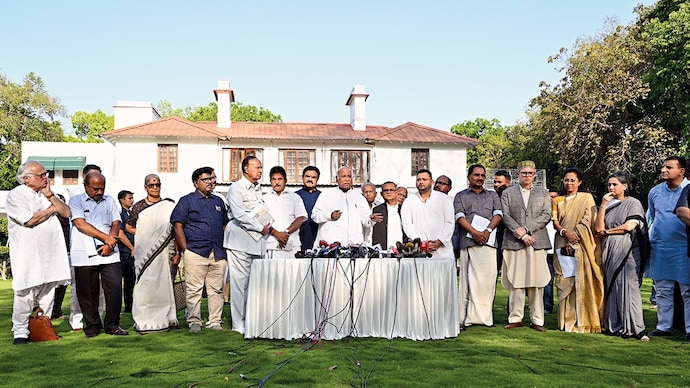
When Opposition parties gathered in the muggy summer of 2023 to christen itself the Indian National Developmental Inclusive Alliance, or INDIA, they governed 11 states. The Congress held Rajasthan, Himachal Pradesh, Chhattisgarh and Karnataka. The Trinamool Congress was firmly in power in West Bengal; so was the Communist Party of India (Marxist)-led Left Democratic Front in Kerala. A Dravida Munnetra Kazhagam-led front ruled Tamil Nadu, the Aam Aadmi Party held the reins in Delhi and Punjab, the Congress-Left, Janata Dal (United)-Rashtriya Janata Dal mahagathbandhan governed Bihar, and a Jharkhand Mukti Morcha-Congress-RJD combine was in power in Jharkhand.
When Opposition parties gathered in the muggy summer of 2023 to christen itself the Indian National Developmental Inclusive Alliance, or INDIA, they governed 11 states. The Congress held Rajasthan, Himachal Pradesh, Chhattisgarh and Karnataka. The Trinamool Congress was firmly in power in West Bengal; so was the Communist Party of India (Marxist)-led Left Democratic Front in Kerala. A Dravida Munnetra Kazhagam-led front ruled Tamil Nadu, the Aam Aadmi Party held the reins in Delhi and Punjab, the Congress-Left, Janata Dal (United)-Rashtriya Janata Dal mahagathbandhan governed Bihar, and a Jharkhand Mukti Morcha-Congress-RJD combine was in power in Jharkhand.
Cut to the summer of 2026. The map has shrunk by more than half. In the assembly polls since the 2024 general election, Maharashtra, Haryana, Bihar, Delhi—and now West Bengal and Assam—have all been retained or wrested anew by the BJP. Mamata Banerjee, the Trinamool’s redoubtable matriarch, is out of power for the first time since 2011. DMK chief M.K. Stalin has lost Tamil Nadu to a film star. The Left, having lost Kerala, finds itself without a single CM for the first time since 1977.
Bengal and Tamil Nadu together send 81 MPs to the Lok Sabha—nearly a sixth of the House—and were the very turfs where the Bharatiya Janata Party had been decisively blocked in 2024. In the general election that year, the Opposition had deprived the BJP of a third consecutive majority, restricting its tally to 240 seats, 32 short of the required mark of 272. And this was despite the pre-poll exit of INDIA’s co-founder Nitish Kumar. Now, the Opposition bloc stands reduced to five state governments—Kerala, Karnataka, Telangana, Himachal Pradesh and Jharkhand—along with the National Conference in the Union territory of Jammu and Kashmir. The two powerful regional titans who have fallen, Mamata and Stalin, lost even their own assembly seats—a humiliation piled onto defeat. Both are in their 70s; five years out of power could very well force a generational change. New leadership, in turn, may recalibrate equations within the INDIA bloc. As it stands now, the acronym seems to mock its founders; the real India is overwhelmingly with the NDA.
BATTLE OF PERCEPTION
Kerala offers some consolation, but it could quickly curdle into complications. The Congress-led United Democratic Front (UDF) has secured a decisive mandate, with the Congress alone winning 63 of 140 seats and the front crossing the 90 mark. The Left stands humbled; Pinarayi Vijayan’s two-term reign is over. Yet the more ominous statistic sits in the BJP column. From zero seats in 2021, the party has won three. This may appear modest, but a similar arithmetic once applied in West Bengal, where the Left had ruled for 34 years. In 2016, Bengal returned three BJP MLAs in a 294-seat assembly on a vote share just above 10 per cent. By 2026, the BJP holds 207 seats with 45.9 per cent of the vote. In Tripura, another former Left bastion, the BJP polled 1.54 per cent and won no seats in 2013; five years later, it formed the government with 36 of 60 seats and a 45 per cent vote share.
Kerala’s demography offers familiar contours: a Hindu population of 54 per cent and a Muslim population of 27 per cent—almost identical, in the latter case, to West Bengal and not far from Assam’s 34 per cent. These are the very arenas where the BJP’s polarisation politics has yielded its richest returns. The conditions for a BJP offensive in Kerala are, therefore, in place. If the Left traces the same arc it did in Bengal and Tripura—and the BJP will work to ensure that it does—the Opposition space in Kerala could be the next prize on the saffron shopping list.
This is the trap the Opposition appears to have wandered into without an exit plan. By default, it reinforces the BJP’s framing of the INDIA bloc as a coalition primarily for Muslim voters. In Assam, 18 of the Congress’s 19 MLAs are Muslim. So are all three MLAs from the Congress and the Left in the new Bengal assembly. Even within the TMC, 32 of 80 MLAs are Muslim—a 40 per cent share. The reciprocal arithmetic is sharper still: the BJP in both states does not have a single Muslim legislator. For a party that foregrounds religion in its campaigns, this a gift that keeps on giving.
There is a historical irony here that may sting the Congress. After the 2014 Lok Sabha rout, it was a Keralite, A.K. Antony, who had warned that the party needed to counter the perception of favouring Muslims. Twelve years on, the Antony report—intended as a roadmap for revival—gathers dust. Several INDIA bloc constituents face a similar bind. Without a credible effort to broaden their appeal among Hindu voters—or at least to signal such intent—the Opposition will continue to fight elections in which the BJP needs only to consolidate the majority to win.
A GROWING DIVIDE
Inside the bloc, unity is flickering. After the setbacks in Maharashtra and Bihar, ties between the Congress and its regional partners—Shiv Sena (Uddhav Balasaheb Thackeray) and the RJD—have slipped from cordial to chilly. Talk of a merger between the two Nationalist Congress Party factions could yet cost the alliance another founder member, Sharad Pawar. In Uttar Pradesh, the Samajwadi Party, while cooperating with the Congress in Parliament, shows little appetite for on-ground coordination ahead of the 2027 assembly election. The AAP has already exited the bloc. In Punjab, also due for polls next year, there is effectively no INDIA bloc left to speak of.
Meanwhile, Rahul Gandhi, the leader of the Opposition in the Lok Sabha, spent the assembly campaign attacking Mamata, arguing that the TMC regime’s failures—corruption, polarisation and weak governance—had enabled the BJP’s rise in Bengal. After the TMC’s rout, however, he recast himself as a voice for Opposition unity, endorsing Mamata’s claim that more than 100 seats had been “stolen” and extending the same explanation to the Congress’s collapse in Assam.
The shift has not been universally welcomed within his party. On May 5, Rahul himself noted that some Congress leaders were privately gloating over the TMC’s defeat, warning that the BJP’s victory poses a collective, existential threat to all Opposition parties. This underscores a familiar contradiction: while the Congress’s central leadership seeks a national anti-BJP front, state units often view regional INDIA allies as their immediate rivals. For many in the Bengal Congress, Mamata’s defeat is not a democratic setback but a political opening.
In Tamil Nadu, the Congress has already abandoned its long-time ally, the DMK, prompting the latter to declare it as the end of INDIA. Rahul had moved swiftly to congratulate Vijay’s Tamilaga Vettri Kazhagam (TVK), a day after it stunned both Dravidian majors. The TVK has fallen just 10 seats short of a majority; the Congress’s five MLAs could help reduce that gap. Notably, a section within the Congress—among them data cell and professionals’ Congress head Praveen Chakravarty and party whip in the Lok Sabha Manickam Tagore—had pushed for a pre-poll alliance with Vijay, only to be overruled by party president Mallikarjun Kharge and the state unit.
THE CHALLENGE AHEAD
The latest setbacks come barely a fortnight after the Opposition’s most consequential parliamentary win in years. On April 17, a united INDIA bloc defeated the Constitution (131st Amendment) Bill, 2026—the Modi government’s bid to expand the Lok Sabha to 850 seats and advance delimitation based on the 2011 Census. The tally was 298 in favour and 230 against. The government, needing 352 of the 528 members present, fell short by 54—the first time in 12 years that one of its constitutional amendments failed. The coalition that delivered the blow included the DMK and the TMC, whose MPs voted as one. The test for the bloc is whether it can sustain that unity till 2029, as state-level equations shift.
The INDIA bloc’s problem is no longer merely arithmetic; it is territorial and psychological. Its five-state footprint is geographically lopsided—three governments in the South, one in Himachal Pradesh and one in Jharkhand. The Congress, the only party with a plausible claim to national opposition leadership, risks being recast as a southern party. Its allies, meanwhile, are strongest precisely where they must also compete with it.
Across the aisle stands a BJP that governs 17 states/ UTs on its own, with NDA partners running another five. Together, they govern more than 70 per cent of India’s population and over two-thirds of its landmass. The contrast is stark: the INDIA bloc can still block a constitutional amendment in Parliament, but it is steadily losing the republic beyond it. In state after state, allies turn adversaries, local ambitions trump national strategy, and the BJP harvests the fallout. To reclaim India, INDIA must first decide whether it is an alliance, an arrangement, or merely an acronym that has outlived its purpose.

