Kerala | Funeral pyrotechnics
The Thrissur fireworks accident is yet another call for India to celebrate with restraint
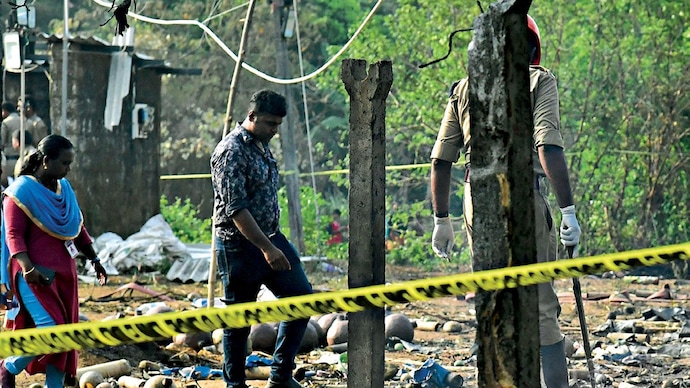
Mundathikkode is in silence—averse to sound, almost. It was too deafening when it came this year, and too close. Now the village mourns its dead: a total of 16, after DNA tests added the four declared missing earlier to the toll. That’s besides the 200-plus houses damaged, and 11 injured. The puncha paddy crop that fringes the site, singed right before harvest, the scarred trees, the numbed villagers, all bear signs of the hellfire that erupted at 3:25 pm on April 21.
Mundathikkode is in silence—averse to sound, almost. It was too deafening when it came this year, and too close. Now the village mourns its dead: a total of 16, after DNA tests added the four declared missing earlier to the toll. That’s besides the 200-plus houses damaged, and 11 injured. The puncha paddy crop that fringes the site, singed right before harvest, the scarred trees, the numbed villagers, all bear signs of the hellfire that erupted at 3:25 pm on April 21.
This is not how festival season was supposed to go: five days past Vishu, five before Thrissur Pooram. Mundathikkode has a special relationship with the latter event—the state’s cultural showstopper, which sees up to two million people swarm that temple-dense town in central Kerala. This village, 17 km off Thrissur, is one of the primary places where the famous Pooram fireworks are manufactured. About 4,000 kg of pyrotechnic chemicals go up in a brilliant competitive display between two temples every year on Pooram night—if detonated all at once, say, equivalent to 1.68 tonnes of TNT.
Something like that happened that day at the firecracker unit run by Satheeshan. About 11 tonnes of explosives, stored across five sheds, ignited. Some say it was spontaneous combustion due to the extreme heat, with even minor friction or static electricity potentially acting as a trigger for unstable chemicals. Others hint at the presence of prohibited material like potassium chlorate: police have not called it yet, nor ruled it out.
The first blast was powerful enough to be felt miles away: you can judge from the crater it left. Secondary blasts continued for two and a half hours, turning it into a “war zone” that fire officials couldn’t enter as the stored amittu shells—fireworks meant to go off in the sky—went into serial detonation and stray incendiary particles popped and fizzed in the air.
SCARRED BY TRAGEDY
The 46-year-old Satheeshan, who later died of severe burns, had the contract for Thiruvambadi temple. “I’ve worked for him and his father Mani Pappan for 20 years,” Velayudhan Vettikattil, 64, tells india today. “Many TV crews were visiting that day. I was sitting outside the tent and making safety fuses, dipping them in black powder. I heard the blast, and ran for my life to the paddy fields. I saw the place burning behind me, then went blank.”
The contractors keep their chemical combination a secret and engage only loyal workers. “There was no risk,” says Velayudhan, whose work year was split in two: January-May at this unit, the rest as a coconut plucker. “I don’t know what happened that day. I’ve lost all my friends. I can’t sleep at night... won’t go back to this work.” All villagers are in trauma. A furlong from Velayudhan’s home, sisters Kottayil Subhadra and Valsala sit in their bedroom praying for the dead. Both were working at the unit and survived.
Xavier Chittilappilly, the local CPI(M) MLA now camped at the site to assist rescue ops, says “greater vigil” is a collective onus. It’s a widely held view: Kerala errs more towards abandon than restraint around festivals. Pooram 2026 was kept subdued in grief: fireworks cancelled, the elephant-top parasol exchange abbreviated. “The crowds were missing due to the tragedy,” says ex-IPS officer K.M. Antony. The St Joseph’s Church feast, held on April 24-26, also abandoned its fireworks, as did the Malankara Orthodox Church. The question is: will one-time abstention suffice?

