Rajasthan | The rape of a river
Illegal sand mining is serially destroying the Chambal, one of India's most pristine river systems. Even Supreme Court admonitions fail against entrenched interests
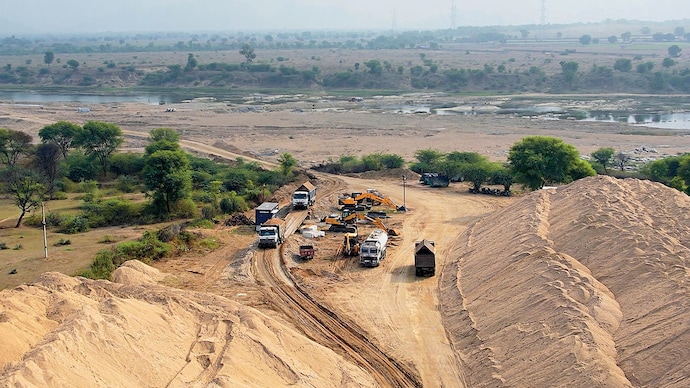
The crime is so much the default norm, so deeply ingrained in the local ecologies of power, that it goads even the highest court to cross lines in the sand. In mid-April, it was an irate Supreme Court that threatened to go beyond judicial oversight and wade right into the slush of law enforcement. Even paramilitary deployment could be considered, it said, taking suo motu cognisance of the killing of two forest personnel in the Chambal belt. Dacoits? Well, the court did use the metaphor, but sand mafia kingpins are not exactly horseback desperadoes who merely ride rough over the ravines. Quite the opposite.
The crime is so much the default norm, so deeply ingrained in the local ecologies of power, that it goads even the highest court to cross lines in the sand. In mid-April, it was an irate Supreme Court that threatened to go beyond judicial oversight and wade right into the slush of law enforcement. Even paramilitary deployment could be considered, it said, taking suo motu cognisance of the killing of two forest personnel in the Chambal belt. Dacoits? Well, the court did use the metaphor, but sand mafia kingpins are not exactly horseback desperadoes who merely ride rough over the ravines. Quite the opposite.
For a furtive job, sand mining is remarkably sedentary—as long as the site has life. On the dry banks and sand bars of the Chambal, they use heavy machinery like bulldozers and JCBs to gouge out their grains of yellow gold, sweeping away gharial and turtle nests, carrying away a part of their habitat forever in their front-end loaders.
From the riverbed, they suck up tonnes of slurry with diesel-run suction dredgers, cutting deep wounds into what’s still one of India’s most pristine rivers. The raw sand gets piled on to tractor-trolleys that move out in convoys in the dark. All the way to modern India’s glitzy buildings—you might be sitting in one of them as you read this.
On April 2, the court had stayed a controversial Rajasthan notification, issued in December, that denotified 732 hectares of the National Chambal Sanctuary. Calling it prima facie illegal, the court said critical wildlife habitats could not be sacrificed for the reckless harvesting of sand.
FOOTSOLDIERS FELLED
But nothing changed on the ground. Hundreds of trucks still ferry illegally mined sand across the region—a sign that enforcement itself could be compromised. Except when the occasional footsoldier tries to do his job. In January, forest guard Jitendra Singh Shekhawat tried to stop a speeding tractor-trolley at the Jhiri checkpoint in Dholpur, Rajasthan. The vehicle ran him over.
On April 8, the scene was repeated, in nearby Morena, Madhya Pradesh. Harikesh Gurjar was run over as his patrol team intercepted a tractor-trolley at 6 am. It was at the next hearing, April 17, that Justices Vikram Nath and Sandeep Mehta warned that if states failed to act against the “modern dacoits”, officials would be held personally accountable. The complicity implied there shifts the story to the rampant corruption illegal mining has brought into state administrations. The reproof came just months after Rajasthan witnessed an unprecedented #SaveAravalli movement, a sign of how benumbed administrations are even towards the public mood, forget the environment.
Injury to fragile systems like the Chambal may be irreparable. The courts have reiterated a basic scientific principle: sand mining must follow replenishment cycles. Extract from a stretch, leave it untouched for at least five years to allow natural regeneration. On that logic, the Rajasthan High Court had quashed 93 gravel mining leases this year—likely in vain.
There is a workable alternative—one Rajasthan itself has experimented with, albeit without scaling it. The desiltation initiative at the Bisalpur Dam on the Banas river showed extraction can align ecological and economic goals. The idea here was to segregate usable sand from silt, then track its movement through GPS. Multiple ends were served: reservoir capa-city is being restored, revenue flows were kept up without pressure on natural riverbeds.
But such systems disrupt entrenched interests that profit from opacity. These are times when states have to be stopped from shrinking sanctuaries and lowering the height of hills to legitimise illegal extraction.

