RGV asks if AI drives Trump's changing rhetoric on Iran-Strait of Hormuz tensions
Ram Gopal Varma questioned Donald Trump's shifting stance on Iran, suggesting his decisions may resemble AI-driven outputs. His remarks come amid rising tensions and a stark warning from the US President.
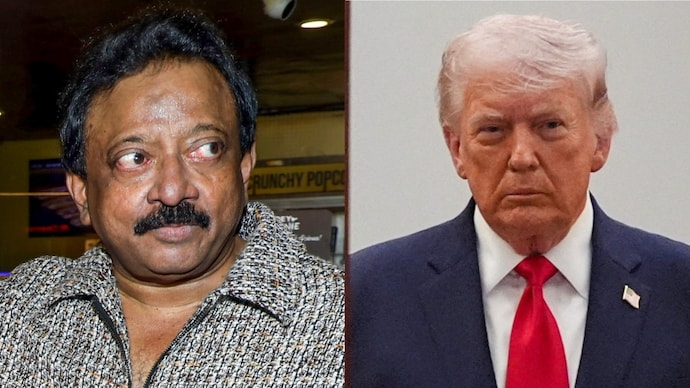
Filmmaker Ram Gopal Varma took a break from praising Dhurandhar: The Revenge, and expressed his take on geopolitics - this time on US President Donald Trump and his shifting rhetoric around the ongoing tensions involving Iran and the strategic Strait of Hormuz. In a series of sharp observations, Varma questioned whether Trump's rapid-fire statements are driven less by human counsel and more by something far more unconventional: artificial intelligence.
The director's post came as Trump warned of destroying all of Iran's power plants if its leadership fails to reopen the Strait of Hormuz by Tuesday evening, sharply escalating pressure on Tehran.
A pattern of contradictions?
In his long X post on Monday morning, Varma pointed to what he described as a puzzling pattern in Trump's public remarks: "One moment he shouts: 'Major combat operations over' to say later: 'A short term excursion' nearing completion."
"Then threatens to bomb power plants and bridges - 'Will throw Iran back to the Stone Ages’ if the Strait of Hormuz isn't opened immediately followed by sudden turnaround as to ‘productive negotiations,’ and then he claims that ‘regime change’ has already happened.”
These seemingly conflicting statements, Varma argued, raise a strong question: how can a leader move between escalation and de-escalation so rapidly?
Is AI shaping decisions?
Building on this, Varma floated a striking theory - that Trump's decisions may resemble outputs generated by AI systems rather than traditional policymaking processes.
RGV wrote, "What kind of actionable human intelligence or advisor consensus could flood the Oval Office every few hours to justify these constant contradictions?"
He contrasted the pace of conventional governance - briefings, cabinet discussions, intelligence reports - with the speed of artificial intelligence, which can process vast streams of data in real time.
RGV added, "Traditional briefings move at human speed. But AI can devour live data streams and spit out thousands of branching ‘what if’ scenarios."
According to Varma, such a system could generate rapid, calculated shifts in tone - balancing aggression with negotiation, and rhetoric with restraint: "The pattern isn't chaotic human whim but an algorithmic optimisation chasing short-term wins."
Ongoing geopolitical tensions
Tensions around the Strait of Hormuz - through which a significant portion of the world's oil supply passes - often trigger global concern. Any threat to block or militarise the route can impact oil prices, international alliances, and regional stability. Statements from a US president, therefore, carry enormous weight, influencing not just diplomacy but markets and security calculations worldwide.
A sharp personal critique
Varma's argument delivered a blunt personal critique of Trump's ability to process sensitive issues: "Even if AI is smart if the user is as dumb as Trump, then he will be spoiled for choice Listening to a smart entity doesn’t mean a thing if you do not have a brain to process it."
He suggested that the sheer volume of options generated by AI could overwhelm rather than assist, especially if not filtered through careful judgment.
RGV further moved from geopolitics to cultural reflection, questioning the impact of leadership behaviour on public norms: "If the PRESIDENT OF UNITED STATES OF AMERICA screams ‘Open the F*ING Strait You crazy BASTARDS!’ I am really keen to see how parents and teachers will explain that to their children."
The filmmaker underscored what he sees as a contradiction between the values societies try to instil, and the example set by those in power.
Trump's warning to Iran:
On Sunday, President Trump delivered a warning unlike any other in recent US-Iran tensions: a blunt, chilling ultimatum. "There is a good chance, but if they don’t make a deal, I am blowing up everything over there," he told Axios.
The threat comes as the US and Iran engage in indirect talks through Pakistan, Egypt, and Turkey. The goals are a ceasefire and a reopening of the Strait of Hormuz.
Ahead of his Tuesday deadline, Trump did not mince words. He warned that Iranian infrastructure, including power plants and bridges, could be targeted. "Tuesday will be Power Plant Day, and Bridge Day, all wrapped up in one, in Iran. There will be nothing like it!!! Open the F***kin’ Strait, you crazy bastards, or you’ll be living in Hell – JUST WATCH! Praise be to Allah," he wrote on Truth Social.
Filmmaker Ram Gopal Varma took a break from praising Dhurandhar: The Revenge, and expressed his take on geopolitics - this time on US President Donald Trump and his shifting rhetoric around the ongoing tensions involving Iran and the strategic Strait of Hormuz. In a series of sharp observations, Varma questioned whether Trump's rapid-fire statements are driven less by human counsel and more by something far more unconventional: artificial intelligence.
The director's post came as Trump warned of destroying all of Iran's power plants if its leadership fails to reopen the Strait of Hormuz by Tuesday evening, sharply escalating pressure on Tehran.
A pattern of contradictions?
In his long X post on Monday morning, Varma pointed to what he described as a puzzling pattern in Trump's public remarks: "One moment he shouts: 'Major combat operations over' to say later: 'A short term excursion' nearing completion."
"Then threatens to bomb power plants and bridges - 'Will throw Iran back to the Stone Ages’ if the Strait of Hormuz isn't opened immediately followed by sudden turnaround as to ‘productive negotiations,’ and then he claims that ‘regime change’ has already happened.”
These seemingly conflicting statements, Varma argued, raise a strong question: how can a leader move between escalation and de-escalation so rapidly?
Is AI shaping decisions?
Building on this, Varma floated a striking theory - that Trump's decisions may resemble outputs generated by AI systems rather than traditional policymaking processes.
RGV wrote, "What kind of actionable human intelligence or advisor consensus could flood the Oval Office every few hours to justify these constant contradictions?"
He contrasted the pace of conventional governance - briefings, cabinet discussions, intelligence reports - with the speed of artificial intelligence, which can process vast streams of data in real time.
RGV added, "Traditional briefings move at human speed. But AI can devour live data streams and spit out thousands of branching ‘what if’ scenarios."
According to Varma, such a system could generate rapid, calculated shifts in tone - balancing aggression with negotiation, and rhetoric with restraint: "The pattern isn't chaotic human whim but an algorithmic optimisation chasing short-term wins."
Ongoing geopolitical tensions
Tensions around the Strait of Hormuz - through which a significant portion of the world's oil supply passes - often trigger global concern. Any threat to block or militarise the route can impact oil prices, international alliances, and regional stability. Statements from a US president, therefore, carry enormous weight, influencing not just diplomacy but markets and security calculations worldwide.
A sharp personal critique
Varma's argument delivered a blunt personal critique of Trump's ability to process sensitive issues: "Even if AI is smart if the user is as dumb as Trump, then he will be spoiled for choice Listening to a smart entity doesn’t mean a thing if you do not have a brain to process it."
He suggested that the sheer volume of options generated by AI could overwhelm rather than assist, especially if not filtered through careful judgment.
RGV further moved from geopolitics to cultural reflection, questioning the impact of leadership behaviour on public norms: "If the PRESIDENT OF UNITED STATES OF AMERICA screams ‘Open the F*ING Strait You crazy BASTARDS!’ I am really keen to see how parents and teachers will explain that to their children."
The filmmaker underscored what he sees as a contradiction between the values societies try to instil, and the example set by those in power.
Trump's warning to Iran:
On Sunday, President Trump delivered a warning unlike any other in recent US-Iran tensions: a blunt, chilling ultimatum. "There is a good chance, but if they don’t make a deal, I am blowing up everything over there," he told Axios.
The threat comes as the US and Iran engage in indirect talks through Pakistan, Egypt, and Turkey. The goals are a ceasefire and a reopening of the Strait of Hormuz.
Ahead of his Tuesday deadline, Trump did not mince words. He warned that Iranian infrastructure, including power plants and bridges, could be targeted. "Tuesday will be Power Plant Day, and Bridge Day, all wrapped up in one, in Iran. There will be nothing like it!!! Open the F***kin’ Strait, you crazy bastards, or you’ll be living in Hell – JUST WATCH! Praise be to Allah," he wrote on Truth Social.

