Mortal Kombat II review: Karl Urban's arcade bloodbath is dumb fun done right
Mortal Kombat II The film brings Earthrealm into the long-delayed tournament against Shao Kahn's forces. Leaning fully into camp and carnage, Karl Urban's arcade bloodbath is dumb fun done right. Here is our review.
There are films that aspire to attain prestige, and then there are Mortal Kombat films, where a man can get punched through a portal, sliced in half, set on fire and still somehow find time for a one-liner. Mortal Kombat II understands exactly what franchise it belongs to. Mercifully, it does not pretend otherwise.
Director Simon McQuoid’s sequel arrives louder, bloodier and far more self-aware than the 2021 reboot. This time, the film finally delivers what the previous instalment oddly delayed: the actual tournament. The result is a chaotic, occasionally exhausting, but undeniably entertaining spectacle that treats absurdity not as a flaw, but as its entire personality.
Set after the events of the first film, Mortal Kombat II throws Earthrealm into direct conflict with Shao Kahn’s (Martyn Ford) expanding Outworld forces. Familiar faces return – Liu Kang (Ludi Lin), Sonya Blade (Jessica McNamee), Jax (Mehcad Brooks), Raiden (Tadanobu Asano) and Scorpion (Hiroyuki Sanada) - while the sequel introduces fan favourites like Kitana (Adeline Rudolph), Jade (Tati Gabrielle) and, most importantly, Johnny Cage, played by Karl Urban. The stakes, naturally, involve the fate of worlds. The solutions, equally naturally, involve breaking bones in increasingly imaginative ways.
The film’s biggest upgrade is tone. Mortal Kombat II finally embraces the campy excess that made the games iconic in the first place. There are gruesome fatalities, ridiculous dialogue, neon-drenched arenas and enough slow-motion carnage to satisfy fans who grew up memorising finishing moves instead of algebra formulas.
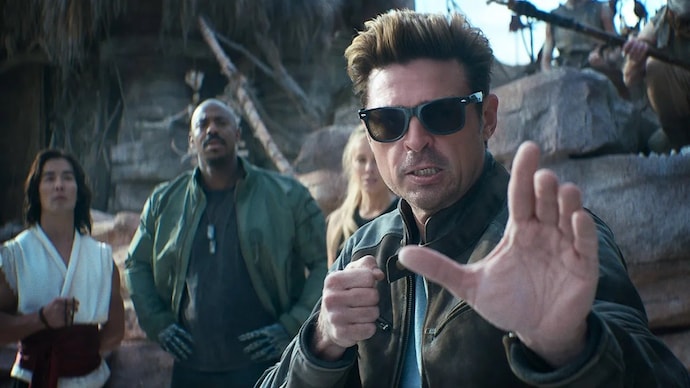
And right at the centre of this madness is Karl Urban, who walks into the film like he understands the assignment better than anyone else. His Johnny Cage is washed-up, vain, unserious and deeply entertaining. Urban plays him with the perfect balance of parody and sincerity, never trying too hard to make him cool. The performance works because Cage himself knows he is ridiculous. In a film full of grim-faced warriors discussing destiny, Urban’s self-aware chaos becomes oddly refreshing.
Adeline Rudolph’s Kitana also leaves a strong impression. The film gives her more emotional weight than characters in this franchise usually receive, and Rudolph manages to ground the fantasy chaos with genuine conviction. Jessica McNamee continues to bring sharpness to Sonya Blade, while Hiroyuki Sanada’s Scorpion once again proves that screen presence can often do more than dialogue.
Visually, the sequel is a major improvement over its predecessor. The arenas feel larger, stranger and more alive, almost as if the filmmakers have finally stopped being embarrassed by the video-game origins. The action choreography is slick, brutal and often delightfully insane. One portal fight sequence, in particular, feels ripped straight out of an arcade fever dream in the best possible way.
Where the film works best is in its complete commitment to spectacle. Mortal Kombat was never built on subtlety. This is a universe where people freeze opponents, tear out spines and return from death with minimal explanation. The sequel wisely stops overexplaining and simply starts having fun.
But the film also suffers from the same problem that plagues many video-game adaptations: the story mostly exists to transport characters from one fight scene to another. The emotional arcs are thin, the dialogue swings wildly between intentionally cheesy and accidentally clunky, and several characters feel less like people and more like selectable avatars waiting on a gaming screen.
The pacing becomes uneven in the second half as well. Once the novelty of the violence settles in, the film occasionally starts resembling a very expensive compilation of boss battles. Some emotional beats arrive abruptly, while others disappear before they can properly land. The film wants you to care about sacrifice and destiny, but its real interest clearly lies in creatively destroying bodies.
Still, there is something almost admirable about Mortal Kombat II’s commitment to excess. It does not chase sophistication. It chases entertainment. And for the most part, it succeeds.
This is not high art, nor does it aspire to be. But as a gloriously chaotic midnight-movie experience filled with flying limbs, campy energy and unapologetic arcade madness, Mortal Kombat II delivers enough fun to earn its “Flawless Victory” moment, even if the film itself is far from flawless.
Mortal Kombat II theatrically released in India on May 8. The film was earlier scheduled to release on October 24.
There are films that aspire to attain prestige, and then there are Mortal Kombat films, where a man can get punched through a portal, sliced in half, set on fire and still somehow find time for a one-liner. Mortal Kombat II understands exactly what franchise it belongs to. Mercifully, it does not pretend otherwise.
Director Simon McQuoid’s sequel arrives louder, bloodier and far more self-aware than the 2021 reboot. This time, the film finally delivers what the previous instalment oddly delayed: the actual tournament. The result is a chaotic, occasionally exhausting, but undeniably entertaining spectacle that treats absurdity not as a flaw, but as its entire personality.
Set after the events of the first film, Mortal Kombat II throws Earthrealm into direct conflict with Shao Kahn’s (Martyn Ford) expanding Outworld forces. Familiar faces return – Liu Kang (Ludi Lin), Sonya Blade (Jessica McNamee), Jax (Mehcad Brooks), Raiden (Tadanobu Asano) and Scorpion (Hiroyuki Sanada) - while the sequel introduces fan favourites like Kitana (Adeline Rudolph), Jade (Tati Gabrielle) and, most importantly, Johnny Cage, played by Karl Urban. The stakes, naturally, involve the fate of worlds. The solutions, equally naturally, involve breaking bones in increasingly imaginative ways.
The film’s biggest upgrade is tone. Mortal Kombat II finally embraces the campy excess that made the games iconic in the first place. There are gruesome fatalities, ridiculous dialogue, neon-drenched arenas and enough slow-motion carnage to satisfy fans who grew up memorising finishing moves instead of algebra formulas.
And right at the centre of this madness is Karl Urban, who walks into the film like he understands the assignment better than anyone else. His Johnny Cage is washed-up, vain, unserious and deeply entertaining. Urban plays him with the perfect balance of parody and sincerity, never trying too hard to make him cool. The performance works because Cage himself knows he is ridiculous. In a film full of grim-faced warriors discussing destiny, Urban’s self-aware chaos becomes oddly refreshing.
Adeline Rudolph’s Kitana also leaves a strong impression. The film gives her more emotional weight than characters in this franchise usually receive, and Rudolph manages to ground the fantasy chaos with genuine conviction. Jessica McNamee continues to bring sharpness to Sonya Blade, while Hiroyuki Sanada’s Scorpion once again proves that screen presence can often do more than dialogue.
Visually, the sequel is a major improvement over its predecessor. The arenas feel larger, stranger and more alive, almost as if the filmmakers have finally stopped being embarrassed by the video-game origins. The action choreography is slick, brutal and often delightfully insane. One portal fight sequence, in particular, feels ripped straight out of an arcade fever dream in the best possible way.
Where the film works best is in its complete commitment to spectacle. Mortal Kombat was never built on subtlety. This is a universe where people freeze opponents, tear out spines and return from death with minimal explanation. The sequel wisely stops overexplaining and simply starts having fun.
But the film also suffers from the same problem that plagues many video-game adaptations: the story mostly exists to transport characters from one fight scene to another. The emotional arcs are thin, the dialogue swings wildly between intentionally cheesy and accidentally clunky, and several characters feel less like people and more like selectable avatars waiting on a gaming screen.
The pacing becomes uneven in the second half as well. Once the novelty of the violence settles in, the film occasionally starts resembling a very expensive compilation of boss battles. Some emotional beats arrive abruptly, while others disappear before they can properly land. The film wants you to care about sacrifice and destiny, but its real interest clearly lies in creatively destroying bodies.
Still, there is something almost admirable about Mortal Kombat II’s commitment to excess. It does not chase sophistication. It chases entertainment. And for the most part, it succeeds.
This is not high art, nor does it aspire to be. But as a gloriously chaotic midnight-movie experience filled with flying limbs, campy energy and unapologetic arcade madness, Mortal Kombat II delivers enough fun to earn its “Flawless Victory” moment, even if the film itself is far from flawless.
Mortal Kombat II theatrically released in India on May 8. The film was earlier scheduled to release on October 24.

