Isro reveals Gaganyaan astronaut training details: What's ready, what's pending
Isro has outlined how Gaganyatris are being trained through mock-ups and virtual reality simulations for Gaganyaan. The update also shows wider mission readiness work across control, communication and tracking systems.
India’s human spaceflight ambitions are gathering pace as the Indian Space Research Organisation (Isro) has revealed key details of astronaut training and mission readiness for its maiden Gaganyaan mission.
The updates, published in the agency’s latest annual report, offer the clearest picture yet of how India is preparing its first astronauts, known as Gaganyatris, for a journey into space.
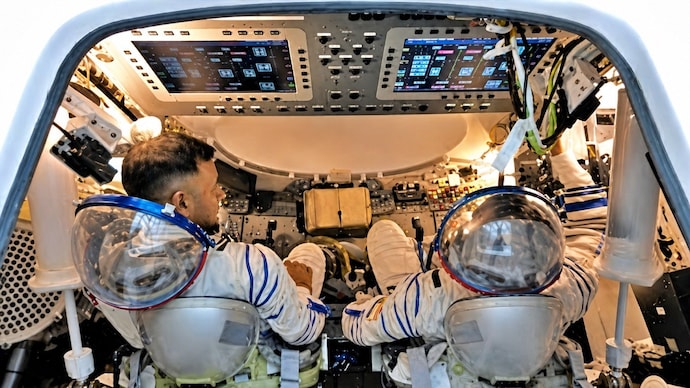
A major highlight is the extensive use of a Static Mock-up Simulator, a life-sized replica of the crew module designed to familiarise astronauts with real mission conditions.
Training sessions in the simulator have been conducted for durations of 2, 6, 10, and up to 18 hours. These trials assess critical parameters such as crew reachability, onboard audio-visual communication, emergency exit procedures, and responses to off-nominal, or unexpected, mission scenarios.
The simulator also allows astronauts to become comfortable with display systems and the confined environment of the crew module.
Habitability trials are a key component, ensuring that astronauts can function efficiently in tight quarters for extended periods, a crucial requirement for spaceflight.
Complementing the physical simulator is an upgraded Virtual Reality (VR) Training Simulator. This immersive system replicates mission scenarios digitally, allowing Gaganyatris to practise operations, navigation, and emergency handling in a controlled yet realistic environment.
The VR upgrade enhances situational awareness and reduces reliance on physical simulations alone.
MISSION CONTROL TRAINING UNDERWAY
Isro has also established a dedicated Mission Control Training Room to prepare ground personnel who will support the mission.
This facility enables coordinated training between astronauts and mission control teams, ensuring seamless communication during flight operations.
Beyond crew training, Isro has made significant progress in strengthening its communication and tracking infrastructure. The agency has operationalised the Amazon Web Services (AWS) network, which has already been validated during the SPADEX mission.
Communication systems were further tested through collaboration with the European Space Agency, including Radio Frequency Compatibility Tests and end-to-end checks for audio and video data transmission at a ground station in Germany.
India’s own infrastructure has also been expanded. Feeder stations under the IDRSS-1 network have been set up at ISTRAC in Bengaluru and SHAR.
Data transmission using GSAT satellites has been successfully demonstrated, while terrestrial communication links now connect the Indian Naval Station, SHAR, and mission control centres in Bengaluru and Delhi.
International partnerships are playing a key role as well. Isro has signed a contract with the Swedish Space Corporation for ground station support and has established a new terminal in Australia’s Cocos (Keeling) Islands to enhance global tracking coverage.
While Isro is preparing for the crewed mission, which is already delayed and is unlikely to launch by 2028, the Indian space agency is yet to provide a launch date for the maiden uncrewed mission, which is likely to lift off in 2026.
India’s human spaceflight ambitions are gathering pace as the Indian Space Research Organisation (Isro) has revealed key details of astronaut training and mission readiness for its maiden Gaganyaan mission.
The updates, published in the agency’s latest annual report, offer the clearest picture yet of how India is preparing its first astronauts, known as Gaganyatris, for a journey into space.
A major highlight is the extensive use of a Static Mock-up Simulator, a life-sized replica of the crew module designed to familiarise astronauts with real mission conditions.
Training sessions in the simulator have been conducted for durations of 2, 6, 10, and up to 18 hours. These trials assess critical parameters such as crew reachability, onboard audio-visual communication, emergency exit procedures, and responses to off-nominal, or unexpected, mission scenarios.
The simulator also allows astronauts to become comfortable with display systems and the confined environment of the crew module.
Habitability trials are a key component, ensuring that astronauts can function efficiently in tight quarters for extended periods, a crucial requirement for spaceflight.
Complementing the physical simulator is an upgraded Virtual Reality (VR) Training Simulator. This immersive system replicates mission scenarios digitally, allowing Gaganyatris to practise operations, navigation, and emergency handling in a controlled yet realistic environment.
The VR upgrade enhances situational awareness and reduces reliance on physical simulations alone.
MISSION CONTROL TRAINING UNDERWAY
Isro has also established a dedicated Mission Control Training Room to prepare ground personnel who will support the mission.
This facility enables coordinated training between astronauts and mission control teams, ensuring seamless communication during flight operations.
Beyond crew training, Isro has made significant progress in strengthening its communication and tracking infrastructure. The agency has operationalised the Amazon Web Services (AWS) network, which has already been validated during the SPADEX mission.
Communication systems were further tested through collaboration with the European Space Agency, including Radio Frequency Compatibility Tests and end-to-end checks for audio and video data transmission at a ground station in Germany.
India’s own infrastructure has also been expanded. Feeder stations under the IDRSS-1 network have been set up at ISTRAC in Bengaluru and SHAR.
Data transmission using GSAT satellites has been successfully demonstrated, while terrestrial communication links now connect the Indian Naval Station, SHAR, and mission control centres in Bengaluru and Delhi.
International partnerships are playing a key role as well. Isro has signed a contract with the Swedish Space Corporation for ground station support and has established a new terminal in Australia’s Cocos (Keeling) Islands to enhance global tracking coverage.
While Isro is preparing for the crewed mission, which is already delayed and is unlikely to launch by 2028, the Indian space agency is yet to provide a launch date for the maiden uncrewed mission, which is likely to lift off in 2026.

