Ahmedabad-based Aaka Space builds Asia's first 3D-printed shield for houses on Mars
The successful test highlights India's growing capabilities in space architecture, materials science, and robotics.
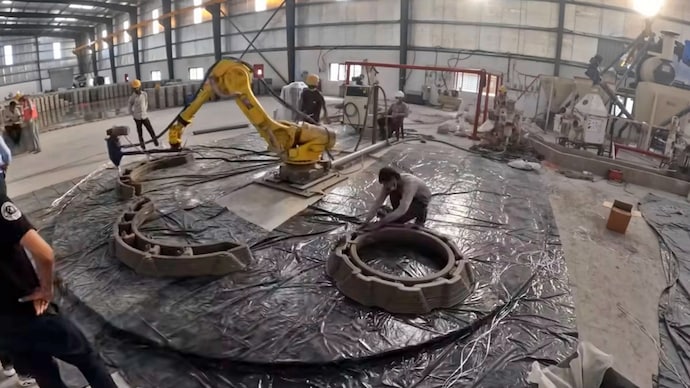
In a significant leap for India’s space technology ecosystem, Ahmedabad-based AAKA Space Studio has developed and tested Asia’s first 3D-printed Mars radiation shield, marking a breakthrough in sustainable extraterrestrial construction.
Radiation shielding is one of the most critical requirements for any Mars habitat because the Red Planet offers almost no natural protection from harmful space radiation.
The innovation was recently demonstrated during one of the world’s largest analog space missions, showcasing how future habitats on Mars and the Moon could be built using locally available materials rather than relying on costly payloads from Earth.
At the core of this advancement lies the concept of In-Situ Resource Utilisation (ISRU), which focusses on using materials already present on celestial bodies.
Mars, for instance, is rich in construction-grade resources such as olivine-rich basalt and carbonate deposits. AAKA has replicated these conditions on Earth by developing high-fidelity Martian soil analogues.
The team sourced olivine-rich materials from ultramafic complexes in Salem, Tamil Nadu, and combined them with marly limestone analogues from the Ariyalur basin.
These were paired with specially engineered lime-based binders designed to mimic the behaviour of cement on Mars.
Working in collaboration with MiCoB and its advanced MiCO-V 3D concrete printing systems, along with Government Arts College, AAKA successfully integrated these materials into robotic and gantry-based 3D printing processes.
This enabled the creation of regolith-based structures through autonomous, layer-by-layer construction. The result is a monolithic radiation shield capable of protecting astronauts from harmful cosmic radiation while also offering thermal stability—two critical requirements for long-term habitation on Mars.
Experts say such technology could drastically reduce dependence on Earth-supplied materials, significantly cutting mission costs and payload requirements. It also opens the door for scalable habitat construction on other planetary surfaces, a key challenge for future deep space missions.
The successful test highlights India’s growing capabilities in space architecture, materials science, and robotics.
By combining indigenous resources with advanced manufacturing techniques, AAKA Space is helping position the country as a serious contributor to global efforts aimed at human settlement beyond Earth.
As space agencies worldwide prepare for long-duration missions to the Moon and Mars, innovations like this could play a crucial role in turning the vision of extraterrestrial living into reality.
In a significant leap for India’s space technology ecosystem, Ahmedabad-based AAKA Space Studio has developed and tested Asia’s first 3D-printed Mars radiation shield, marking a breakthrough in sustainable extraterrestrial construction.
Radiation shielding is one of the most critical requirements for any Mars habitat because the Red Planet offers almost no natural protection from harmful space radiation.
The innovation was recently demonstrated during one of the world’s largest analog space missions, showcasing how future habitats on Mars and the Moon could be built using locally available materials rather than relying on costly payloads from Earth.
At the core of this advancement lies the concept of In-Situ Resource Utilisation (ISRU), which focusses on using materials already present on celestial bodies.
Mars, for instance, is rich in construction-grade resources such as olivine-rich basalt and carbonate deposits. AAKA has replicated these conditions on Earth by developing high-fidelity Martian soil analogues.
The team sourced olivine-rich materials from ultramafic complexes in Salem, Tamil Nadu, and combined them with marly limestone analogues from the Ariyalur basin.
These were paired with specially engineered lime-based binders designed to mimic the behaviour of cement on Mars.
Working in collaboration with MiCoB and its advanced MiCO-V 3D concrete printing systems, along with Government Arts College, AAKA successfully integrated these materials into robotic and gantry-based 3D printing processes.
This enabled the creation of regolith-based structures through autonomous, layer-by-layer construction. The result is a monolithic radiation shield capable of protecting astronauts from harmful cosmic radiation while also offering thermal stability—two critical requirements for long-term habitation on Mars.
Experts say such technology could drastically reduce dependence on Earth-supplied materials, significantly cutting mission costs and payload requirements. It also opens the door for scalable habitat construction on other planetary surfaces, a key challenge for future deep space missions.
The successful test highlights India’s growing capabilities in space architecture, materials science, and robotics.
By combining indigenous resources with advanced manufacturing techniques, AAKA Space is helping position the country as a serious contributor to global efforts aimed at human settlement beyond Earth.
As space agencies worldwide prepare for long-duration missions to the Moon and Mars, innovations like this could play a crucial role in turning the vision of extraterrestrial living into reality.

