Amur falcon begins 6,000-km-long flight back to India: Will it reach in six days?
The tiny raptor is expected to fly nearly 6,000 km almost non-stop towards the forests along the India-Myanmar border in Manipur.
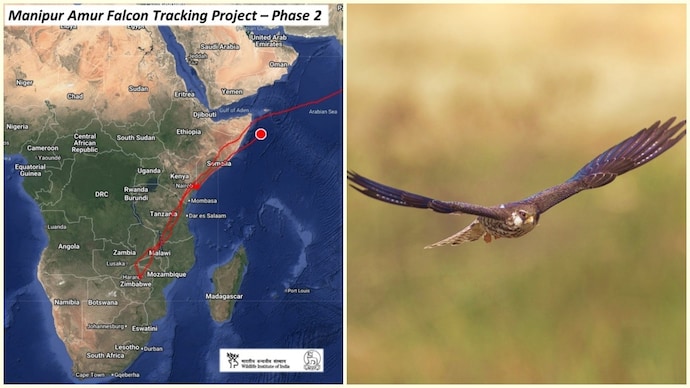
Apapang, one of three satellite-tagged Amur falcons, has begun his long journey back from Somalia, officials announced on May 1, 2026.
The tiny raptor is expected to fly nearly 6,000 km almost non-stop towards the forests along the India-Myanmar border in Manipur.
Supriya Sahu, Tamil Nadu’s Additional Chief Secretary for Environment, shared the update on social media platform X, using real-time data from the Manipur Amur Falcon Tracking Project Phase 2 led by the Wildlife Institute of India (WII).
“Mark it! Apapang has now begun his return flight from Somalia,” Sahu wrote. “This incredible tiny powerhouse of a bird is expected to undertake a near-continuous 6,000 km journey reaffirming the precision, endurance and ecological significance of one of the most extraordinary migratory routes.”
The news marks a thrilling new chapter in the birds’ round-trip adventure. Apapang, along with a young female named Alang, and an adult female named Ahu, had been wintering in southern Africa after an impressive southward journey.
AN INCREDIBLE MIGRATORY JOURNEY
The three falcons were tagged in November 2025 in Tamenglong district, Manipur as part of the WII project.
Weighing only about 150 grams each, they stunned scientists with their endurance and migratory and navigational skills.
Apapang and the others covered nearly 5,000 km from Manipur to Somalia in just five days, often flying up to 1,000 km per day. They later pushed even farther, logging around 6,000 km to reach wintering grounds in places like Zimbabwe, Botswana, and Kenya.
During their time in Africa, the trio rested and refuelled in savannas, before getting ready to head back home.
By early April 2026, Alang and Apapang had started moving northward from Botswana and Zimbabwe towards Somalia, while Ahu’s movements were also being monitored closely.
The birds often wait for favourable tailwinds before attempting the risky ocean crossing.
A CALL FOR CONSERVATION
Amur falcons breed in northeast Asia during summer and migrate thousands of kilometres to southern Africa for winter.
On both legs of the journey, huge flocks traditionally stop over in the hills of Nagaland and Manipur to feast on insects, especially termites, building up fat reserves for the long flights.
The WII project that is tracking the relentless birds is meant to help scientists understand how these small birds navigate using winds, weather cues, and remarkable internal compasses.
It also highlights critical stopover sites that need protection.
Owing to the community efforts in Manipur and Nagaland, hunting that once threatened the species has largely stopped and the local people now celebrate the falcons’ arrival as a sign of healthy ecosystems.
As Apapang pushes towards home, bird lovers and researchers are watching the satellite signals with hope.
His successful return, along with Alang and Ahu, will once again showcase one of nature’s greatest endurance stories and the power of conservation in northeast India.
Apapang, one of three satellite-tagged Amur falcons, has begun his long journey back from Somalia, officials announced on May 1, 2026.
The tiny raptor is expected to fly nearly 6,000 km almost non-stop towards the forests along the India-Myanmar border in Manipur.
Supriya Sahu, Tamil Nadu’s Additional Chief Secretary for Environment, shared the update on social media platform X, using real-time data from the Manipur Amur Falcon Tracking Project Phase 2 led by the Wildlife Institute of India (WII).
“Mark it! Apapang has now begun his return flight from Somalia,” Sahu wrote. “This incredible tiny powerhouse of a bird is expected to undertake a near-continuous 6,000 km journey reaffirming the precision, endurance and ecological significance of one of the most extraordinary migratory routes.”
The news marks a thrilling new chapter in the birds’ round-trip adventure. Apapang, along with a young female named Alang, and an adult female named Ahu, had been wintering in southern Africa after an impressive southward journey.
AN INCREDIBLE MIGRATORY JOURNEY
The three falcons were tagged in November 2025 in Tamenglong district, Manipur as part of the WII project.
Weighing only about 150 grams each, they stunned scientists with their endurance and migratory and navigational skills.
Apapang and the others covered nearly 5,000 km from Manipur to Somalia in just five days, often flying up to 1,000 km per day. They later pushed even farther, logging around 6,000 km to reach wintering grounds in places like Zimbabwe, Botswana, and Kenya.
During their time in Africa, the trio rested and refuelled in savannas, before getting ready to head back home.
By early April 2026, Alang and Apapang had started moving northward from Botswana and Zimbabwe towards Somalia, while Ahu’s movements were also being monitored closely.
The birds often wait for favourable tailwinds before attempting the risky ocean crossing.
A CALL FOR CONSERVATION
Amur falcons breed in northeast Asia during summer and migrate thousands of kilometres to southern Africa for winter.
On both legs of the journey, huge flocks traditionally stop over in the hills of Nagaland and Manipur to feast on insects, especially termites, building up fat reserves for the long flights.
The WII project that is tracking the relentless birds is meant to help scientists understand how these small birds navigate using winds, weather cues, and remarkable internal compasses.
It also highlights critical stopover sites that need protection.
Owing to the community efforts in Manipur and Nagaland, hunting that once threatened the species has largely stopped and the local people now celebrate the falcons’ arrival as a sign of healthy ecosystems.
As Apapang pushes towards home, bird lovers and researchers are watching the satellite signals with hope.
His successful return, along with Alang and Ahu, will once again showcase one of nature’s greatest endurance stories and the power of conservation in northeast India.

