5,000 km non-stop: Amur falcons begin daring return journey from Africa to India
Apapang, Alang, and Ahu, the three Amur Falcons that began their migratory journey from India, have completed their trip and are now heading back to India. Read about their journey and what's ahead.
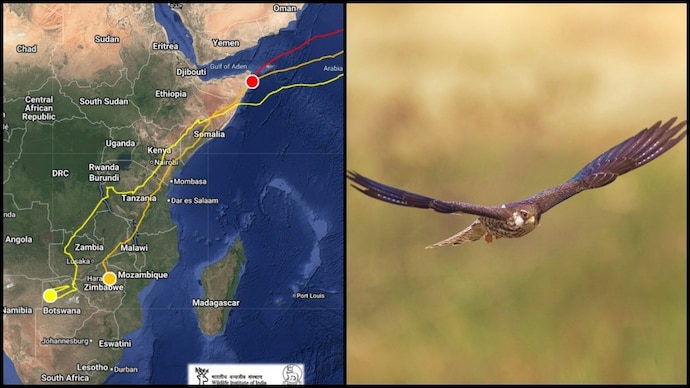
Three tiny Amur falcons named Apapang, Alang, and Ahu have started flying back towards India after spending the winter in Southern Africa.
The three birds are geotagged and are being tracked using satellites as they currently move north from the savannas of Botswana and Zimbabwe towards the coast of Somalia. From there, they will attempt a tough non-stop flight of about 3,000 kilometres across the Arabian Sea.
Supriya Sahu, Additional Chief Secretary, Environment Climate Change & Forests, Tamil Nadu, shared the latest update on social media along with a map from the Manipur Amur Falcon Tracking Project Phase 2 showing their positions as of early April 2026.
The birds are waiting for strong tailwinds to help them complete the dangerous sea crossing.
WHO ARE THE THREE AMUR FALCONS?
Amur falcons are small birds of prey. They are grey and white and weigh only about 150 grams.
The falcons breed in northeast Asia during summer and fly thousands of kilometres every year to spend winter in Southern Africa.
In autumn, large flocks stop in the hills of Nagaland and Manipur in northeast India to rest and eat insects.
In the past, Amur falcons had become endangered due to constant hunting. That was until communities in Manipur, coupled with efforts by the government and scientists, put a stop to it.
These three particular falcons have been tracked since November 2025 as part of a project by the Wildlife Institute of India (WII).
The Manipur Amur Falcon Tracking Project aims to learn more about these long-migratory journeys spanning continents.
In Phase 2 of the project, the three birds were gently caught and fitted with very light satellite tags in Tamenglong district of Manipur in November 2025. The tags send location signals without harming the birds.
And ever since, the journey of the trio has been widely documented.
HOW FAR HAVE AMUR FALCONS TRAVELLED?
In November 2025, the falcons flew up to 1,000 km a day and completed a nearly 5,000-km non-stop trip from Manipur to Somalia in just a 5 days. A month later, in December 2025, the birds flew a record 6,000-km to places like Zimbabwe and Kenya, marking one of the most incredible non-stop flights by any small bird.
The trio has since grabbed headlines for their persistence and navigation skills.
Out of the three, Apapang is an adult male, Alang is a young female, and Ahu is an adult female.
Now the seasons are changing, and the birds are heading back to their breeding grounds.
The Arabian Sea crossing is the riskiest part because they cannot land on water. They depend on good winds to fly for days without rest. They will have to navigate this extremely long flight without food or rest in order to complete their annual migratory trip.
The tracking project helps scientists understand how birds navigate long distances and handle weather changes. The information will also help protect important resting places along their route.
For now, many people are watching and hoping the winds stay favourable so Apapang, Alang, and Ahu can return safely to India. Their epic round trip shows the wonder of nature.
Three tiny Amur falcons named Apapang, Alang, and Ahu have started flying back towards India after spending the winter in Southern Africa.
The three birds are geotagged and are being tracked using satellites as they currently move north from the savannas of Botswana and Zimbabwe towards the coast of Somalia. From there, they will attempt a tough non-stop flight of about 3,000 kilometres across the Arabian Sea.
Supriya Sahu, Additional Chief Secretary, Environment Climate Change & Forests, Tamil Nadu, shared the latest update on social media along with a map from the Manipur Amur Falcon Tracking Project Phase 2 showing their positions as of early April 2026.
The birds are waiting for strong tailwinds to help them complete the dangerous sea crossing.
WHO ARE THE THREE AMUR FALCONS?
Amur falcons are small birds of prey. They are grey and white and weigh only about 150 grams.
The falcons breed in northeast Asia during summer and fly thousands of kilometres every year to spend winter in Southern Africa.
In autumn, large flocks stop in the hills of Nagaland and Manipur in northeast India to rest and eat insects.
In the past, Amur falcons had become endangered due to constant hunting. That was until communities in Manipur, coupled with efforts by the government and scientists, put a stop to it.
These three particular falcons have been tracked since November 2025 as part of a project by the Wildlife Institute of India (WII).
The Manipur Amur Falcon Tracking Project aims to learn more about these long-migratory journeys spanning continents.
In Phase 2 of the project, the three birds were gently caught and fitted with very light satellite tags in Tamenglong district of Manipur in November 2025. The tags send location signals without harming the birds.
And ever since, the journey of the trio has been widely documented.
HOW FAR HAVE AMUR FALCONS TRAVELLED?
In November 2025, the falcons flew up to 1,000 km a day and completed a nearly 5,000-km non-stop trip from Manipur to Somalia in just a 5 days. A month later, in December 2025, the birds flew a record 6,000-km to places like Zimbabwe and Kenya, marking one of the most incredible non-stop flights by any small bird.
The trio has since grabbed headlines for their persistence and navigation skills.
Out of the three, Apapang is an adult male, Alang is a young female, and Ahu is an adult female.
Now the seasons are changing, and the birds are heading back to their breeding grounds.
The Arabian Sea crossing is the riskiest part because they cannot land on water. They depend on good winds to fly for days without rest. They will have to navigate this extremely long flight without food or rest in order to complete their annual migratory trip.
The tracking project helps scientists understand how birds navigate long distances and handle weather changes. The information will also help protect important resting places along their route.
For now, many people are watching and hoping the winds stay favourable so Apapang, Alang, and Ahu can return safely to India. Their epic round trip shows the wonder of nature.

