Destination Moon: Nasa launches four astronauts on 1st lunar trip in over 50 years
Nasa's first crewed lunar voyage in over 50 years is commanded by Reid Wiseman, and carries a historic crew that includes the first woman, the first person of colour, and the first Canadian astronaut on a round trip to the far side of the Moon.
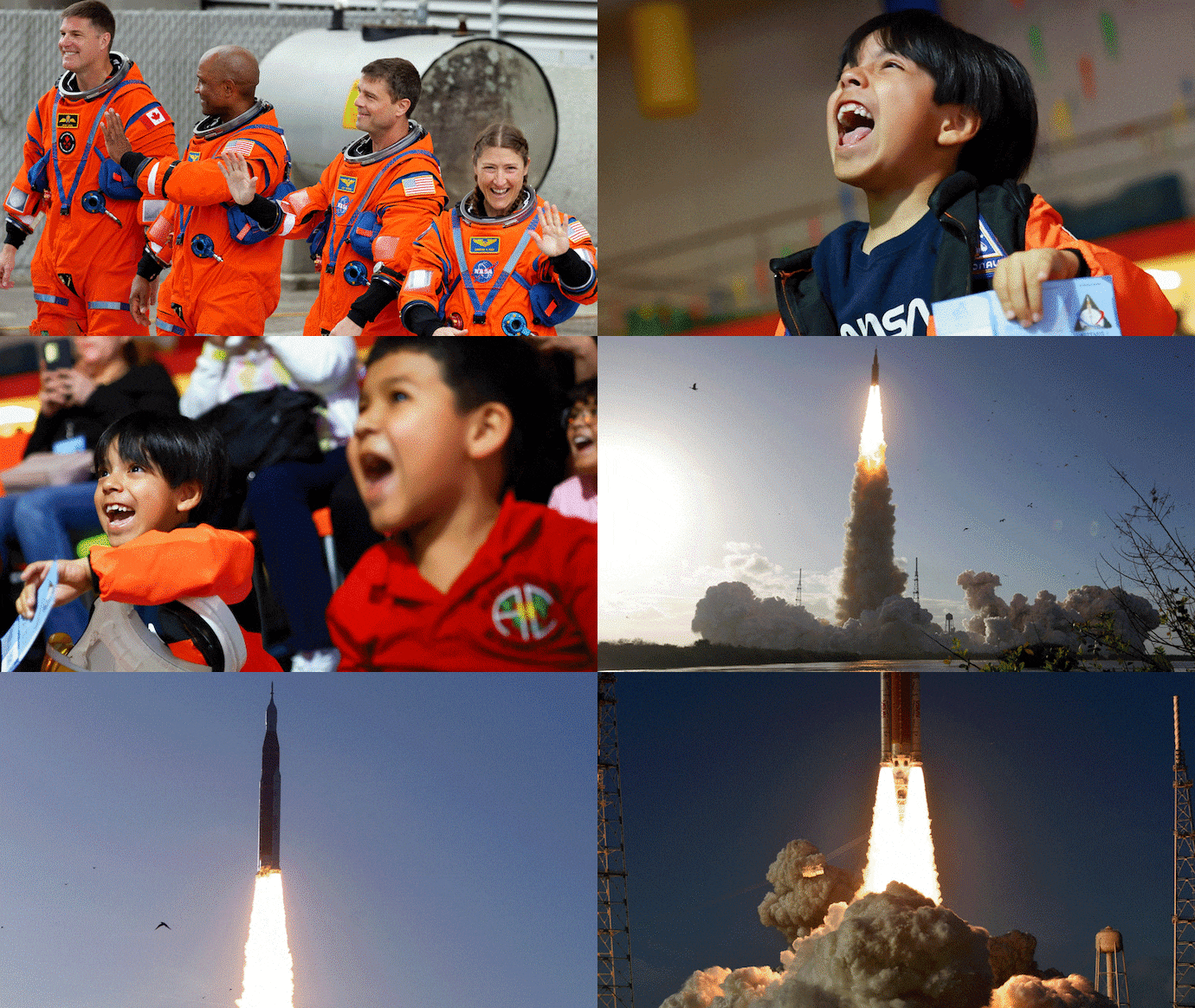
More than half a century after humans last journeyed to the Moon, four astronauts lifted off in the early hours of Thursday, marking a powerful return to deep space.
The Orion spacecraft, riding atop Nasa’s Space Launch System, thundered out of the Kennedy Space Centre in Florida.
Its destination: The Moon.
The Artemis-II mission, Nasa’s first crewed lunar voyage in over 50 years, is commanded by Reid Wiseman and carries a historic crew that includes the first woman, the first person of colour, and the first Canadian astronaut on a round trip to the far side of the Moon.
The launch follows a series of delays, including a last-minute rollback of the rocket and technical fixes to resolve issues such as helium leaks, highlighting the complexity of sending humans beyond Earth orbit once again.
PICTURE-PERFECT LAUNCH: WHAT’S NEXT?
The Space Launch System (SLS), among the most powerful rockets ever built, lifted off at 4:04 am IST from the iconic launch pad at Kennedy Space Centre, roaring into the sky with the four astronauts secured inside the Orion capsule.
The Orion capsule separated from the rocket nearly eight minutes after liftoff.
RIDE THE ARTEMIS-II MOON MISSION IMMERSIVE
On the first full day after the Artemis-II launch, the crew will remain in Earth orbit, focusing on critical system checks and preparations for the Moon-bound journey. The Orion spacecraft is in a multi-day orbit around Earth, allowing engineers and astronauts to verify that key systems, including propulsion, navigation, and life support, are functioning properly before committing to a lunar trajectory.
During this phase, mission controllers will wake the crew to perform a crucial perigee-raising burn using Orion’s service module engine, ensuring the spacecraft is on a safe path that still allows a return to Earth if necessary.
BUSY DAY 1 FOR ARTEMIS-II ASTRONAUTS
Inside the spacecraft, the astronauts transition out of their launch suits into regular clothing and begin setting up essential onboard systems such as the water supply, toilet, carbon dioxide removal, and fire safety equipment.
They will also reorganise the cabin into a functional living and working space for all four crew members, including preparing sleeping arrangements.
As part of their activities, the crew will conduct a brief proximity operations demonstration with the discarded upper stage to refine piloting skills needed for future missions.
Given Orion’s compact interior, the crew will sleep in two shorter shifts of about four hours each, allowing ground teams to continuously monitor spacecraft systems while ensuring the astronauts remain rested.
By the end of Flight Day 1, Orion will be in a stable orbit, with a key decision looming early on Flight Day 2, whether to proceed with the trans-lunar injection burn that will send Artemis-II on its path toward the Moon.
WHEN WILL THEY REACH THE MOON?
Artemis-II is expected to reach the Moon roughly four days after launch. The Orion is taking a unique route to the Moon that forms a figure 8 loop in space.
Following the crucial trans-lunar injection (TLI) burn on Flight Day 2, the Orion spacecraft will leave Earth orbit and begin its journey through deep space toward the Moon on a free-return trajectory.
During this four-day transit, the crew will remain actively engaged in monitoring Orion’s critical systems, ensuring that propulsion, navigation, and life-support functions continue to perform as expected in the deep space environment.
The astronauts will also collect valuable data on how the human body responds to conditions beyond low Earth orbit, insights that are essential for planning longer missions to the Moon and eventually Mars.
Along the way, the spacecraft may perform small trajectory correction burns to fine-tune its path and ensure precise navigation toward the Moon.
By the time Artemis-II approaches lunar vicinity, it will set up for a flyby rather than entering orbit, using the Moon’s gravity to slingshot back toward Earth for its return journey.
BREAKING RECORDS AND STEREOTYPES
Artemis-II launch is not just a technological milestone, it’s also redefining who gets to explore deep space.
For the first time in history, a lunar mission crew includes a woman, a person of colour, and an astronaut who is not from Nasa, marking a powerful shift from the traditionally exclusive image of space exploration.
While US President Donald Trump pushed for shutting down inclusive initiatives at Nasa, the American space agency has sent not just a diverse crew, but one that's all about inclusion. During the Apollo missions of the 1960s and 70s, astronauts were exclusively white American men, largely military test pilots. Artemis-II challenges that legacy.
By assembling a more diverse crew, Nasa is sending a clear message that space exploration is no longer limited by gender, race, or nationality. It's for everyone.
Astronaut Christina Koch will become the first woman to travel to the Moon, breaking a barrier that persisted through the entire Apollo era.
Astronautb Victor Glover, who is piloting the mission, will be the first person of colour to go to the Moon, expanding representation in human spaceflight.
Jeremy Hansen, from the Canadian Space Agency, will be the first non-Nasa astronaut on a lunar mission, highlighting global collaboration.
Reid Wiseman, commanding the mission, brings experience and leadership to this historic crew.
WHY IS ARTEMIS-II MISSION CRITICAL FOR NASA AND BEYOND?
The Artemis-II mission is far more than just a return trip to the Moon, it is a stepping stone for Nasa’s long-term ambitions in deep space. This will be the first crewed lunar mission since 1972, and its success will shape not only future Artemis missions but also humanity’s path toward Mars.
Artemis-II is the first real test of sending astronauts beyond low Earth orbit in over five decades.
Unlike missions to the International Space Station, this journey exposes the crew to deep space radiation, longer isolation, and greater communication delays.
Nasa needs to validate that the Orion spacecraft’s life-support, navigation, and safety systems can handle these conditions before committing astronauts to a lunar landing mission.
More than half a century after humans last journeyed to the Moon, four astronauts lifted off in the early hours of Thursday, marking a powerful return to deep space.
The Orion spacecraft, riding atop Nasa’s Space Launch System, thundered out of the Kennedy Space Centre in Florida.
Its destination: The Moon.
The Artemis-II mission, Nasa’s first crewed lunar voyage in over 50 years, is commanded by Reid Wiseman and carries a historic crew that includes the first woman, the first person of colour, and the first Canadian astronaut on a round trip to the far side of the Moon.
The launch follows a series of delays, including a last-minute rollback of the rocket and technical fixes to resolve issues such as helium leaks, highlighting the complexity of sending humans beyond Earth orbit once again.
PICTURE-PERFECT LAUNCH: WHAT’S NEXT?
The Space Launch System (SLS), among the most powerful rockets ever built, lifted off at 4:04 am IST from the iconic launch pad at Kennedy Space Centre, roaring into the sky with the four astronauts secured inside the Orion capsule.
The Orion capsule separated from the rocket nearly eight minutes after liftoff.
RIDE THE ARTEMIS-II MOON MISSION IMMERSIVE
On the first full day after the Artemis-II launch, the crew will remain in Earth orbit, focusing on critical system checks and preparations for the Moon-bound journey. The Orion spacecraft is in a multi-day orbit around Earth, allowing engineers and astronauts to verify that key systems, including propulsion, navigation, and life support, are functioning properly before committing to a lunar trajectory.
During this phase, mission controllers will wake the crew to perform a crucial perigee-raising burn using Orion’s service module engine, ensuring the spacecraft is on a safe path that still allows a return to Earth if necessary.
BUSY DAY 1 FOR ARTEMIS-II ASTRONAUTS
Inside the spacecraft, the astronauts transition out of their launch suits into regular clothing and begin setting up essential onboard systems such as the water supply, toilet, carbon dioxide removal, and fire safety equipment.
They will also reorganise the cabin into a functional living and working space for all four crew members, including preparing sleeping arrangements.
As part of their activities, the crew will conduct a brief proximity operations demonstration with the discarded upper stage to refine piloting skills needed for future missions.
Given Orion’s compact interior, the crew will sleep in two shorter shifts of about four hours each, allowing ground teams to continuously monitor spacecraft systems while ensuring the astronauts remain rested.
By the end of Flight Day 1, Orion will be in a stable orbit, with a key decision looming early on Flight Day 2, whether to proceed with the trans-lunar injection burn that will send Artemis-II on its path toward the Moon.
WHEN WILL THEY REACH THE MOON?
Artemis-II is expected to reach the Moon roughly four days after launch. The Orion is taking a unique route to the Moon that forms a figure 8 loop in space.
Following the crucial trans-lunar injection (TLI) burn on Flight Day 2, the Orion spacecraft will leave Earth orbit and begin its journey through deep space toward the Moon on a free-return trajectory.
During this four-day transit, the crew will remain actively engaged in monitoring Orion’s critical systems, ensuring that propulsion, navigation, and life-support functions continue to perform as expected in the deep space environment.
The astronauts will also collect valuable data on how the human body responds to conditions beyond low Earth orbit, insights that are essential for planning longer missions to the Moon and eventually Mars.
Along the way, the spacecraft may perform small trajectory correction burns to fine-tune its path and ensure precise navigation toward the Moon.
By the time Artemis-II approaches lunar vicinity, it will set up for a flyby rather than entering orbit, using the Moon’s gravity to slingshot back toward Earth for its return journey.
BREAKING RECORDS AND STEREOTYPES
Artemis-II launch is not just a technological milestone, it’s also redefining who gets to explore deep space.
For the first time in history, a lunar mission crew includes a woman, a person of colour, and an astronaut who is not from Nasa, marking a powerful shift from the traditionally exclusive image of space exploration.
While US President Donald Trump pushed for shutting down inclusive initiatives at Nasa, the American space agency has sent not just a diverse crew, but one that's all about inclusion. During the Apollo missions of the 1960s and 70s, astronauts were exclusively white American men, largely military test pilots. Artemis-II challenges that legacy.
By assembling a more diverse crew, Nasa is sending a clear message that space exploration is no longer limited by gender, race, or nationality. It's for everyone.
Astronaut Christina Koch will become the first woman to travel to the Moon, breaking a barrier that persisted through the entire Apollo era.
Astronautb Victor Glover, who is piloting the mission, will be the first person of colour to go to the Moon, expanding representation in human spaceflight.
Jeremy Hansen, from the Canadian Space Agency, will be the first non-Nasa astronaut on a lunar mission, highlighting global collaboration.
Reid Wiseman, commanding the mission, brings experience and leadership to this historic crew.
WHY IS ARTEMIS-II MISSION CRITICAL FOR NASA AND BEYOND?
The Artemis-II mission is far more than just a return trip to the Moon, it is a stepping stone for Nasa’s long-term ambitions in deep space. This will be the first crewed lunar mission since 1972, and its success will shape not only future Artemis missions but also humanity’s path toward Mars.
Artemis-II is the first real test of sending astronauts beyond low Earth orbit in over five decades.
Unlike missions to the International Space Station, this journey exposes the crew to deep space radiation, longer isolation, and greater communication delays.
Nasa needs to validate that the Orion spacecraft’s life-support, navigation, and safety systems can handle these conditions before committing astronauts to a lunar landing mission.

