This is what humans have in common with dragonflies. Findings to unravel medicine
This breakthrough connects insect vision to human biology and could advance optogenetics, enabling new treatments using light to target cells deep within the body.
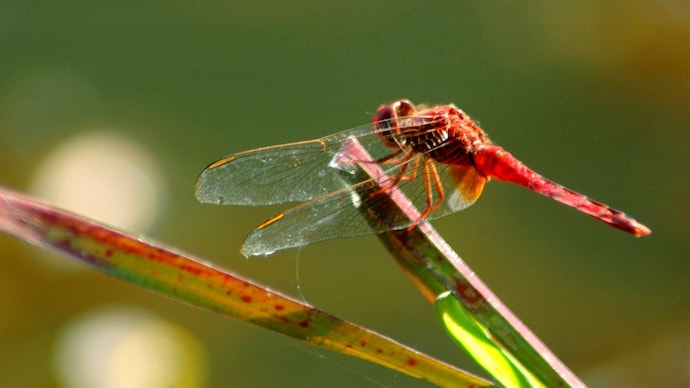
A surprising discovery about how dragonflies detect red light has revealed an unlikely link to human vision and could potentially open doors for next-generation medical treatments.
Scientists at Osaka Metropolitan University (OMU) in Japan have found that dragonflies and humans detect red light using the same biological mechanism, even though the two species last shared a common ancestor hundreds of millions of years ago.
The findings, published in Cellular and Molecular Life Sciences, could have real-world implications for medicine.
SAME EYES, DIFFERENT CREATURES
Like humans, dragonflies see colour through proteins in the eye called opsins. In people, three types of opsins handle blue, green, and red light. Dragonflies have unusually sharp red vision for insects, and OMU researchers found one of their opsins detects light at around 720 nanometres, which is beyond the deepest red that human eyes can register.
"This is one of the most red-sensitive visual pigments ever found," said Professor Akihisa Terakita. "Dragonflies can likely see deeper into red light than most insects."
The team also figured out why dragonflies evolved such powerful red vision. They concluded that the red vision helps them tell males from females during flight.
When the researchers measured how different wavelengths of light bounce off dragonfly bodies, they found notable differences between the sexes in the red and near-infrared range. In other words, this evolution could help males spot these wavelengths and quickly find a mate on the wing.
The bigger surprise was how dragonfly red opsins work.
Despite being worlds apart on the evolutionary tree, dragonflies and mammals use the identical molecular trick to detect red light.
"Surprisingly, the mechanism by which dragonfly red opsin detects red light is identical to that of red opsin in mammals, including humans. This is an unexpected result, suggesting that the same evolutionary process occurred independently in distantly related lineages," said graduate student Ryu Sato, the study's first author.
HOW CAN MEDICINE BENEFIT?
Beyond zoology, the discovery has potential medical uses.
The researchers identified a single key position in the dragonfly opsin protein that controls its light sensitivity. By tweaking it, they pushed the protein's sensitivity even further into the near-infrared range, and showed it could trigger a response in living cells.
This matters for a field called optogenetics, where light-sensitive proteins are used to study and potentially treat diseases. Near-infrared light penetrates deeper into body tissue than regular red light, making it far more useful for reaching organs or nerves inside the body.
"These findings demonstrate this opsin as a promising optogenetic tool capable of detecting light even deep within living organisms," said Professor Mitsumasa Koyanagi.
A surprising discovery about how dragonflies detect red light has revealed an unlikely link to human vision and could potentially open doors for next-generation medical treatments.
Scientists at Osaka Metropolitan University (OMU) in Japan have found that dragonflies and humans detect red light using the same biological mechanism, even though the two species last shared a common ancestor hundreds of millions of years ago.
The findings, published in Cellular and Molecular Life Sciences, could have real-world implications for medicine.
SAME EYES, DIFFERENT CREATURES
Like humans, dragonflies see colour through proteins in the eye called opsins. In people, three types of opsins handle blue, green, and red light. Dragonflies have unusually sharp red vision for insects, and OMU researchers found one of their opsins detects light at around 720 nanometres, which is beyond the deepest red that human eyes can register.
"This is one of the most red-sensitive visual pigments ever found," said Professor Akihisa Terakita. "Dragonflies can likely see deeper into red light than most insects."
The team also figured out why dragonflies evolved such powerful red vision. They concluded that the red vision helps them tell males from females during flight.
When the researchers measured how different wavelengths of light bounce off dragonfly bodies, they found notable differences between the sexes in the red and near-infrared range. In other words, this evolution could help males spot these wavelengths and quickly find a mate on the wing.
The bigger surprise was how dragonfly red opsins work.
Despite being worlds apart on the evolutionary tree, dragonflies and mammals use the identical molecular trick to detect red light.
"Surprisingly, the mechanism by which dragonfly red opsin detects red light is identical to that of red opsin in mammals, including humans. This is an unexpected result, suggesting that the same evolutionary process occurred independently in distantly related lineages," said graduate student Ryu Sato, the study's first author.
HOW CAN MEDICINE BENEFIT?
Beyond zoology, the discovery has potential medical uses.
The researchers identified a single key position in the dragonfly opsin protein that controls its light sensitivity. By tweaking it, they pushed the protein's sensitivity even further into the near-infrared range, and showed it could trigger a response in living cells.
This matters for a field called optogenetics, where light-sensitive proteins are used to study and potentially treat diseases. Near-infrared light penetrates deeper into body tissue than regular red light, making it far more useful for reaching organs or nerves inside the body.
"These findings demonstrate this opsin as a promising optogenetic tool capable of detecting light even deep within living organisms," said Professor Mitsumasa Koyanagi.

