2,29,000 eggs on Tamil Nadu beaches: How many Olive Ridley turtles survived?
Olive Ridley turtles are remarkable travellers that travel thousands of kilometres across the ocean, returning precisely to the same beaches where they hatched years earlier.
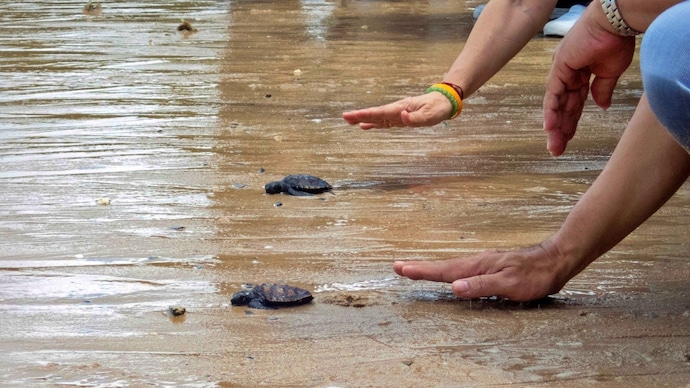
Tamil Nadu's coastline is buzzing with hope this year as thousands of tiny Olive Ridley sea turtles make their way into the ocean.
Thanks to dedicated teamwork and planning, the state has achieved impressive results in protecting these gentle creatures during the 2026 nesting season.
Here's how the Tamil Nadu did this season.
A STRONG SEASON
The latest update was by Supriya Sahu, Additional Chief Secretary for Environment, Climate Change and Forests in Tamil Nadu, highlighting real progress.
Forest teams and partners have recorded 1,985 turtle nests along the coast and have safely collected and protected around 2,29,000 eggs in hatcheries.
So far, 1,65,000 healthy hatchlings have been released into the sea, with many more expected in the coming weeks as the season continues.
Chennai's beaches led the way with 656 nests and over 74,000 eggs collected. Cuddalore district stood out for hatchling releases, sending more than 48,000 babies into the waves already.
These figures highlight the massive scale of the effort across multiple coastal districts.
HOPE RENEWED
One of the biggest wins this year was a sharp drop in turtle deaths.
Mortality has been cut nearly in half, from 1,572 deaths reported last year to just 784 this season. This success comes from better monitoring, coordination with the Coast Guard, fisheries teams, and local fishing communities.
Compared to recent years, the 2026 season builds on strong momentum.
The previous 2024-25 season saw a record 2,29,432 hatchlings released from about 3,19,895 eggs.
Earlier years showed steady growth, too. Around 2,15,778 hatchlings were recorded in 2023-24, rising from the much lower numbers of 60,789 in 2019-20.
This year's nest count and protected eggs, combined with fewer deaths, point to continued improvement in conservation outcomes.
WHAT ARE THESE MIGRATORY TURTLES?
Olive Ridley turtles are remarkable travellers that travel thousands of kilometres across the ocean, returning precisely to the same beaches where they hatched years earlier.
They use the Earth's magnetic field like a built-in GPS, along with ocean currents and beach cues, to navigate back to Tamil Nadu's shores.
Each mother lays roughly 100 eggs per clutch during the December-to-April nesting season.
Tamil Nadu's scattered nesting sites, including popular spots like Chennai's Marina and Besant Nagar beaches, form an important part of their eastern coast habitat outside Odisha's famous mass nesting areas.
This season's success story involves forest department staff, NGOs like the Students Sea Turtle Conservation Network and Tree Foundation, volunteers, and local fishers working hand in hand.
Their efforts have so far helped in protecting nests from predators and human threats while giving hatchlings the best start in life.
As more than 1,65,000 babies swim into the Bay of Bengal, they carry forward an ancient cycle.
With ongoing protection, Tamil Nadu is ensuring these vulnerable turtles keep returning to its shores for generations to come.
Tamil Nadu's coastline is buzzing with hope this year as thousands of tiny Olive Ridley sea turtles make their way into the ocean.
Thanks to dedicated teamwork and planning, the state has achieved impressive results in protecting these gentle creatures during the 2026 nesting season.
Here's how the Tamil Nadu did this season.
A STRONG SEASON
The latest update was by Supriya Sahu, Additional Chief Secretary for Environment, Climate Change and Forests in Tamil Nadu, highlighting real progress.
Forest teams and partners have recorded 1,985 turtle nests along the coast and have safely collected and protected around 2,29,000 eggs in hatcheries.
So far, 1,65,000 healthy hatchlings have been released into the sea, with many more expected in the coming weeks as the season continues.
Chennai's beaches led the way with 656 nests and over 74,000 eggs collected. Cuddalore district stood out for hatchling releases, sending more than 48,000 babies into the waves already.
These figures highlight the massive scale of the effort across multiple coastal districts.
HOPE RENEWED
One of the biggest wins this year was a sharp drop in turtle deaths.
Mortality has been cut nearly in half, from 1,572 deaths reported last year to just 784 this season. This success comes from better monitoring, coordination with the Coast Guard, fisheries teams, and local fishing communities.
Compared to recent years, the 2026 season builds on strong momentum.
The previous 2024-25 season saw a record 2,29,432 hatchlings released from about 3,19,895 eggs.
Earlier years showed steady growth, too. Around 2,15,778 hatchlings were recorded in 2023-24, rising from the much lower numbers of 60,789 in 2019-20.
This year's nest count and protected eggs, combined with fewer deaths, point to continued improvement in conservation outcomes.
WHAT ARE THESE MIGRATORY TURTLES?
Olive Ridley turtles are remarkable travellers that travel thousands of kilometres across the ocean, returning precisely to the same beaches where they hatched years earlier.
They use the Earth's magnetic field like a built-in GPS, along with ocean currents and beach cues, to navigate back to Tamil Nadu's shores.
Each mother lays roughly 100 eggs per clutch during the December-to-April nesting season.
Tamil Nadu's scattered nesting sites, including popular spots like Chennai's Marina and Besant Nagar beaches, form an important part of their eastern coast habitat outside Odisha's famous mass nesting areas.
This season's success story involves forest department staff, NGOs like the Students Sea Turtle Conservation Network and Tree Foundation, volunteers, and local fishers working hand in hand.
Their efforts have so far helped in protecting nests from predators and human threats while giving hatchlings the best start in life.
As more than 1,65,000 babies swim into the Bay of Bengal, they carry forward an ancient cycle.
With ongoing protection, Tamil Nadu is ensuring these vulnerable turtles keep returning to its shores for generations to come.

