Watch: New Mars helicopter spins at staggering Mach-1, breaks sound barrier
Nasa engineers spun experimental Mars helicopter blades past Mach 1 in simulated Martian conditions.
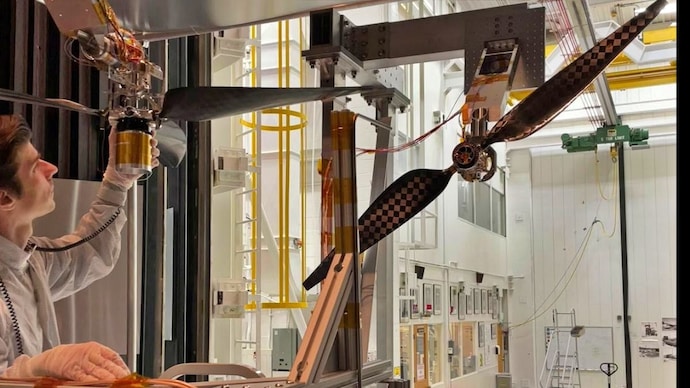
Nasa engineers have pushed the rotor blades of future Mars helicopters past the speed of sound during a series of high-risk tests designed to help the next generation of aircraft carry heavier payloads and fly farther across the Red Planet.
The tests, conducted in March at Jet Propulsion Laboratory in California, saw experimental helicopter blades spin at speeds exceeding Mach 1 inside a specialised chamber that simulates the thin atmosphere of Mars.
The achievement marks a major step beyond the capabilities of Ingenuity, the tiny robotic helicopter that made history in 2021 by performing the first powered flight on another planet.
WATCH MARS HELICOPTER SPINS AT MACH-1
“The faster a Mars helicopter’s rotors spin, the heavier the payloads it can transport and the farther it can fly,” Nasa said.
Flying on Mars is extraordinarily difficult because the planet’s atmosphere is only about 1% as dense as Earth’s. Although Mars has lower gravity, aircraft must spin their blades much faster to generate enough lift in the thin air.
Engineers are therefore trying to push rotor blades close to, and now beyond, the sonic barrier.
“While everything about Mars is hard, flying there is just about the hardest thing you can do,” said Al Chen.
Inside JPL’s historic 25-Foot Space Simulator, engineers replaced Earth’s air with carbon dioxide at pressures matching the Martian atmosphere. They then spun prototype rotors at increasingly high speeds while blasting them with artificial headwinds.
The team tested a three-bladed rotor developed by AeroVironment, pushing it to around 3,750 revolutions per minute. At those speeds, the rotor tips approached Mach 0.98 before engineers added stronger simulated winds. Eventually, the blades reached Mach 1.08, breaking the sound barrier in Martian conditions.
The tests were considered risky enough that engineers lined parts of the chamber with sheet metal in case the blades shattered during the experiment.
“If Chuck Yeager were here, he’d tell you things can get squirrely around Mach 1,” said JPL rotor test lead Jaakko Karras.
During Ingenuity’s 72 flights on Mars, Nasa never allowed the helicopter’s blades to exceed 2,700 rpm because engineers wanted to avoid unpredictable aerodynamic effects near the speed of sound.
But future Mars aircraft are expected to do far more than Ingenuity, which carried no science instruments.
Nasa’s planned next-generation systems, including the proposed SkyFall mission, are being designed to transport scientific instruments, sensors and possibly larger batteries for longer missions.
According to Nasa, pushing rotor speeds into the supersonic range boosted lift capability by roughly 30%, potentially allowing future helicopters to carry heavier scientific payloads and explore terrain inaccessible to rovers.
Engineers also tested a longer two-bladed SkyFall rotor that achieved similar near-supersonic speeds at slightly lower rotational speeds, further expanding design possibilities for future Mars exploration aircraft.
Nasa engineers have pushed the rotor blades of future Mars helicopters past the speed of sound during a series of high-risk tests designed to help the next generation of aircraft carry heavier payloads and fly farther across the Red Planet.
The tests, conducted in March at Jet Propulsion Laboratory in California, saw experimental helicopter blades spin at speeds exceeding Mach 1 inside a specialised chamber that simulates the thin atmosphere of Mars.
The achievement marks a major step beyond the capabilities of Ingenuity, the tiny robotic helicopter that made history in 2021 by performing the first powered flight on another planet.
WATCH MARS HELICOPTER SPINS AT MACH-1
“The faster a Mars helicopter’s rotors spin, the heavier the payloads it can transport and the farther it can fly,” Nasa said.
Flying on Mars is extraordinarily difficult because the planet’s atmosphere is only about 1% as dense as Earth’s. Although Mars has lower gravity, aircraft must spin their blades much faster to generate enough lift in the thin air.
Engineers are therefore trying to push rotor blades close to, and now beyond, the sonic barrier.
“While everything about Mars is hard, flying there is just about the hardest thing you can do,” said Al Chen.
Inside JPL’s historic 25-Foot Space Simulator, engineers replaced Earth’s air with carbon dioxide at pressures matching the Martian atmosphere. They then spun prototype rotors at increasingly high speeds while blasting them with artificial headwinds.
The team tested a three-bladed rotor developed by AeroVironment, pushing it to around 3,750 revolutions per minute. At those speeds, the rotor tips approached Mach 0.98 before engineers added stronger simulated winds. Eventually, the blades reached Mach 1.08, breaking the sound barrier in Martian conditions.
The tests were considered risky enough that engineers lined parts of the chamber with sheet metal in case the blades shattered during the experiment.
“If Chuck Yeager were here, he’d tell you things can get squirrely around Mach 1,” said JPL rotor test lead Jaakko Karras.
During Ingenuity’s 72 flights on Mars, Nasa never allowed the helicopter’s blades to exceed 2,700 rpm because engineers wanted to avoid unpredictable aerodynamic effects near the speed of sound.
But future Mars aircraft are expected to do far more than Ingenuity, which carried no science instruments.
Nasa’s planned next-generation systems, including the proposed SkyFall mission, are being designed to transport scientific instruments, sensors and possibly larger batteries for longer missions.
According to Nasa, pushing rotor speeds into the supersonic range boosted lift capability by roughly 30%, potentially allowing future helicopters to carry heavier scientific payloads and explore terrain inaccessible to rovers.
Engineers also tested a longer two-bladed SkyFall rotor that achieved similar near-supersonic speeds at slightly lower rotational speeds, further expanding design possibilities for future Mars exploration aircraft.

