Netrasemi makes first 12nm Indian chip, it all began with Pokhran 2 nuke tests
Netrasemi has achieved silicon bring-up for the A2000, India's first 12nm edge AI chip. The milestone ties Jyothis Indirabhai's post-Pokhran setback to India's push for sovereign computing.
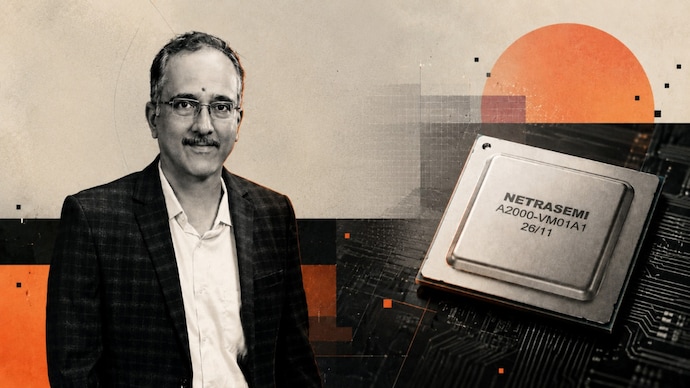
In 1999, Jyothis Indirabhai found himself caught in the geopolitical upheaval. Fresh off a stint as an FPGA engineer at the Centre for Development of Advanced Computing (C-DAC) in Trivandrum, he was working as a semiconductor consultant for Hitachi in Japan when India conducted its Pokhran 2 nuclear tests. Almost overnight, global sanctions rippled through the tech sector.
“I was one of the victims of that experiment because I lost my job,” Indirabhai tells India Today Tech. India’s nuke tests brought a new scrutiny of tech knowhow. “For Indian engineers, they said you cannot work on less than 350-nanometre (nm) semiconductor technologies. But I was working on 180nm. My project was cancelled.”
Forced to relocate to the United States, he spent the next two decades scaling the ranks of Silicon Valley’s chipmaking ecosystem, first at early wireless and Bluetooth startups, and later at Intel where he worked as a GPU design manager for almost 10 years.
Fast forward to 2026. Indirabhai is back where his journey began, sitting in Trivandrum as the CEO and co-founder of Netrasemi. But this time, he isn't braving any sanctions. He is breaking barriers by designing “sovereign AI chips” for India. Founded by a three-person team in 2020, today, Netrasemi has scaled into a 91-member engineering powerhouse that recently achieved “silicon bring-up” for the A2000, which is India’s first 12nm Edge AI system-on-chip (SoC).
“Without AI, defence will not survive”
While commercial applications for Netrasemi’s chips span over a hundred distinct use cases, ranging from retail analytics and smart city infrastructure to advanced robotics, the most critical frontier for this technology, as it turns out, may lie in strengthening the country’s national defence. The rules of global warfare are changing rapidly, with AI and tech playing a bigger role, something we recently saw in Iran-US war as well as Russia-Ukraine war.
“Without AI, defence will not survive. That is what the reality is,” Indirabhai says bluntly. “If the US, China, and all these countries are investing a significant amount of money in drones, electronic warfare, and all those things, you cannot ignore AI. If you ignore it, I think you will go back 50 years, or maybe 100 years. Defence by default is going to be AI warfare.”
New rules mandate new course of action. You cannot secure a sovereign nation using foreign cloud infrastructure that can be switched off during a geopolitical situation. The computing must happen locally, securely, and instantaneously at the “edge” directly on the drone, the border surveillance camera, or the field radar. Netrasemi's A2000 chip is built or rather, it is designed, keeping some of these use-cases in mind. According to the company, the chip can process massive, high-resolution vector data like live video streams and millimetre-radar signals in real time without leaning on external cloud processing.
The road to India’s first 12nm AI chip
When Indirabhai returned to India and began developing intellectual property (IP) cores in 2017, the local semiconductor ecosystem was virtually non-existent. Trying to secure capital for a semiconductor startup was an uphill task.
“It (semiconductors) was almost like Latin to investors (back then),” Indirabhai quips.
But things changed in late 2021 with the launch of the India Semiconductor Mission. The catalyst was the government’s push for “Atmanirbhar Bharat” in the wake of growing geopolitical uncertainty. Backed by ministers like Ashwini Vaishnaw and Rajeev Chandrasekhar and a historic Rs 76,000 crore financial commitment, the initiative introduced Design-Linked Incentives (DLI) for fabless startups and Production-Linked Incentives (PLI) for manufacturing facilities aka foundries.
Suddenly, Netrasemi went from being seen as a high-risk gamble to becoming one of the top beneficiaries of design-led chip innovation. “Today, I get at least 5 to 10 calls every week from investors,” Indirabhai says. “2022 changed everything.”
There is a common misconception in the public domain that to become a semiconductor superpower, a nation must instantly build multi-billion-dollar manufacturing foundries (fabs). While conglomerates like Tata are building fabs, and other players are investing heavily in OSAT (Outsourced Semiconductor Assembly and Test) packaging plants, Indirabhai believes the fabless model is the way forward.
“The US owns around more than 50 per cent of semiconductor revenue,” he explains. “We may always think that semiconductors are in Taiwan all the time, but Taiwan doesn't own that much. The US owns a 70 per cent market share in fabless. Nvidia is a 5.5 trillion-dollar company, it is more than Indian GDP. Qualcomm, AMD, NXP, everyone is a fabless player.”
Talent and cost in India are other top pro-fabless arguments in favour of pursuing the fab-less path. “About 20 to 25 per cent of global semiconductor talent is from India, with 95 per cent of those engineers working in the design and fabless domain,” says Indirabhai. “Indians have a common logical thinking capability, we are inherently built for software and design thinking. We can design world-class silicon right here from Kerala, but at probably one-fifth of the expense you would incur in Silicon Valley.”
Let the chips fall where they may
Once the chip design is finalised, it undergoes a “tape-out”, the point where the digital blueprints are sent to a foundry to create a sample run. In the case of the A2000 this foundry is Taiwan Semiconductor Manufacturing Company (TSMC). The silicon arrived back from TSMC in March, passed its initial post-silicon bring-up validation, and is now undergoing rigorous field-testing with early-access customers.
“The chip came back in March,” Indirabhai shares. “We brought up the silicon, and it is working good. We are actually giving these chips to customers for them to build the products.”
The final step is the most expensive: freezing the design into a permanent “mask set” for commercial mass production. “The mask set is the most expensive part of production. Once the mask set is frozen, you cannot change it. After that, you can only print the chips at a very high commercial volume.” Netrasemi plans to start full-scale commercial mass production by the middle of next year. The total cost of production per chip is estimated to be about Rs 50 to Rs 100 Crores. “If I am doing the same thing in the US, it (would cost) maybe three to four times more,” Indirabhai says.
The choice of using 12nm nodes is deliberate. “If we wanted to just claim we made an AI chip, we could have taped out on 28-nanometres,” Indirabhai points out. “But the A2000 is engineered to ingest multiple high-resolution video streams simultaneously and execute highly complex AI algorithms in real time without dropping frames. To hit that kind of processing power within a strict device power envelope, 12-nanometres is our absolute sweet spot.”
Netrasemi could have simply purchased off-the-shelf Intellectual Property (IP) blocks from foreign vendors, stitched them together, and routed them to a foundry. These shortcuts would have saved production time, cutting it down to as low as two years. But it would not have given the company complete control over its technology.
“Everyone published that we made India's first AI chip,” Indirabhai notes. “But the real story is that Netrasemi built India’s first complete computer vision and AI IP portfolio. We built the neural processors, the vision processing units, the image signal processors, and the video compression units ourselves.”
Netrasemi is simultaneously working on two more chips. One is a low-power AI microcontroller running on an open-source RISC-V core called the R1000 that would go into smart IoT devices, such as temperature and humidity sensors. The other, called the A4000, uses a more advanced 2D “chiplet” architecture and would go on to power high-performance, 500-TOPS enterprise AI servers and heavy-duty tactical command centres with a targeted release next year.
“Once you have an AI chip, your scope is extremely huge. How much you can capture with your limited manpower and with limited resources is what matters,” Indirabhai says, adding, “I can see significant demand from the Indian defence industry for AI chips, because that whole area is wide open and there is an absolute gap there. But the problem is, Netrasemi can do only so much.”
Netrasemi now wants to scale its engineering team from 91 members to over double that size to meet what is without a doubt, a very ambitious roadmap ahead. It is also working on ways to increase funding. Zoho and Unicorn India Ventures are primary investors for now.
Indirabhai believes that India needs to create a self-sustaining tech and AI ecosystem, where Indian system developers, software engineers, and fabless designers work together. By providing local OEMs with early access to silicon like the A2000 alongside its native software development kits (SDKs), India can shift from a manufacturing assembly hub to a true “product nation.” That is the end goal.
AI may have come as a blessing. The world at large is living inside an AI craze right now. For Indirabhai, it represents a once in a lifetime opportunity.
“AI will be one of the biggest tools the human race ever had,” he asserts. "It is going to erase a lot of jobs, and we have to be careful about that. But it will open up a lot of new opportunities. The question is: what can India do about it?"
For decades, India excelled as the back-office of global tech giants, supplying the human capital to build their platforms. With startups like Netrasemi, India stands at the cusp of a new generation of technologies and technologists who aspire to think differently as well as act differently. “I don't know whether Nvidia will be here, but Netrasemi will be here,” Indirabhai says. “Let us become creators rather than users. Product is the ultimate target. Once we learn to build and sell systems to the world, everything else will align.”
In 1999, Jyothis Indirabhai found himself caught in the geopolitical upheaval. Fresh off a stint as an FPGA engineer at the Centre for Development of Advanced Computing (C-DAC) in Trivandrum, he was working as a semiconductor consultant for Hitachi in Japan when India conducted its Pokhran 2 nuclear tests. Almost overnight, global sanctions rippled through the tech sector.
“I was one of the victims of that experiment because I lost my job,” Indirabhai tells India Today Tech. India’s nuke tests brought a new scrutiny of tech knowhow. “For Indian engineers, they said you cannot work on less than 350-nanometre (nm) semiconductor technologies. But I was working on 180nm. My project was cancelled.”
Forced to relocate to the United States, he spent the next two decades scaling the ranks of Silicon Valley’s chipmaking ecosystem, first at early wireless and Bluetooth startups, and later at Intel where he worked as a GPU design manager for almost 10 years.
Fast forward to 2026. Indirabhai is back where his journey began, sitting in Trivandrum as the CEO and co-founder of Netrasemi. But this time, he isn't braving any sanctions. He is breaking barriers by designing “sovereign AI chips” for India. Founded by a three-person team in 2020, today, Netrasemi has scaled into a 91-member engineering powerhouse that recently achieved “silicon bring-up” for the A2000, which is India’s first 12nm Edge AI system-on-chip (SoC).
“Without AI, defence will not survive”
While commercial applications for Netrasemi’s chips span over a hundred distinct use cases, ranging from retail analytics and smart city infrastructure to advanced robotics, the most critical frontier for this technology, as it turns out, may lie in strengthening the country’s national defence. The rules of global warfare are changing rapidly, with AI and tech playing a bigger role, something we recently saw in Iran-US war as well as Russia-Ukraine war.
“Without AI, defence will not survive. That is what the reality is,” Indirabhai says bluntly. “If the US, China, and all these countries are investing a significant amount of money in drones, electronic warfare, and all those things, you cannot ignore AI. If you ignore it, I think you will go back 50 years, or maybe 100 years. Defence by default is going to be AI warfare.”
New rules mandate new course of action. You cannot secure a sovereign nation using foreign cloud infrastructure that can be switched off during a geopolitical situation. The computing must happen locally, securely, and instantaneously at the “edge” directly on the drone, the border surveillance camera, or the field radar. Netrasemi's A2000 chip is built or rather, it is designed, keeping some of these use-cases in mind. According to the company, the chip can process massive, high-resolution vector data like live video streams and millimetre-radar signals in real time without leaning on external cloud processing.
The road to India’s first 12nm AI chip
When Indirabhai returned to India and began developing intellectual property (IP) cores in 2017, the local semiconductor ecosystem was virtually non-existent. Trying to secure capital for a semiconductor startup was an uphill task.
“It (semiconductors) was almost like Latin to investors (back then),” Indirabhai quips.
But things changed in late 2021 with the launch of the India Semiconductor Mission. The catalyst was the government’s push for “Atmanirbhar Bharat” in the wake of growing geopolitical uncertainty. Backed by ministers like Ashwini Vaishnaw and Rajeev Chandrasekhar and a historic Rs 76,000 crore financial commitment, the initiative introduced Design-Linked Incentives (DLI) for fabless startups and Production-Linked Incentives (PLI) for manufacturing facilities aka foundries.
Suddenly, Netrasemi went from being seen as a high-risk gamble to becoming one of the top beneficiaries of design-led chip innovation. “Today, I get at least 5 to 10 calls every week from investors,” Indirabhai says. “2022 changed everything.”
There is a common misconception in the public domain that to become a semiconductor superpower, a nation must instantly build multi-billion-dollar manufacturing foundries (fabs). While conglomerates like Tata are building fabs, and other players are investing heavily in OSAT (Outsourced Semiconductor Assembly and Test) packaging plants, Indirabhai believes the fabless model is the way forward.
“The US owns around more than 50 per cent of semiconductor revenue,” he explains. “We may always think that semiconductors are in Taiwan all the time, but Taiwan doesn't own that much. The US owns a 70 per cent market share in fabless. Nvidia is a 5.5 trillion-dollar company, it is more than Indian GDP. Qualcomm, AMD, NXP, everyone is a fabless player.”
Talent and cost in India are other top pro-fabless arguments in favour of pursuing the fab-less path. “About 20 to 25 per cent of global semiconductor talent is from India, with 95 per cent of those engineers working in the design and fabless domain,” says Indirabhai. “Indians have a common logical thinking capability, we are inherently built for software and design thinking. We can design world-class silicon right here from Kerala, but at probably one-fifth of the expense you would incur in Silicon Valley.”
Let the chips fall where they may
Once the chip design is finalised, it undergoes a “tape-out”, the point where the digital blueprints are sent to a foundry to create a sample run. In the case of the A2000 this foundry is Taiwan Semiconductor Manufacturing Company (TSMC). The silicon arrived back from TSMC in March, passed its initial post-silicon bring-up validation, and is now undergoing rigorous field-testing with early-access customers.
“The chip came back in March,” Indirabhai shares. “We brought up the silicon, and it is working good. We are actually giving these chips to customers for them to build the products.”
The final step is the most expensive: freezing the design into a permanent “mask set” for commercial mass production. “The mask set is the most expensive part of production. Once the mask set is frozen, you cannot change it. After that, you can only print the chips at a very high commercial volume.” Netrasemi plans to start full-scale commercial mass production by the middle of next year. The total cost of production per chip is estimated to be about Rs 50 to Rs 100 Crores. “If I am doing the same thing in the US, it (would cost) maybe three to four times more,” Indirabhai says.
The choice of using 12nm nodes is deliberate. “If we wanted to just claim we made an AI chip, we could have taped out on 28-nanometres,” Indirabhai points out. “But the A2000 is engineered to ingest multiple high-resolution video streams simultaneously and execute highly complex AI algorithms in real time without dropping frames. To hit that kind of processing power within a strict device power envelope, 12-nanometres is our absolute sweet spot.”
Netrasemi could have simply purchased off-the-shelf Intellectual Property (IP) blocks from foreign vendors, stitched them together, and routed them to a foundry. These shortcuts would have saved production time, cutting it down to as low as two years. But it would not have given the company complete control over its technology.
“Everyone published that we made India's first AI chip,” Indirabhai notes. “But the real story is that Netrasemi built India’s first complete computer vision and AI IP portfolio. We built the neural processors, the vision processing units, the image signal processors, and the video compression units ourselves.”
Netrasemi is simultaneously working on two more chips. One is a low-power AI microcontroller running on an open-source RISC-V core called the R1000 that would go into smart IoT devices, such as temperature and humidity sensors. The other, called the A4000, uses a more advanced 2D “chiplet” architecture and would go on to power high-performance, 500-TOPS enterprise AI servers and heavy-duty tactical command centres with a targeted release next year.
“Once you have an AI chip, your scope is extremely huge. How much you can capture with your limited manpower and with limited resources is what matters,” Indirabhai says, adding, “I can see significant demand from the Indian defence industry for AI chips, because that whole area is wide open and there is an absolute gap there. But the problem is, Netrasemi can do only so much.”
Netrasemi now wants to scale its engineering team from 91 members to over double that size to meet what is without a doubt, a very ambitious roadmap ahead. It is also working on ways to increase funding. Zoho and Unicorn India Ventures are primary investors for now.
Indirabhai believes that India needs to create a self-sustaining tech and AI ecosystem, where Indian system developers, software engineers, and fabless designers work together. By providing local OEMs with early access to silicon like the A2000 alongside its native software development kits (SDKs), India can shift from a manufacturing assembly hub to a true “product nation.” That is the end goal.
AI may have come as a blessing. The world at large is living inside an AI craze right now. For Indirabhai, it represents a once in a lifetime opportunity.
“AI will be one of the biggest tools the human race ever had,” he asserts. "It is going to erase a lot of jobs, and we have to be careful about that. But it will open up a lot of new opportunities. The question is: what can India do about it?"
For decades, India excelled as the back-office of global tech giants, supplying the human capital to build their platforms. With startups like Netrasemi, India stands at the cusp of a new generation of technologies and technologists who aspire to think differently as well as act differently. “I don't know whether Nvidia will be here, but Netrasemi will be here,” Indirabhai says. “Let us become creators rather than users. Product is the ultimate target. Once we learn to build and sell systems to the world, everything else will align.”

