
Tushar Mehta on the use and abuse of AI in legal profession
Read an excerpt from one of the two new books by Tushar Mehta, Solicitor General of India, on the unfamiliar, curious and quirky side of law.
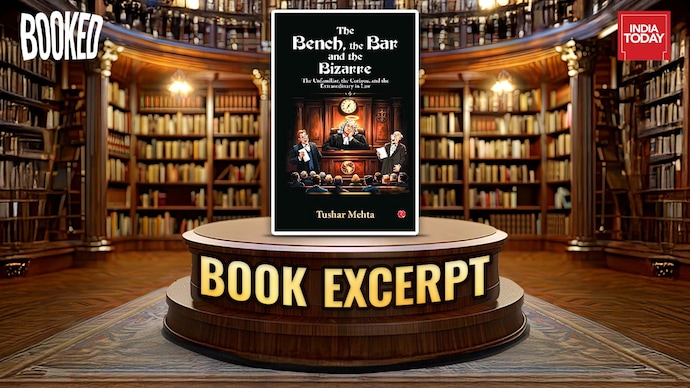

Tushar Mehta, Solicitor General of India since 2018, found time from his busy schedule to pen a few essays on the lesser known side of the law. He has published two collections, The Bench, the Bar and the Bizarre: The Unfamiliar, the Curious, and the Extraordinary in Law and The Lawful and the Awful: Quirky Tales from the World of Law (Rupa Publications).
The Bench, the Bar and the Bizarre introduces the reader to the curious, unexpected, and often amusing aspects of the legal field around the world. The essays are as amusing as thought-provoking. Here is an excerpt from one of the most talked about phenomena of our times:
Artificially Intelligent, Legally Embarrassed
Hallucinations, Fake Citations, and the Perils of Robo-Research
Technology—the great transformative force of the modern age—has revolutionized every sphere of life, reshaping not only how we work but also how we think. No field has escaped its reach. Even in the dusty corridors of law, among its notoriously solemn practitioners on both sides of the bar and bench, technology has made its presence unmistakably felt. Files are out, iPads are in; video conferencing has become routine; and artificial intelligence (AI) has quietly become the preferred tool of legal research, replacing our own natural stupidity.
Elon Musk, CEO of Tesla and X, once rightly remarked: ‘With artificial intelligence, we are summoning the demon.’ A similar concern was expressed by Apple CEO Tim Cook, who said, ‘We’d rather build Apple Intelligence than just artificial intelligence—one respects your privacy, the other might sell it.’ Experience so far suggests that AI is much like a rocket—without a proper control system, it’s simply a potential bomb.
At the pace AI is developing, Warren Bennis’s prophecy may yet come true: ‘The factory of the future will have only two employees, a man and a dog. The man will be there to feed the dog. The dog will be there to keep the man from touching the equipment.’ But ignoring technology is not an option. Once it rolls over you, if you are not part of the steamroller, you are definitely part of the road.
Let me make it clear—I am neither a techno-romantic nor a techno-sceptic. But the thought of artificial intelligence entering judicial adjudication—whether through the Bench or the Bar—is a chilling one. The real danger is not that machines will start thinking like humans, but that humans will stop thinking like humans and begin to imitate machines.
The speed with which technology is consuming every sphere of life has coincided with a steady decline in creative reasoning and problem-solving in humans. Children now struggle with even basic arithmetic without a calculator, while adults have become slaves to their screens—ever ‘prompt-ready’. Young lawyers instinctively turn to the internet for legal research rather than engaging their own faculties in nuanced interpretation of the law. There is a visible shift in cognitive behaviour: an almost reflexive desire for instant answers through technology, bypassing the intellectual labour that deep thinking, reflection and natural deduction demand.
Our time-tested system of gradual professional progression—beginning as a junior advocate, learning under seniors, and eventually earning designation at a suitably mature stage—is eroding. We now encounter ‘counsel’ fully formed on the day they join the Bar, armed with downloaded material (and occasionally downloaded indignation) drawn from legal research software.
Technology has brought with it a measurable decline in attention span, memory and analytical depth. This human-made monster is penetrating the legal field with astonishing speed—no longer a servant, but increasingly the master. I have no objection to the use of AI, but it must remain a tool, never the adjudicator, and certainly not a substitute for human judgement or legal preparation.
As John Burn-Murdoch of the ‘Financial Times’ recently asked in his article, ‘Have Humans Passed Peak Brain Power?’, the decline we are witnessing is neither biological nor environmental. It is something far more insidious: a reshaping of our very cognitive capacities by the technology we created.
Keeping this concern in mind, I began looking for instances where AI has embarrassed itself in the world of law. What I found was both comic and alarming. It turns out that AI doesn’t just err; it hallucinates. On a lighter note, it seems to have acquired all the human follies and tendencies. [...]
Ultimately, artificial intelligence is like a toddler—you must teach it, guide it, and keep it away from the sockets. It is only as good, or as bad, as what and how you feed it. [...]
So, have we entered the age of e-justice? The answer, at least for now, is no. Technology is only as effective as its users, and the legal profession, like any other profession, has its share of both those who work hard and those who work hardly. In the hands of the latter, great force produces only a great farce. Whether it is social media or artificial intelligence, farcical situations arise when misused by those in law—judges and lawyers alike.
This discussion is not about technology in general, but specifically about AI in the field of law. The way artificial intelligence is being used for legal research suggests humanity is racing to prove Aldous Huxley right when, in 1937, he said ‘technological progress has merely provided us with more efficient means for going backwards.’ Huxley, an English writer and philosopher, had warned that mindless reliance on technology will erode human thought and intellectual creativity. It seems the human race is moving fast towards the finishing line to prove him right.
AI is already being utilized by arbitrators for drafting procedural orders or organizing evidence. Perhaps that should be its only use, at least at this stage. However, there’s been a recent case where an arbitrator was accused of using AI to draft the award. Think about that: the arbitrator—who is supposed to adjudicate a dispute between contesting parties—allegedly let a machine perform the decision-making. The parties might just as well have agreed to literal ‘mechanical adjudication’. The award is currently under challenge on the grounds that the arbitrator allegedly used AI to prepare the award, thus ‘outsourcing his adjudicative role’.