
Hiranandani says India's affordable housing crisis is getting worse. Here's proof
For many aspiring homeowners, the biggest challenge today is no longer deciding where to buy a house, it is finding one that fits the budget. As affordable housing supply drops, experts warn that the problem is becoming harder to ignore.

New Delhi,UPDATED: May 27, 2026 18:16 IST
For millions of Indians, buying a home is no longer just difficult — it is slowly beginning to feel impossible.
Talk to any middle-class family in a big city and you will hear a familiar worry: “We earn decently, but can we really afford a house anymore?” Homes that once looked achievable now seem to move further away with every passing year.
What makes this more worrying is that the problem is not just about rising prices. The real issue is that affordable homes are quietly disappearing from the market.
And industry veterans say the crisis is now deeper than ever.
“I’VE NEVER SEEN SUCH A SEVERE DECLINE”
Veteran real estate developer Niranjan Hiranandani believes India’s affordable housing sector is facing one of its toughest phases.
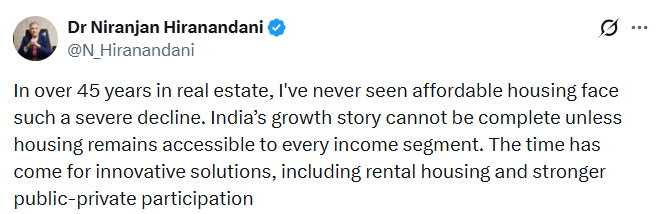
"In over 45 years in real estate, I've never seen affordable housing face such a severe decline," he said.
His concern is hard to ignore.
According to ANAROCK Research data, affordable housing’s share in the market has dropped sharply, i.e., from 38% in 2019 to just 18% in 2025. That is not a temporary slowdown. Experts increasingly see it as a structural problem that could deepen if ignored.
Hiranandani warns that India’s larger economic story cannot succeed if housing becomes inaccessible for ordinary families.
“India’s growth story cannot be complete unless housing remains accessible to every income segment. The time has come for innovative solutions, including rental housing and stronger public-private participation,” he said.
THE DEMAND EXISTS — BUT SUPPLY IS DRYING UP
Interestingly, the crisis is not because people have stopped wanting affordable homes.
In fact, the demand remains strong.
The bigger issue is supply.
Vishal Srivastava, Head of Corporate Finance and Managing Director at ANAROCK Capital, says India is facing a serious housing gap.
“Despite strong demand, affordable housing remains underfunded and requires dedicated capital structures,” he said.
The numbers tell a worrying story.
India currently faces an urban housing shortage of roughly 10 million units, and the country may need at least 25 million affordable homes by 2030, Srivastava said.
Yet supply is moving in the opposite direction.
“Homes priced below Rs 40 lakh accounted for just 10% of new launches in Q1 2026, down from 26% in 2021,” he explained.
At the same time, luxury and premium housing have grown rapidly.
“Premium housing has surged, with homes priced above Rs 1.5 crore making up 53% of new launches,” he added.
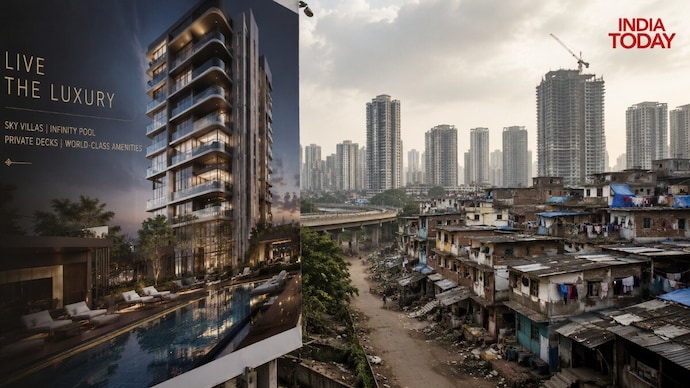
In simple words: builders are increasingly constructing expensive homes, while affordable options continue to disappear.
WHY ARE DEVELOPERS MOVING AWAY FROM AFFORDABLE HOMES?
The answer, many experts say, comes down to simple economics.
Affordable housing may sound socially important, but financially, it is becoming harder for developers to justify.
Margins on affordable housing projects are often limited to around 10–12%. Meanwhile, premium or luxury projects can generate returns of 25–30% or even higher.
For developers, the maths becomes difficult to ignore.
Land prices in cities have climbed sharply. Construction materials such as steel and cement remain expensive. Skilled labour costs have risen, and approval processes often take time.
When costs rise but selling prices remain capped, profits become thinner.
As a result, many developers have shifted focus towards premium housing, where returns are higher and risks feel more manageable.
THE DEFINITION OF ‘AFFORDABLE’ NO LONGER FEELS AFFORDABLE
There is another problem quietly making matters worse: policy definitions are struggling to keep pace with reality.
The affordable housing cap remains at Rs 45 lakh — a threshold set years ago.
But in many cities today, even homes on the outskirts cost far more.
In Mumbai, a 600-square-foot apartment in peripheral areas now costs between Rs 60–75 lakh. In Bengaluru and Delhi-NCR, prices are similarly disconnected from policy definitions, said Anuj Puri, Chairman, ANAROCK Group.
What qualifies as “affordable” on paper often no longer feels affordable in real life.
This mismatch has also reduced incentives for developers.
Earlier tax benefits that encouraged affordable housing projects have faded, making such developments less financially attractive.
A CRISIS THAT COULD AFFECT INDIA’S GROWTH STORY
Affordable housing is not just about real estate.
It affects jobs, migration, family savings and even urban growth.
When homes become unaffordable, families either delay purchases, move farther away from workplaces or continue paying rent for years.
That financial pressure quietly changes everyday life.
The bigger concern is whether India can sustain economic growth if a large section of aspiring homeowners gets priced out of the market.
For now, the warning signs are becoming difficult to miss.
The dream of owning a reasonably priced home is still alive for millions of Indians, but unless supply improves and policies catch up with reality, that dream could become increasingly expensive to achieve.
- Ends