
India's affordable housing dream hits a luxury roadblock
India's housing market is tilting towards luxury projects even as affordable demand remains strong. Experts say rising costs, weak funding and policy gaps are pushing home ownership further from the middle class.
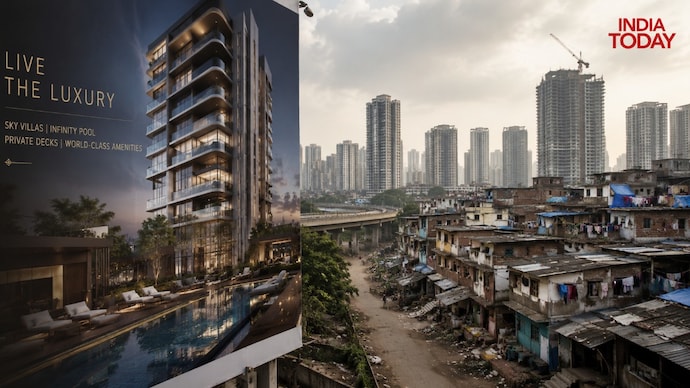

Drive through almost any major city today and one thing becomes impossible to miss. Billboards rising above highways promise sky villas, private decks, rooftop pools, golf-facing apartments, and 'elevated luxury living'.
Open a newspaper and glossy full-page advertisements showcase infinity pools and premium clubhouses. Scroll online and real estate ads increasingly sell aspiration, not affordability.
The language of Indian housing has changed.
Real estate today is less about finding a home and increasingly about selling a lifestyle.
But beneath this luxury boom sits a difficult question: what happens to affordable housing in a country where millions still struggle to buy a home?
Because while premium and luxury housing projects continue to dominate launches and advertising, experts say India’s affordable housing need has not disappeared at all. In fact, it remains massive.
What has changed instead is the economics of building affordable homes.
And that shift may slowly be pushing middle-class homeownership further out of reach.
INDIA STILL NEEDS AFFORDABLE HOUSING. A LOT OF IT
Despite the growing focus on premium housing, experts say India’s need for affordable homes remains massive.
“The demand for affordable housing never went away,” said Santhosh Kumar, Vice Chairman at ANAROCK Group.
“India is projected to face an urban housing shortage of 30 million units by 2030.”
But the supply side tells a completely different story.
According to ANAROCK Research, the share of affordable homes in overall residential sales has fallen sharply from 38% in 2019 to just 18% in 2025.
At the same time, luxury housing sales surged 170% in 2024 alone.
“This change is largely a result of developers seeking viability, rather than any real shift in what buyers want,” Kumar said.
That contradiction sits at the heart of India’s changing housing market.
Affordable housing demand still exists at scale. But developers increasingly find luxury housing more financially practical to build.
ECONOMICS OF AFFORDABLE HOUSING ARE BREAKING DOWN
Several experts pointed to the same issue, affordable housing has become increasingly difficult to make commercially viable.
“Developers make only 10–12% margins in affordable housing projects as against 25–30% or more in premium and luxury projects,” Kumar said.
Rising land prices, higher construction costs and long regulatory timelines have steadily weakened the economics of budget housing.
“The gap has only widened,” he added.
One major problem is that the government’s affordable housing price cap of Rs 45 lakh has remained unchanged since 2017.
“Now, even peripheral city locations tend to cross that price barrier,” Kumar said.
That means many homes that would once qualify as affordable housing no longer fit within the framework.
Aniruddha Mehta, Chairman and Managing Director of Umiya Buildcon Ltd, said the challenge is fundamentally economic rather than demand-driven.
“Input costs such as land, labour, construction materials, financing, and regulatory compliance have increased significantly,” Mehta said.
“In many urban markets, it has become increasingly difficult to deliver homes within affordable price brackets while maintaining project viability.”
Premium housing, meanwhile, offers developers far more flexibility in absorbing those costs.
LUXURY HOUSING IS NOT JUST A DEVELOPER STORY
The luxury boom is not happening only because developers are chasing higher margins.
Buyer behaviour itself has changed.
Atul Monga, CEO and Co-Founder of BASIC Home Loan, said demand in the Rs 1 crore-plus segment is rising rapidly.
“India’s housing market is shifting toward luxury projects because demand in the Rs 1 crore-plus segment is rising faster, supported by wealth creation, lifestyle aspirations and inflation-hedge investing,” Monga said.
Mehta echoed that point, saying buyers today are no longer looking at housing only as shelter.
“Homebuyers today are looking beyond basic shelter and are placing greater emphasis on factors such as lifestyle, amenities, community infrastructure, open spaces, and overall living experience,” he said.
This aspiration shift is visible across urban India.
Gated communities, clubhouses, wellness spaces, larger homes and lifestyle amenities have become central to how projects are marketed.
But experts say this growing appetite for premium living is masking a much larger structural imbalance.
“Affordable and mid-income housing still remains central to India’s long-term housing growth story,” Monga said.
AFFORDABLE HOUSING IS NOW CHRONICALLY UNDER-FUNDED
The bigger problem, experts say, is no longer just affordability. It is funding.
According to ANAROCK Capital, more than 4.5 lakh stalled affordable and mid-range homes across over 1,500 projects are currently stuck and require around Rs 55,000 crore in funding support to resume.
Kumar described this as a “deep and structural financing crisis”.
“India’s affordable housing problem is no longer a demand problem but a structural capital allocation and financing architecture problem,” he said.
“Institutional capital remains flowing into premium housing, offices and REIT-backed assets, leaving affordable housing as the biggest structural funding gap in the sector.”
That funding imbalance is slowly reshaping what kind of homes India builds.
Monga said the challenge is now about enabling financially viable homeownership at scale.
“Demand exists, but conversions are weaker because buyers face higher EMIs, inflationary pressures and limited credit options,” he said.
“It indicates that the sector’s challenge is not housing need, but enabling financially viable homeownership at scale.”
THE MIDDLE CLASS IS GETTING SQUEEZED
Experts repeatedly warned that the people most affected by this shift are salaried middle-class families.
ANAROCK data show that while the total value of homes sold rose 6% in 2025 compared to 2024, the number of sold units fell 14%.
“That is a sign of a market where fewer people can buy, even as prices are rising,” Kumar said.
Abhishek Kumar, Sebi RIA and founder of Sahaj Money, said property prices in major cities are increasingly moving beyond the reach of ordinary salaried buyers.
“Real estate prices in Tier 1 cities are indeed outpacing typical salaried wage growth,” he said.
“The sharp decline in the launch of budget residential projects, combined with developers prioritising high-margin luxury projects, has significantly squeezed the affordable options available to middle-income buyers.”
Dr Manoranjan Sharma, Chief Economist at Infomerics Ratings, linked the luxury housing boom directly to rising wealth concentration.
“Luxury home sales in major metros have far outpaced mid-income housing, driven by stock-market gains, startup wealth, global capital and high-net-worth investors,” Sharma said.
At the same time, salaried households are seeing far slower income growth compared to rising property prices.
“Homeownership is becoming increasingly difficult for salaried middle-class families in Mumbai, Bengaluru, Delhi-NCR and Hyderabad,” he said.
Over the past decade, property prices have risen much faster than median incomes, while spending on education, healthcare and transport has further reduced savings capacity.
“Many younger professionals are delaying home purchases or moving to distant suburbs with longer commutes,” Sharma said.
He warned that if current trends continue, homeownership may increasingly become concentrated among households with inherited wealth rather than salaried earners.
PEOPLE ARE TAKING BIGGER FINANCIAL RISKS JUST TO BUY HOMES
The affordability pressure is also changing how Indians finance homes.
Abhishek Kumar said many buyers are now stretching far beyond financially safe levels.
“We generally recommend keeping home loan monthly instalments within 30% to 40% of net monthly income,” he said.
“But many urban buyers are stretching toward half or more of their monthly take-home pay.”
To manage purchases, salaried professionals are increasingly:
- opting for maximum loan tenures
- dipping into retirement savings
- using emergency funds
- stretching household finances aggressively
“This leaves household balance sheets highly leveraged and vulnerable to income disruptions, health emergencies, or unexpected shifts in floating interest rates,” Kumar warned.
He also cautioned buyers against focusing only on loan eligibility.
“Buyers must carefully calculate the complete out-of-pocket cost of acquisition, including stamp duty, registration fees, processing charges and immediate interior work,” he said.
“It is essential to ensure that mortgage payments do not compromise retirement, emergency funds and long-term wealth-building goals.”
THE LUXURY BOOM IS ALSO DEEPENING INEQUALITY
For economists, the housing shift reflects a much larger story about wealth concentration in India.
Dr Sharma said developers increasingly favour luxury housing because it offers:
- higher margins
- better absorption of regulatory costs
- stronger investor interest
But the long-term consequences could be severe.
“The widening gap between income growth and housing prices poses serious economic risks,” Sharma said.
“Rapid property inflation alongside moderate wage growth increases household debt, encourages speculation and weakens affordability.”
He warned that when housing absorbs a large share of household savings, it also limits broader economic mobility.
“A skewed housing market creates broader economic and social risks,” Sharma said.
“When affordable housing remains scarce while luxury supply expands, workers are pushed farther from employment centres, raising commuting costs and lowering productivity.”
He added that excessive focus on luxury housing also encourages speculative investment rather than productive economic activity.
“Over time, inaccessible housing increases inequality, expands informal settlements and weakens inclusive urban growth.”
DEVELOPERS HAVE NOT LEFT AFFORDABLE HOUSING — BUT THEY ARE MOVING AWAY FROM IT
Experts clarified that private developers have not completely stopped building affordable homes.
But their participation has reduced sharply.
Kumar pointed to the expiry of the Section 80-IBA tax holiday for affordable housing developers in 2021 as a major turning point.
“This removed a crucial financial tool that had made budget housing commercially viable for the private sector,” he said.
Today, government-backed schemes continue to drive much of the affordable housing push, while private developers increasingly move toward mid-premium and luxury projects.
Mehta said affordable housing will continue to remain important, but long-term success will require stronger collaboration between public and private sectors.
“Meeting the large-scale demand for affordable housing will require an ongoing commitment from both public and private sectors,” he said.
Monga also stressed that long-term housing growth cannot rely on luxury demand alone.
“A balanced housing market cannot be shaped by luxury demand alone,” he said.
“Strengthening the affordable segment is not just an economic necessity, it is a social imperative.”
INDIA RISKS BECOMING A TWO-TIER HOUSING MARKET
Experts believe the consequences of the current trend may become much more visible over the next decade.
“Without course corrections, India faces entrenching a deeply two-tier housing market,” Kumar warned.
“One defined by a robust luxury segment catering to HNIs, NRIs and wealthy professionals, and another characterised by a severe shortage of homes for the urban middle class and lower-income segments.”
India’s real estate sector is expected to require close to Rs 50 lakh crore of capital over the next decade as the industry moves toward becoming a USD 1 trillion market by 2030.
But Kumar warned that without dedicated financing structures for affordable housing, the imbalance will deepen further.
“The 30-million-unit urban housing deficit could become much sharper by 2030 without an urgent realignment of policy, financing and developer incentives.”
Mehta believes the market will increasingly become more diversified and location-driven, with Tier-II cities and emerging urban corridors playing a larger role in housing demand.
But for now, the larger concern remains unchanged. India’s affordable housing demand still exists massively.
The real question is whether the market still finds it worth building for.