
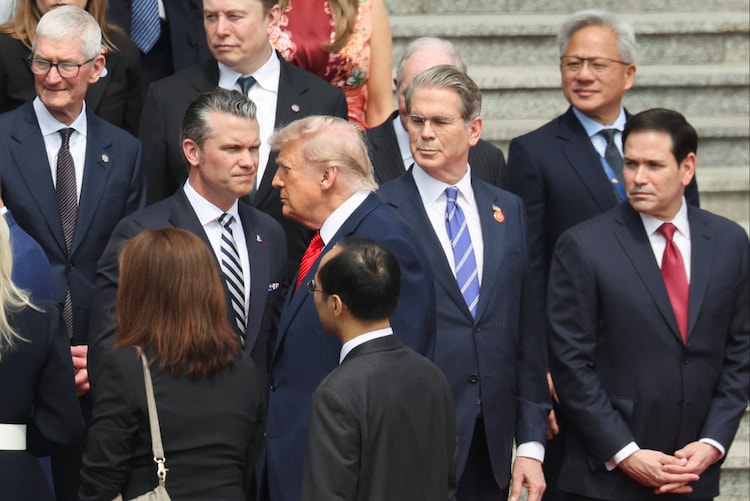
Why Trump took Elon Musk, Tim Cook, Jensen Huang, other top CEOs to China
Travelling with US President Trump are some of the world's biggest corporate names, including Elon Musk, Jensen Huang, Tim Cook and Larry Fink, along with executives from companies such as Meta, Visa, Goldman Sachs, Boeing and Mastercard.
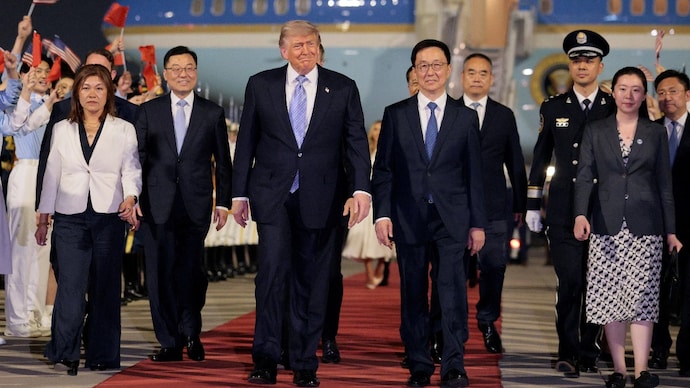
Delegation aims for business breakthroughs, not just diplomacy. (Photo: REUTERS/Evan Vucci)

New Delhi,UPDATED: May 14, 2026 10:25 IST
US President Donald Trump arrived in Beijing with an unusually large group of America’s top business and technology leaders, turning his China visit into far more than just a diplomatic summit.
Travelling with Trump are some of the world’s biggest corporate names, including Elon Musk, Jensen Huang, Tim Cook and Larry Fink, along with executives from companies such as Meta, Visa, Goldman Sachs, Boeing and Mastercard.
The scale and nature of the delegation has raised one key question: why has Trump brought so many business executives to China?
The answer appears to lie in a mix of business pressure, geopolitical competition and attempts to secure economic wins at a time when US-China relations remain tense but deeply interconnected.
NOT JUST A CEREMONIAL VISIT
Unlike Trump’s 2017 China visit, which focused heavily on large trade deals and grand public events, this trip appears far more targeted.
Many of the companies accompanying Trump are trying to resolve long-pending business and regulatory issues with China.
News agency Reuters reported that one of the conditions for companies to join the delegation was having a “tangible ask” that could potentially lead to a concrete agreement, regulatory approval or business breakthrough during or after the summit.
In short, many CEOs are not just accompanying the president for optics. They are there because they need something from Beijing.
WHY NVIDIA’S JENSEN HUANG IS IN CHINA
Nvidia CEO Jensen Huang’s presence is especially important.
Nvidia has been facing difficulties selling advanced artificial intelligence chips in China because of export controls and regulatory restrictions.
The company has reportedly struggled to secure approvals to sell its powerful H200 AI chips in the Chinese market.
China remains one of the world’s biggest AI and semiconductor markets, making regulatory access extremely important for Nvidia’s long-term growth.
ELON MUSK ALSO HAS BIG BUSINESS INTERESTS
Tesla CEO Elon Musk also has major business interests tied to China.
Tesla is seeking Chinese approval to expand the use of its Full Self-Driving assistance system in the country, the world’s biggest automobile market.
Tesla is also dependent on Chinese suppliers for solar manufacturing equipment.
Reuters had earlier reported that Tesla was planning to buy around $2.9 billion worth of solar equipment from Chinese suppliers, but approvals from Chinese authorities remain important for the expansion plans.
At the same time, China is considering restrictions on exports of solar manufacturing equipment to the United States, adding further uncertainty.
WHY APPLE, META AND WALL STREET ARE INTERESTED
For Apple CEO Tim Cook, China remains both a critical manufacturing base and a major consumer market.
Meanwhile, Reuters reported that Meta is dealing with pressure from Chinese authorities over its acquisition of artificial intelligence startup Manus.
The company reportedly needs to resolve regulatory concerns as China tightens scrutiny on foreign investment in sensitive technology sectors.
Financial giants are also seeking deeper access to Chinese markets.
Mastercard and Visa are hoping to improve their position in China’s tightly controlled payments market.
Mastercard is reportedly seeking a larger stake in its China joint venture, while Visa is hoping to enter China’s domestic bank-card clearing business with full ownership rights.
Similarly, Citigroup CEO Jane Fraser and Goldman Sachs CEO David Solomon are also part of the delegation as Wall Street firms continue trying to expand access to China’s financial markets.
CHINA STILL MATTERS DESPITE TENSIONS
The visit also highlights an important reality: despite years of trade tensions, technology restrictions and geopolitical rivalry, American companies still view China as too important to ignore.
Many of the firms travelling with Trump rely on China for manufacturing, supply chains, consumers or regulatory approvals.
Reuters quoted Reva Goujon, geopolitical strategist at Rhodium Group, as saying many companies in the delegation are there to secure access to critical inputs and supply chains.
“This could help the US administration’s messaging that to even be able to discuss a board of investment, China needs to be a reliable investment partner and not weaponise supply,” Goujon told Reuters.
TRUMP ALSO NEEDS ECONOMIC WINS
Trump’s China visit comes at a difficult time politically and economically.
The US economy is dealing with inflation concerns, market volatility and the economic impact of the Iran conflict.
Trump is also trying to maintain a fragile trade truce with China while showing American businesses and investors that his administration can still secure economic opportunities abroad.
That explains why the delegation includes companies from:
- artificial intelligence
- semiconductors
- finance
- aviation
- payments
- biotech
- agriculture
- and energy.
WHO IS PART OF THE US BUSINESS DELEGATION?
Apart from Musk, Huang, Cook and Fink, the delegation also includes:
- Dina Powell McCormick of Meta
- Kelly Ortberg of Boeing
- Ryan McInerney of Visa
- Stephen Schwarzman of Blackstone
- Brian Sikes of Cargill
- Jane Fraser of Citi
- Jim Anderson of Coherent
- Henry Lawrence Culp of GE Aerospace
- David Solomon of Goldman Sachs
- Jacob Thaysen of Illumina
- and Michael Miebach of Mastercard.
Analysts say the summit may not immediately produce major trade agreements, but it could help unlock stalled regulatory approvals and improve business communication channels between the two countries.
For many companies, even small regulatory progress in China could be worth billions of dollars in future business opportunities.
- Ends