
India vs US: Why India's AI strategy may have an edge over America's AI degree boom
As AI reshapes the job market, the US is rapidly launching dedicated AI degrees while India is integrating AI across higher education through policy reforms, curriculum changes, and campus technologies. While specialised AI degrees may help in technical roles, employers are likely to value practical AI skills and real-world application most.
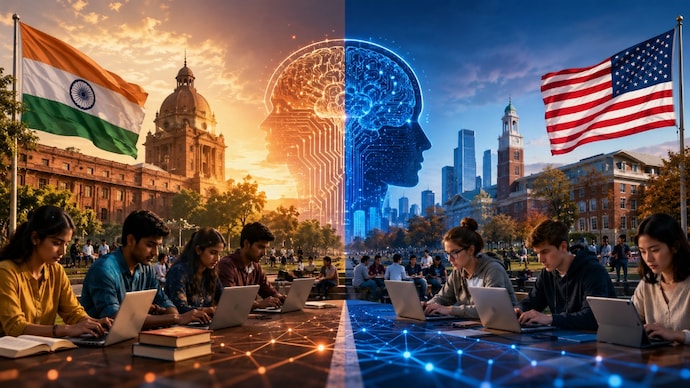
India vs US: How universities are taking different approaches to the AI revolution (AI generated image)

A few years ago, earning a degree in Artificial Intelligence sounded like something out of a science fiction novel. Today, it is becoming a reality.
As artificial intelligence reshapes industries, automates tasks, and changes the nature of work, universities around the world are scrambling to ensure their students remain relevant in an AI-driven economy. But while the United States is creating dedicated AI degrees at a rapid pace, India is taking a different route: embedding AI across higher education rather than building entire degree programmes around it.
The divergence raises a critical question for students and employers alike: In the future job market, will companies value an AI degree or AI skills?
THE AMERICAN APPROACH
In the United States, universities are moving at a speed rarely associated with higher education.
According to a report by The New York Times, only five American colleges offered an undergraduate major focused on Artificial Intelligence in 2021. Today, researchers at Northeastern University's Center for Inclusive Computing estimate that students can choose from at least 74 AI majors and 89 AI minors across US campuses.
The surge reflects a growing belief that AI will fundamentally alter the labour market and that students need specialised training to stay competitive.
Yet the new degrees look dramatically different from one institution to another. Some programmes dive deep into the mathematics, algorithms, and engineering that power AI systems. Others focus primarily on applying AI tools to solve real-world problems.
Universities see these programmes as a way to attract students who want specialised AI training without necessarily pursuing traditional computer science degrees. For some institutions, AI majors have also emerged as computer science enrolments have plateaued and graduates face a more challenging hiring environment.
However, the rapid expansion has sparked debate.
Critics question whether universities are prioritising relevance over rigour. As colleges race to launch AI programmes, some academics worry that institutions may be chasing a trend before industry standards have fully formed. After all, no one yet knows how employers will evaluate graduates holding degrees specifically labelled "Artificial Intelligence."
The rush has challenged the long-standing perception that higher education moves slowly. But it has also raised concerns about whether some programmes are being built around a buzzword rather than a well-defined academic discipline.
THE INDIAN APPROACH
While American universities are creating dedicated AI majors, India is integrating AI throughout the higher education ecosystem.
Artificial Intelligence, machine learning, big data analytics, blockchain, extended reality, and other emerging technologies are increasingly becoming part of university operations, curriculum design, research, and student learning.
The shift aligns closely with the goals of the National Education Policy (NEP) 2020, which emphasises innovation, interdisciplinary learning, critical thinking, and digital readiness.

Speaking at the India Today Conclave 2026, Higher Education Secretary and UGC Chairperson Vineet Joshi highlighted how Indian institutions are building indigenous AI capabilities and innovation ecosystems.
"If you look at IIT Madras, the innovations happening there are as good as or better than many global counterparts. India's decentralised system allows multiple models to thrive, reflecting the diversity of our country," Joshi said.
The government is also looking to deepen AI integration through its proposed Education-to-Employment Committee, which aims to align educational outcomes more closely with industry requirements. According to Joshi, institutions are increasingly using mentoring systems and personalised support mechanisms to help students adapt to rapidly changing skill demands.
The momentum is already visible on campuses.
According to the EY-Parthenon–FICCI report, Future-Ready Campuses: Unlocking the Power of AI in Higher Education, more than 60 per cent of higher education institutions in India now permit students to use AI tools. Meanwhile, 53 per cent have begun using generative AI to create learning materials.
The report further reveals that 40 per cent of institutions have deployed AI-powered tutoring systems and chatbots, 39 per cent use adaptive learning platforms, and 38 per cent employ AI for automated grading.
These numbers suggest that Indian higher education is no longer merely preparing students for AI—it is already operating with AI.
BUILDING AN AI ECOSYSTEM
India's AI ambitions extend far beyond classrooms.
The IndiaAI Mission, launched in March 2024 with an allocation of 10,371.92 crore over five years, seeks to build the infrastructure necessary for the country's AI ecosystem. The initiative supports computing infrastructure, dataset development, and AI applications across sectors, including education.
The government's undergraduate curriculum framework, introduced in 2022, includes subjects such as AI, machine learning, big data analytics, drone technology, deep learning, and advanced manufacturing.
Meanwhile, the All India Council for Technical Education (AICTE) has incorporated AI components into IT-related courses, launched AI-focused hackathons, and expanded faculty training programmes.

In another major initiative, IndiaAI and Meta established the Centre for Generative AI, Srijan, at IIT Jodhpur and launched the YuvAi Initiative in collaboration with the Ministry of Electronics and Information Technology and AICTE. The programme aims to train 100,000 students and developers aged 18 to 30 over three years, focusing on AI applications in healthcare, agriculture, education, smart cities, and financial inclusion.
The emphasis is clear: India is not simply creating AI specialists—it is attempting to create an AI-literate workforce.
DEGREES VS SKILLS: WHICH MODEL WILL WIN?
The contrast between the United States and India is striking.
America is building specialised AI degrees, betting that dedicated credentials will become valuable signals in the labour market. India, meanwhile, is embedding AI capabilities across disciplines, betting that AI will become a foundational skill much like digital literacy or internet proficiency.
The reality, however, is that employers may care less about the label on a degree and more about what graduates can actually do.
A company hiring an AI engineer may value a specialised AI degree because it demonstrates deep technical expertise in machine learning models, neural networks, and algorithm development. But for most jobs—from marketing and finance to healthcare and education—employers are increasingly looking for candidates who can effectively use AI tools to improve productivity, solve problems, and innovate within their field.

In that sense, AI skills may ultimately prove more important than AI degrees alone.
A specialised AI degree without practical skills may have limited value. Conversely, a graduate in business, engineering, journalism, medicine, or economics who can successfully leverage AI tools may enjoy a significant competitive advantage.
THE BOTTOM LINE
Will companies trust an AI degree or AI skills?
The answer is likely both, but skills will matter more.
Degrees may help candidates get noticed, especially in highly technical roles. Yet as AI becomes embedded across every profession, employers will increasingly evaluate whether applicants can apply AI effectively in real-world situations.
The future may not belong solely to students with AI degrees. It may belong to students from every discipline who know how to work alongside AI.
And while the United States is experimenting with specialised AI credentials, India appears to be preparing for a world where AI literacy is not a separate qualification, but a basic expectation.
- Ends