
Iran's viral Donald Trump meme recalls when Persia captured a Roman emperor
A viral meme from the Iran Embassy in India featuring Donald Trump has revived the story of Shapur I, the Persian king who captured Roman emperor Valerian in 260 CE. The imagery flips the script, casting West Asia as the power centre and the West as subdued, echoing an ancient moment when Persia held the upper hand over Rome.
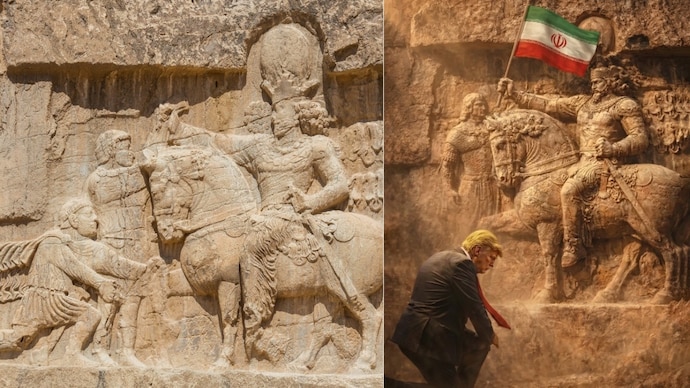
A viral meme has revived the story of Shapur I's capture of Roman emperor Valerian in 260 CE. (Photos: (l) Relief of triumph of Shapur I over Valerian at Naqsh-e Rostam, Iran (Wikimedia Commons) | (r) Donald Trump meme by @Iran_in_India)

New Delhi,UPDATED: Apr 11, 2026 16:42 IST
He’s on one knee, head lowered, tie slipping into the dust. Behind him, a Persian king carved into rock sits upright on horseback, unmoved, almost eternal.
The viral image from the Iranian Embassy in India featuring the image of Donald Trump in the midst of the Iran-US-Israel war isn’t basic trolling, but pulls from a very specific historical moment.
It speaks of the one time when Rome, the ancient superpower that controlled vast parts of Europe, North Africa, and West Asia, lost more than a battle. It lost face.
The man behind that moment was Shapur I.
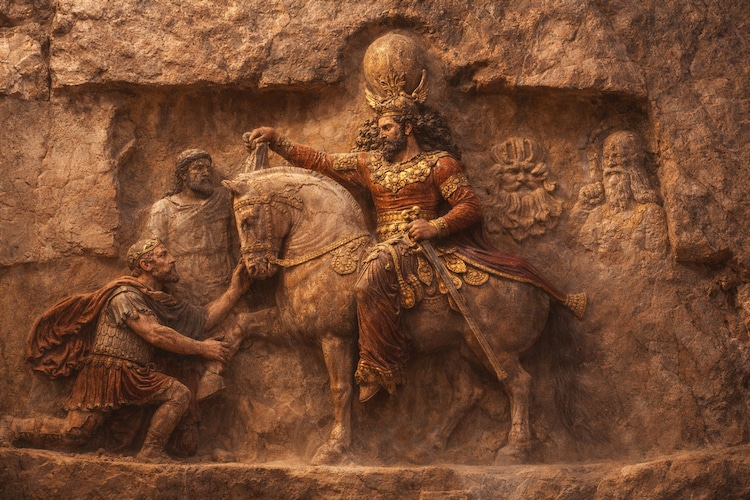
And the one kneeling was Roman Emperor Valerian, who ruled during a period of deep crisis for the Roman Empire.
The incident marked the first and only time a Roman emperor was taken prisoner by a foreign ruler.
THE KING WHO GREW UP AROUND EMPIRE
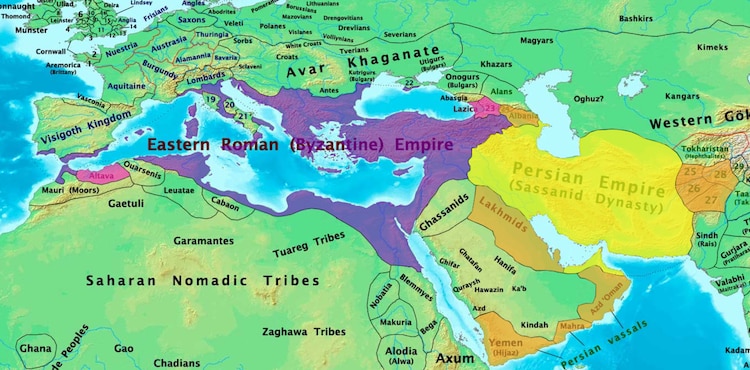
For centuries, the Roman Empire and the Sasanian Empire stood as rival superpowers, locked in a constant struggle over land, trade routes, and influence across West Asia. They weren’t just neighbours but the two biggest forces of their time, each testing how far the other could be pushed.
Founded in 224 CE by Ardashir I after defeating the Parthians, the Sasanian Empire became the last great pre-Islamic Persian power. With its capital at Ctesiphon near present-day Baghdad, it ruled over vast regions of modern Iran, Iraq, and beyond, backed by a centralised state and Zoroastrian institutions.
Shapur I, the son of Ardashir I, was not an accidental conqueror. He was born into that system, into expansion already in motion. By the time he took over, the direction was clear -- expansion, not defence.
He pushed hard and early. Cities like Nisibis and Carrhae in northern Mesopotamia fell to him, a region that sat between the Roman and Persian worlds and was constantly fought over for control of trade routes and military access between East and West.
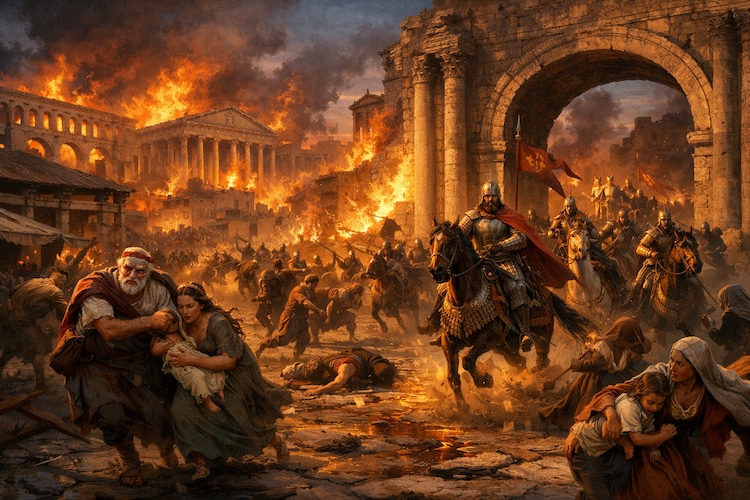
He advanced deep into Roman Syria, even sacking Antioch at one point, a major ancient city founded in 300 BCE and one of the Roman Empire’s most important urban centres outside Italy. It was wealthy, crowded, and politically important. Taking it was not just about loot, but about making a statement.
There were setbacks too. He was defeated at Resaina in 243 by Roman forces under Emperor Gordian III. But even that did not slow him down for long. Within a year, after Gordian’s death, Shapur negotiated a favourable peace with Rome, giving him time to regroup and return stronger.
THE MOMENT THAT CHANGED EVERYTHING
By 260 CE, Rome was struggling internally. Emperors were rising and falling quickly, armies were stretched thin, and multiple frontiers were under pressure at once. Historians often describe this phase as part of the ‘Crisis of the Third Century’.
Shapur saw the opening.
At the Battle of Edessa, near present-day Urfa in Turkey, Roman resistance finally gave way. Emperor Valerian led the campaign himself, trying to restore control in the eastern provinces.
It didn’t work.
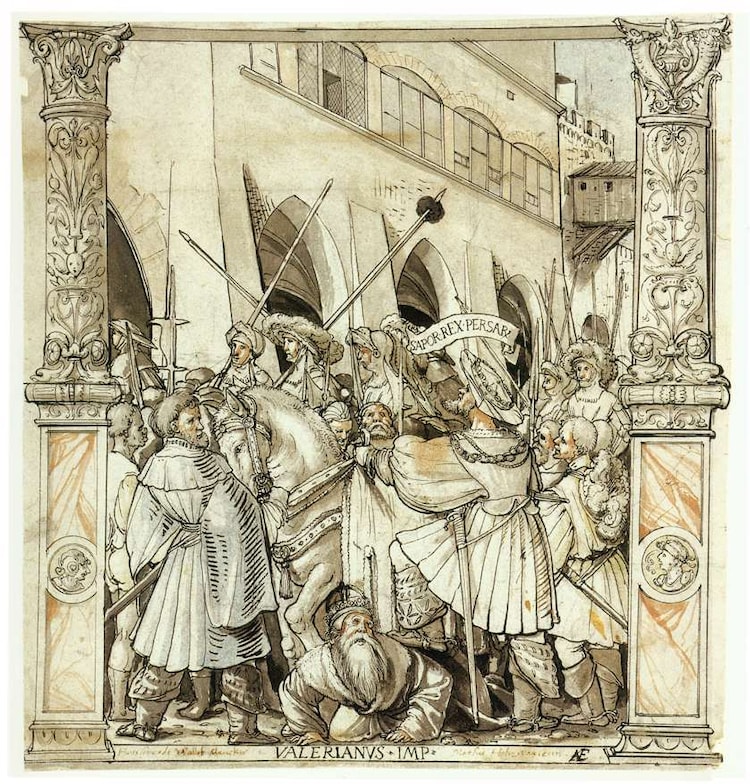
The Roman army was weakened by disease, exhaustion, and poor positioning. What followed was not a heroic last stand, but a collapse. Valerian entered negotiations with Shapur.
But he never returned as emperor.
He spent the remainder of his life in Persian custody, making him the only Roman ruler known to have ended up like this. For an empire that built its identity on strength and authority, this was a deep shock.
Shapur did not let the moment fade into memory. He had it carved into rock. At archaeological sites like Naqsh-e Rustam in Iran, massive reliefs show a Roman emperor standing or bowing before him, turning victory into something permanent.
It wasn’t just a win. It was a message, etched in stone for anyone who came after.
WHAT SHAPUR DID WITH VICTORY
Shapur did not try to permanently occupy Roman lands. Holding distant territories was difficult and expensive.
Instead, he took something far more valuable -- people.
After the sack of Antioch and other campaigns, thousands of Roman captives were taken back into Persian territory. These were not just prisoners. Many were skilled workers, engineers, architects, and craftsmen trained in Roman methods.
They were used to build.
The city of Gondeshapur in southwestern Iran, which later became a major centre of medicine and learning, was developed using these captives.
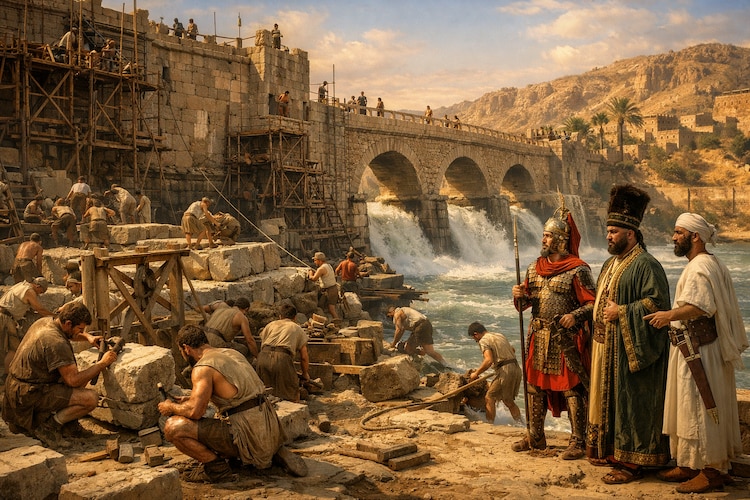
The famous Band-e Qeysar, a large dam and bridge structure at Shushtar, was also built using Roman engineering skill. Its name, meaning ‘Dam of Caesar’, still carries the memory of that captured emperor.
Shapur was not just winning wars. He was turning victory into long-term advantage.
MORE THAN A CONQUEROR
Shapur I also reshaped how he saw himself.
Unlike his father, who styled himself “king of kings of Iran”, Shapur expanded the title to “king of kings of Iran and non-Iran”. It was a clear signal that his authority extended beyond Persian lands into conquered territories.
Religiously, he was rooted in Zoroastrianism, the dominant faith of the empire, but he was not rigid. He supported fire temples and priesthood structures while also showing interest in other belief systems.
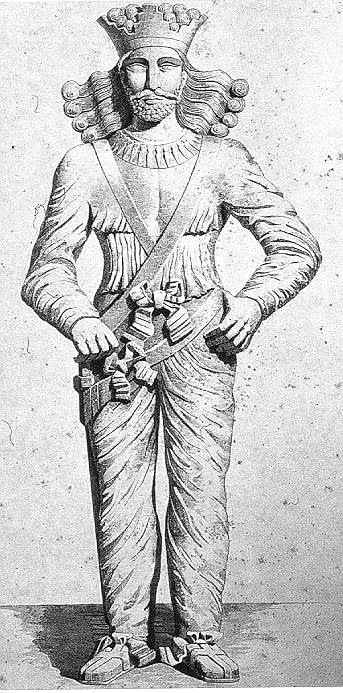
He is known to have extended patronage to Mani, a Persian prophet and religious teacher whose teachings blended elements from multiple traditions, suggesting Shapur was open to building a broader ideological base for his rule.
WHY HE STILL SHOWS UP TODAY
Now go back to that image shared by the Iran Embassy in India again.
A modern political figure resembling Donald Trump kneels before a Persian king.
It’s not about literal comparison. It’s about memory being reused.
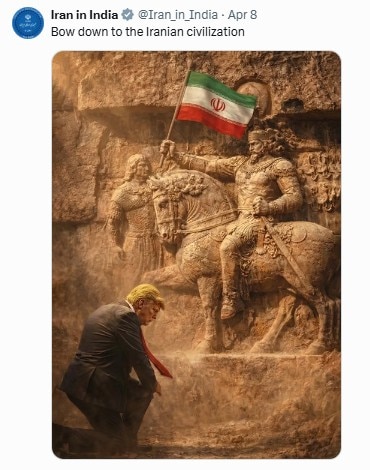
Shapur I represents a rare moment when a dominant global power was forced into an uncomfortable position. That is why his image keeps resurfacing. Not because people are suddenly interested in ancient history, but because this one episode still holds teeth.
In today’s context, Rome often stands in for Western power, especially the United States, while ancient Persia is invoked to represent Iran’s long civilisational identity.
Power can shift. That is the message.
And Shapur I made sure the world would remember that.
- Ends