
Hindu entrepreneurship predates modern capitalism, inspiring startups
A study on Hindu religious entrepreneurship traces how founders are drawing on Dharma, Artha and scriptures in modern ventures. It argues that colonial-era divides and gaps in business literature have obscured these traditions' economic relevance.
Study finds Hindu thought offers an overlooked framework for entrepreneurship

New Delhi,UPDATED: May 23, 2026 23:24 IST
A research paper recently came out from the corridors of the University of Glasgow. An Indian professor published a study titled ‘Understanding Hindu Religious Entrepreneurship: A Translation Perspective’.
At first glance, it may appear to be centred on religion, as Hinduism is often perceived globally.
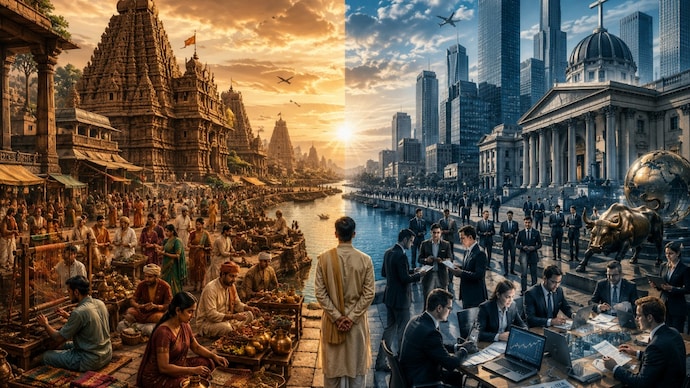
The paper, however, explores something different. It examines how the idea of entrepreneurship, with deep roots in India and often associated with the Vaishya community (The idea of the Vaishya community derives from Vedic texts and was originally rooted in occupational classification), differs from Western notions of capitalism, especially in the understanding of wealth, enterprise and economic activity.
Before the time when terms like startups, unicorns, venture capital or even entrepreneurship walks into everyday language, Indian thought had already placed Artha — economic well-being — among the four Purusharthas, alongside Dharma (duty), Kama (desire) and Moksha (liberation). Wealth, in this framework, was not separate from ethics or social responsibility.
Professor Sreevas Sahasranamam revisits this idea. The study, based on conversations with 15 Hindu entrepreneurs, explores what the author calls Hindu entrepreneurship.
Many who participated in the study did not see business only as a way to generate profit.
For them, enterprise was also linked with values rooted deep in culture, responsibility towards communities, ethical soundness and a sense that talks of society as one.
The paper enters a wider discussion around modern capitalism, often criticised for encouraging accumulation without limits and heavy use of resources.
In contrast, the study argues that Hindu approaches to entrepreneurship have historically placed importance on balance — between wealth and duty, growth and nature, individual gain and social contribution.
This raises a question: how has India viewed wealth?
Modern conversations on entrepreneurship often turn to names such as Bill Gates, Elon Musk, Jeff Bezos or Mark Zuckerberg. Discussions on capitalism frequently move towards industrial-era London, Wall Street or Silicon Valley.
Within these ideas sits another assumption — that India produced philosophers and spiritual traditions, but not systems of trade or enterprise.
History points to a more layered picture.
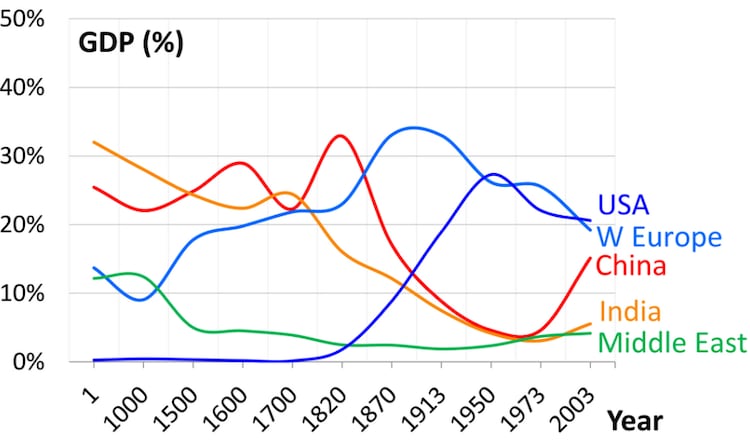
India’s contribution to nearly 33% of the global economy around two millennia ago offers one indication.
Trade routes expanded because Indian goods travelled across regions and remained in demand. Merchants from southern India built maritime links, and commerce connected places long before modern business schools existed.
Trade was not new to the subcontinent. Nor was the idea that wealth carried responsibility.
Even Indian rulers and merchants, at times, linked wealth with duty. One example often cited comes from the 16th century.
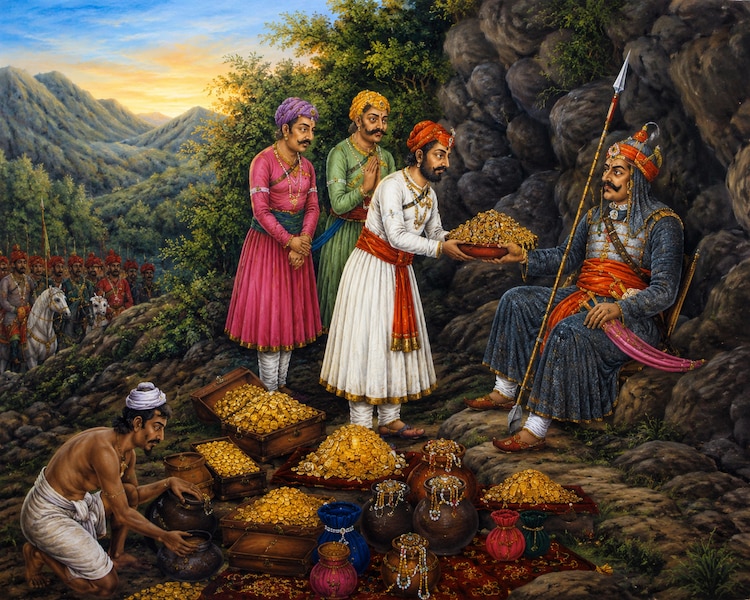
The offering made by Bhamashah, who belonged to the Vaishya community, during Maharana Pratap’s battle against Mughal emperor Akbar reflects how Hindu thought often linked wealth with Dharma and Karma. The episode points towards an idea of responsibility tied to a larger collective cause.
THE OLD NATIVE CONCEPT
Recent findings linked to inscriptions discovered inside an Egyptian pyramid suggest that as early as the 2nd century BCE, regions of southern India were exchanging goods in significant quantities with distant civilisations.
Indian commodities were in demand from East to West. Evidence survives in Song China from around a millennium ago, while the West imported Indian products for centuries, long before terms like ‘market expansion’ and ‘scaling’ entered business language.
Closer to home, villages, and even present-day cities, offer glimpses of how deeply the idea of entrepreneurship has existed across the length and breadth of this land, often tracing back to some of the world’s oldest civilisations.
A potter shaping clay into utensils, pastoral communities selling dairy products, forest-dwelling groups turning honey, herbs or bamboo into everyday goods, weavers producing textiles, blacksmiths crafting tools, or local traders moving commodities between regions, enterprise was woven into ordinary life long before the language of startups and business models emerged.
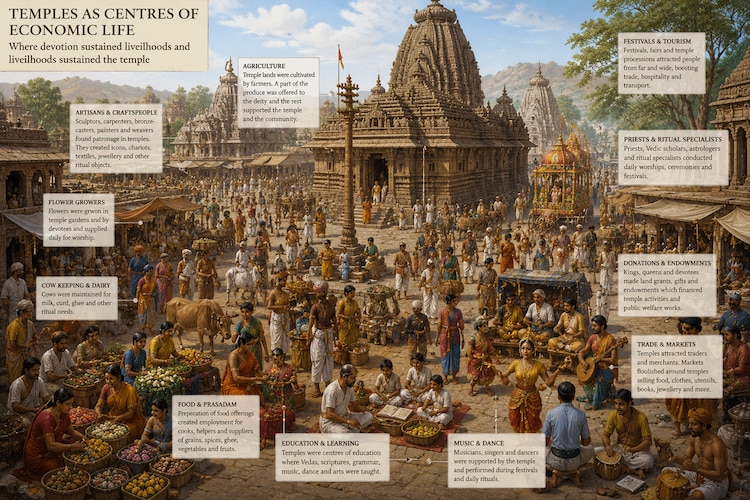
The temple economies, banking networks and philosophical frameworks did not separate ethics from economic activity.
Economic activity was not outside morality. It was expected to function within it.
The irony is difficult to miss.
For decades, research explored Christianity and entrepreneurship, Protestant ethics and capitalism, Islamic finance and enterprise.
Hinduism, despite having nearly 1.2 billion followers, remained largely absent. The paper notes that only two studies explicitly focused on Hinduism in entrepreneurship literature.
Perhaps some ideas disappear not because they lack value, but because nobody writes them into textbooks.
THE EMPIRE THAT CHANGED HOW INDIANS THOUGHT ABOUT WORK
Colonialism altered more than institutions. It rearranged categories inside the mind.
British educational systems and colonial administration introduced ideas where modernity increasingly became associated with Western secular frameworks, while indigenous traditions became confined to private life.
Religion remained at home; ambition entered the office. Sacred and professional became separate rooms in the same person.
Professor Sreevas Sahasranamam explained this divide while discussing Protestant capitalism:
“The sacred became restricted to the private sphere, while the secular was what modern capitalism and professional life were associated with. That boundary really came into existence in countries like India.”
The paper describes this as a “fractured mind” and “double consciousness,” where indigenous philosophies became detached from professional identity.
Modern Indian society inherited many things from Britishers, colonialism left for India railways, bureaucracy, examinations and perhaps an enduring suspicion that tradition and modernity cannot share a table.
According to Measuring Ancient Inequality (World Bank, 2007), by Branko Milanovi, Peter H Lindert and Jeffrey G. Williamson, income distribution across social groups showed significant disparities.
| Social Group | Share of Population (%) | Share of Total Income (%) | Income Relative to Per-Capita Mean |
|---|---|---|---|
| Nobility, Zamindars | 1 | 15 | 15.0 |
| Merchants to Sweepers | 17 | 37 | 2.2 |
| Village Economy | 72 | 45 | 0.6 |
| Tribal Economy | 10 | 3 | 0.3 |
| Total | 100 | 100 | 1.0 |
(Late Mughal economy's income distribution, 1750)
A PODCAST ON AI LED TO AN UNEXPECTED QUESTION
Around late 2023, Scotland’s AI circles sought a Hindu view for discussions concerning technology and religion.
A question was put forth: How might AI influence Hinduism in the next fifty or hundred years? Professor Sreevas Sahasranamam offered his thoughts.
A blog on AI and Hinduism followed.
Then came messages from startup founders.
Soon, entrepreneurs working between emerging technologies and Indian traditions began approaching him.
Some were building AI tools trained on scriptures. Others were recreating temple experiences through virtual reality or designing educational products rooted in older philosophical systems. What began as a response to a question slowly became research.
Interviews with entrepreneurs revealed a pattern that sat apart from ordinary startup discourse. Many did not begin by speaking of valuation, investment rounds or exits.
Their concerns were different. They spoke of recovering heritage, translating old knowledge and fulfilling what they regarded as duty.
Another observation returned often. During periods of success, many entrepreneurs relied upon modern motivational systems, talks, books and frameworks meant to sharpen ambition.
Yet when confronted with personal difficulty, some found these tools lacking. Professor Sahasranamam recalled that entrepreneurs often turned elsewhere.
He noted: “When they were doing well professionally, they would engage with TED Talks or motivational speakers. But when they were going through difficult times, those didn’t resonate as much. Instead, they would turn to something like the Bhagavad Gita for guidance.” One respondent in the study expressed a similar thought, saying that while self-help literature once inspired him, what eventually helped was the Bhagavad Gita.
The finding carries a small irony. The modern world has built an industry around productivity. Yet, in moments of uncertainty, people often return to texts older than the nation-state itself.
The strongest departure from conventional capitalist thinking appeared in the matter of intention. Researchers found that many entrepreneurs did not place profit at the beginning of enterprise.
Instead, they regarded business as Dharma, moral duty.
Professor Sahasranamam explained: “Many of them said that when they started, they were not prioritising profit. Instead, they saw their work as dharma, a moral duty.” This belief shaped practical decisions. One venture building virtual reality products reportedly introduced compulsory breaks for users rather than encouraging endless engagement. In most technology companies, prolonged attention is revenue.
Here, restraint was introduced deliberately.
Indian entrepreneurs of the 20th century, in many ways, carried forward older ideas around enterprise and social responsibility. Names such as Jamsetji Tata and Dhirubhai Ambani became important figures in India’s industrial growth.
The legacy of the Tata Group is often cited in discussions around philanthropy, institution-building and long-term business thinking.
Mahindra Group, whose early years were shaped by the period around Partition, is another example.
Its current leadership has often spoken about purpose in business alongside profit. For some, such approaches reflect ideas associated with Dharma, where enterprise is linked not only to growth, but also to responsibility.
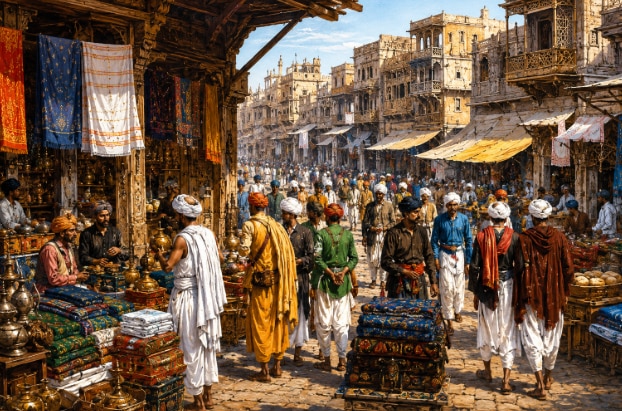
CAN SACRED TEXTS, EPICS AND ARTHASHASTRA INFLUENCE MODERN STARTUPS?
The study further observed that such ventures often preferred open sharing of knowledge and were less inclined towards secrecy around ideas. Knowledge, in several cases, was treated as something to be circulated rather than guarded.
This approach stands apart from modern startup culture, where intellectual property often sits near the centre of value.
Researchers identified varied forms of what they call Hindu entrepreneurship. Some founders create comic books and games drawn from epics. Others train AI systems on Sanskrit texts.
Some use Arthashastra in management training or Nyaya Shastra in negotiation.
The very possibility of bringing older concepts into contemporary life points towards a revival of these ideas and the sentiments associated with them.
The paper repeatedly uses this notion of translation, not merely between languages, but across time and across minds shaped by different histories.
Beneath the study lies another question. If Artha, or economic prosperity, has long existed within Hindu thought, why has Hinduism often been described as indifferent to entrepreneurship?
Professor Sahasranamam addressed this contradiction directly, noting that some earlier studies suggested Hinduism discouraged entrepreneurship, despite Artha being one of the recognised aims of life within the Purushartha framework. The paper argues that economic activity was never absent from Hindu philosophy; rather, interpretations around it changed over time.
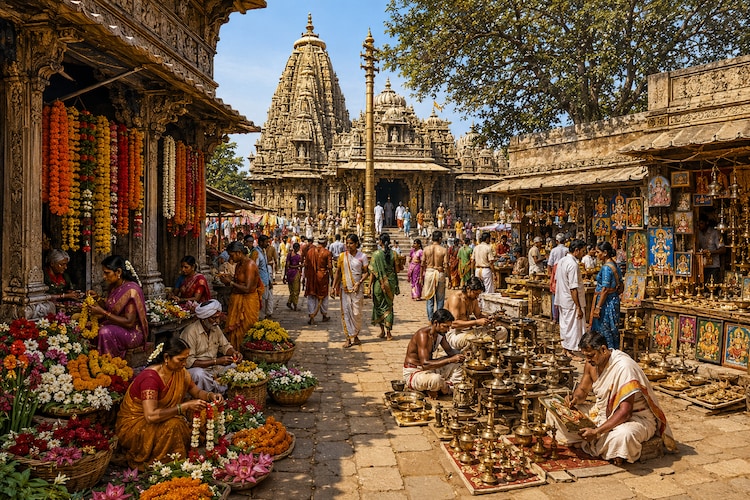
India’s startup economy now speaks in valuations, funding rounds and unicorn status.
Yet another conversation appears to be returning more silently.
It raises questions about whether business can exist alongside duty, whether profit can remain accountable to society, and whether older philosophical ideas still have a place in modern markets.
Professor Sahasranamam also spoke about another challenge, balancing commercialisation with spirituality and belief. As these ideas enter business and entrepreneurship, maintaining the original purpose becomes important.
“Maintaining the balance and finding the right objective becomes more important,” said Professor Sahasranamam.
The answer remains unfinished. Yet one observation persists.
For centuries, India did not merely produce merchants or kingdoms. It produced a framework where Karma was action, Dharma was duty and restraint, and Artha was accepted as a rightful pursuit.
- Ends