

Netflix's Desi Bling is patriarchy repackaged in 40kg gold
Netflix's Desi Bling follows Dubai's ultra-rich Indian expats as power and marriage collide on camera. Beneath the gold, champagne and Burj Khalifa views, the series exposes patriarchy repackaged as aspiration.
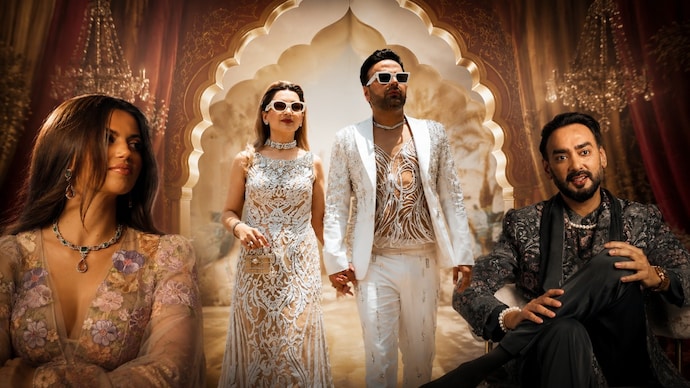
Desi Bling is what happens when patriarchy gets rich. And its deeply unsettling. (Image credit: Author)

New Delhi,UPDATED: May 26, 2026 07:30 IST
The word is... Desi Bling is outright problematic. That's it.
The latest Netflix show about Indian expats opens like every modern luxury reality show wants to. At the centre of the show are billionaire businessman Satish Sanpal and his wife Tabinda, or Binda, whose life is essentially a Pinterest board for maximalist luxury. At one point, she casually reveals she owns 40 kilograms of gold worth over Rs 200 crore and receives another three kilos every Dhanteras.
In another moment – perhaps the show’s most revealing scene – she says she has been massaging her husband’s feet every morning for nine years because he believes it brings "lakshmi" (prosperity). “He wakes up like a prince,” she says.
The wife has also apparently been cutting her husband’s nails ever since marriage, turning matrimony into what looks less like partnership and more like a lifetime premium grooming subscription.
Their world is all about jazz. Everything that sparkles in the Sanpals’ universe is indeed gold. The other couples are equally obsessed with the same lifestyle: cue drone shots of Dubai skylines, Burj Khalifa apartments, champagne towers, and supercars parked like props outside mansions so massive they resemble boutique hotels. Everyone is dripping in couture and diamonds, speaking the language of “hustle”, “success” and “legacy”.
But beneath all the sparkle, the Netflix series is staging something far older and far less glamorous: patriarchy - a glimpse of which we have already discussed above. Not the dusty, visibly oppressive kind that arrives announcing itself. This one comes polished in Cartier, softened by wealth, and hidden under the glow of aspirational excess.
And somehow, that makes it worse.
Patriarchy, but make it luxury
The series follows wealthy Indian expats in Dubai, many of them self-made entrepreneurs who speak proudly about building empires from scratch. Yet the women orbiting these empires are often expected to perform startlingly old-fashioned roles, as though financial progress arrived, but social progress got stuck in customs.
Which is why Desi Bling stops feeling like reality television and starts resembling a gilded time capsule.
The unsettling part is not merely the ritual itself. Adults can structure relationships however they want. The problem is the ecosystem around it – the larger expectation that devotion from women must be unconditional, performative and endless, while men remain the providers whose flaws are to be tolerated as part of the package.
Throughout the show, male cast members repeatedly fall back on the same script: I provide. I pay for everything. I built this life. The implication hangs heavily in the air. Therefore, wives must adjust. Wealth becomes less a shared resource and more a bargaining chip in deeply unequal relationships.
Dubai skyline, feudal mindset
This is where Desi Bling becomes fascinating in the worst way possible. The patriarchy on display is not born from economic dependence or lack of exposure. These are globally mobile millionaires living in one of the world’s most cosmopolitan cities. Yet the emotional architecture of many relationships feels deeply feudal.
Tabinda speaks about moving beyond jealousy and fully trusting her husband despite references to his alleged infidelity and late-night partying. Her reward, the show subtly suggests, is status, luxury and the prestige of being “Mrs Satish Sanpal”.
In one unintentionally brutal moment, she gives relationship advice to actor Karan Kundrra about his partner Tejasswi Prakash not being the right match for him. Karan later says in a confessional tone that her only identity is to be Satish’s wife.
The irony practically writes itself.
‘Alpha men’ and other red flags
Elsewhere, Pamala Serena – introduced with a long list of pageant titles and even longer lashes – cuts through the group’s fake niceness with refreshing bluntness. But even her storyline eventually crashes into the same patriarchal wall. In a jaw-dropping exchange with her ex, AP, Pamala is told that while he is happily single, she is “not allowed” to move on because he is, wait for it, an “alpha man”. And she agrees.
The confidence with which he announces this deeply unserious logic is almost impressive. Beneath the views and labels, it is still the same old script: men treating freedom like a personal right and women like a pending approval request.
Wives/women are judged for speaking too loudly, demanding accountability, or refusing submission disguised as “respect”. The women are expected to maintain appearances; the men are expected to maintain power.
When luxury starts looking like a cage
Then comes the most uncomfortable storyline of all – Dyuti Parruck and his wife Iryna Kinakh. Their relationship peels away whatever glossy illusion the show still tries to maintain.
Iryna speaks about feeling isolated and emotionally unsupported while Dyuti repeatedly minimises her concerns, including issues surrounding his alleged alcoholism. Her fear is not merely emotional. It is structural. She speaks about vulnerability within systems that are not always kind to women.
And that is the real story Desi Bling accidentally tells.
Money does not automatically modernise people. Sometimes, it simply upgrades the prison.
What makes the show especially jarring is how disconnected it feels from the direction contemporary urban India is moving towards. Across cities, more women are financially independent than ever before. Women lead startups, dominate university classrooms, delay marriage, question unpaid emotional labour and increasingly reject relationships built on obedience masquerading as tradition. But in Desi Bling’s far-from-desi world, women are either wives, home-breakers, exes, or endlessly pining for male attention.
The bling fades. The misogyny doesn’t
Desi Bling exists inside a strange parallel universe where billionaires still expect emotional feudalism from women, just with better lighting and imported marble flooring. The series tries very hard to frame this world as aspirational.
The camera lingers lovingly on couture outfits, luxury gifts and extravagant homes. But the more it flaunts the lifestyle, the more hollow the relationships underneath begin to look. Because what is luxury worth if autonomy is still negotiable?
That contradiction becomes the show’s defining image: women buried in gold yet denied individuality. Husbands speaking of love while expecting devotion that borders on worship. Pink Rolls-Royces for one-year-olds, private chefs and Burj Khalifa views - all functioning as distractions from the fact that the gender politics underneath remain painfully outdated.
To be fair, Tejasswi Prakash occasionally pushes back against the toxicity, and Karan shows moments of self-awareness. But even they are not fully immune to the show’s larger ecosystem, where outspoken women are treated as difficult and male defensiveness is normalised as authority.
And maybe that is why Desi Bling is on everyone's minds right now. Not because of the diamonds or the drama, but because it exposes how patriarchy survives by adapting. It no longer always arrives looking oppressive. Sometimes it arrives in a Bentley, hands you a diamond bracelet, calls you “queen”, and quietly expects your obedience in return.
The show wanted to sell viewers bling. What it accidentally revealed instead was the terrifying durability of gilded chains.
- Ends