
Doctor reacts to FSSAI's notice to food brands over no-added sugar claims
The FSSAI's reported action against misleading "no added sugar" claims has sparked a wider debate around jaggery, date sugar, and coconut sugar. Doctor and health influencer Dr Sivaranjini says consumers, especially parents, deserve clearer and more honest food labels.

FSSAI scrutiny fuels sugar-label row

New Delhi,UPDATED: May 21, 2026 12:36 IST
A fresh debate around “no added sugar” claims in packaged foods has erupted after the Food Safety and Standards Authority of India (FSSAI) reportedly sent notices to food brands over potentially misleading sugar-related marketing.
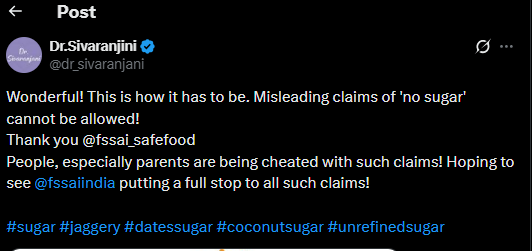
The issue gained major attention after a doctor and health influencer, Dr Sivaranjini, reacted strongly to the development on X (formerly Twitter), calling for stricter action against brands using alternative sweeteners while marketing products as healthier options.
Sharing a screenshot of the report, she wrote, “Wonderful! This is how it has to be. Misleading claims of ‘no sugar’ cannot be allowed!”
She further added that “people, especially parents, are being cheated with such claims,” while urging the food regulator to put a stop to confusing marketing around ingredients such as jaggery, date sugar, coconut sugar, and unrefined sugar.
Her remarks have now reignited an important conversation around how packaged foods are marketed in India and whether terms like “natural sugar” or “no added sugar” truly mean healthier choices for consumers.
WHAT IS THE CONTROVERSY?
The controversy revolves around packaged food brands using ingredients like date powder, jaggery, honey, or coconut sugar instead of refined white sugar while still promoting products with labels such as:
No added sugar
Naturally sweetened
Refined sugar-free
Unrefined sugar
Health experts say these terms can create the impression that the product is sugar-free or safe for unrestricted consumption, even though many of these ingredients can still increase blood sugar levels.
According to reports, the regulator believes claims must not mislead consumers into assuming products are significantly healthier simply because they use alternative sweeteners.
WHY DOCTORS ARE CONCERNED
Doctors and nutrition experts say the issue goes beyond technical food labeling and touches directly on public health awareness.
For many parents, labels like “no added sugar” often influence buying decisions for children’s snacks, cereals, chocolates, and health foods. Experts worry that consumers may unknowingly consume large amounts of sugar through products marketed as “natural” or “clean.”
Dr Sivaranjini highlighted exactly this concern in her social media post, warning against the growing use of ingredients like jaggery and date sugar in products promoted as healthier alternatives.
Nutritionists explain that while some natural sweeteners may contain small amounts of minerals or fibre, they still contribute sugar and calories to the diet. Excess consumption may still raise the risk of obesity, diabetes, fatty liver disease, and other metabolic disorders.
THE RISE OF ‘HEALTHY’ FOOD MARKETING
India’s health-food market has grown rapidly in recent years, with brands increasingly using wellness-focused claims to attract consumers.
Words such as:
Clean ingredients
Natural sweeteners
Chemical-free
Sugar-free
Healthy snacking
It has become common across supermarket shelves and online food platforms.
However, experts say many consumers do not fully understand the nutritional difference between refined sugar and alternative sweeteners.
Several doctors have repeatedly pointed out that the body still processes many of these sweeteners as sugar, even if they sound healthier on packaging.
COULD THIS CHANGE FOOD LABELING IN INDIA?
The latest scrutiny from FSSAI could become a turning point for food marketing in India.
Consumer rights advocates and legal experts say food labels should be transparent, scientifically accurate, and easy for ordinary buyers to understand.
The growing focus on sugar claims may also push brands to become more careful about how they advertise products targeted at health-conscious buyers and parents.
Meanwhile, social media users have largely supported stricter action against misleading health claims, with many calling for clearer front-pack labeling rules.
WHAT CONSUMERS SHOULD REMEMBER
Health experts say consumers should not rely only on marketing phrases printed on the front of food packets.
Instead, they recommend:
Reading ingredient lists carefully
Checking total sugar content
Watching portion sizes
Avoiding assumptions based on words like “natural” or “unrefined”
Doctors say moderation remains important regardless of whether sugar comes from white sugar, jaggery, honey, or dates.
As the debate continues, Dr Sivaranjini’s remarks have added momentum to growing demands for stronger regulation and greater honesty in health-food marketing.
- Ends