
CBSE Class 10 Results 2026: Podar Students Excel with Near-Perfect Scores
Press Release | The performance across multiple Podar schools also points to the importance of consistency.
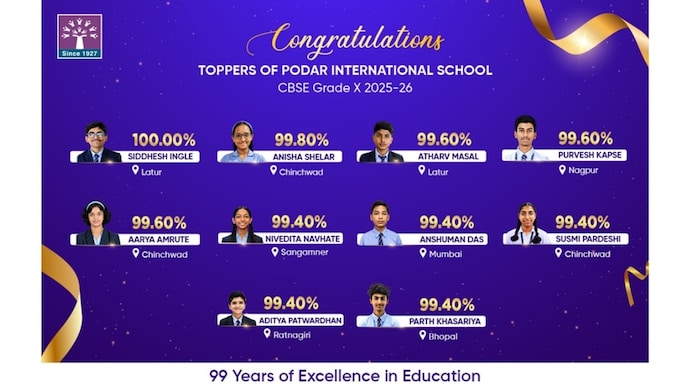

Students from Podar schools across India have achieved near-perfect scores in the CBSE Class 10 Results 2026, with the highest score reaching 100 per cent. The results include strong performances from students across Latur, Chinchwad, Nagpur, Sangamner, Mumbai, Ratnagiri, and Bhopal. Siddhesh Sachin Ingle from Podar International School (CBSE), Latur secured 100 per cent. Anisha Anil Shelar from Podar International School (CBSE), Chinchwad scored 99.80 per cent.
Three students secured 99.60 per cent. They are Atharv Dhulappa Masal from Podar International School (CBSE), Latur, Purvesh Manish Kapse from Podar International School (CBSE), Nagpur (Besa), and Aarya Nitin Amrute from Podar International School (CBSE), Chinchwad.
Five students secured 99.40 per cent. They are Nivedita Nivrutti Navhate from Podar International School (CBSE), Sangamner, Anshuman Das from R N Podar School (CBSE), Mumbai (Santacruz), Susmi Sachin Pardeshi from Podar International School (CBSE), Chinchwad, Aditya Amol Patwardhan from Podar International School (CBSE), Ratnagiri, and Parth Khasariya from Podar International School (CBSE), Bhopal.
While the scores are impressive, the larger story is not limited to marks. Near-perfect performance at the Class 10 level often reflects academic maturity. It shows how students have learnt to understand concepts, present answers clearly, manage time, and respond to feedback.
The Class 10 board examination is a defining stage in a student’s school journey. It is not only an academic checkpoint. It is also a transition point. Students move from foundational learning towards more specialised academic choices. The habits built during this year often shape how they approach higher classes.
An academic coordinator from Mumbai said, “Near-perfect scores are rarely about one examination day alone. They reflect how students understand feedback, refine their answers, and become more aware of their own learning process. That awareness is important for the next stage of education.”
This aspect of self-awareness was visible in the way students described their preparation. A student from Bhopal said, “Class 10 helped me understand how I learn best. I became more aware of my strengths and weak areas. That helped me make better decisions while preparing.”
A student from Sangamner shared a similar view. “I learnt that writing a correct answer is not always enough. It must also be clear, complete, and well-structured. Feedback from teachers helped me improve the way I presented my answers.”
The board year also teaches students how to work with greater independence. They learn to plan their study time. They learn to ask better questions. They also learn how to review their own work. These skills are useful beyond examinations.
For teachers, the focus during the board year is not only on syllabus completion. It is also about helping students develop academic discipline. Students need to know what to study. They also need to know how to think, write, revise, and apply what they have learnt.
Parents also play a steady role during the board year. Their support often shapes the emotional environment at home. A parent from Mumbai said, “We realised that comparison does not help during such an important year. What helped was giving the child space, routine, and encouragement. The school’s guidance made it easier for us to support the child in the right way.”
A parent from Nagpur added, “The result is a proud moment. But what stood out for us was the child’s growth during the year. There was more discipline, more responsibility, and better focus. These changes matter as much as the score.”
The role of student well-being remains central in any board examination journey. High academic expectations can create pressure. Students need support systems that help them stay balanced. They need encouragement to rest, reflect, and continue without fear.
An academic counsellor from Ratnagiri said, “A student’s emotional state affects learning. When students feel safe to ask questions and discuss difficulties, they become more confident. Well-being and performance should not be treated as separate areas.”
This approach is especially important in Class 10. Students often hear many opinions about marks, streams, future choices, and competition. A supportive environment helps them process these expectations. It also helps them make informed choices for the next academic phase.
The performance across multiple Podar schools also points to the importance of consistency. Top scores have come from different cities. This includes students from large urban centres as well as emerging education hubs. Such outcomes show how strong academic habits can develop across varied learning environments.
The near-perfect scores also reflect the value of collaboration. Students worked hard. Teachers guided them. Parents supported them. Counsellors helped them manage expectations. School teams created the structure needed for preparation. Each part of this ecosystem contributed to the final outcome.
As students move towards higher classes, these qualities will continue to be important. The next academic stage will bring new subjects, deeper concepts, and more independent study. The Class 10 experience gives students a strong base for that journey.
Podar Education Network congratulates all students who appeared for the CBSE Class 10 examinations. It also recognises the contribution of teachers, parents, counsellors, and school teams in supporting students through this important academic milestone.
Disclaimer: The material, content, and/or information contained within this impact feature are published strictly for advertorial purposes. T.V. Today Network Limited hereby disclaims any and all responsibility, representation, or endorsement with respect to the accuracy, reliability, or quality of the products and/or services featured or promoted herein. Viewers or consumers are strongly advised to conduct their own due diligence and make independent inquiries before relying on or making any decisions based on the information or claims presented in the impact feature. Any reliance placed on such content is strictly at the individual’s own discretion and risk.