
How BJP broad-based its community pitch with UP cabinet berths in run-up to polls
The BJP sent simultaneous signals to non-Yadav OBCs, Dalits and upper-caste voters while also balancing representation between Purvanchal, western and central UP
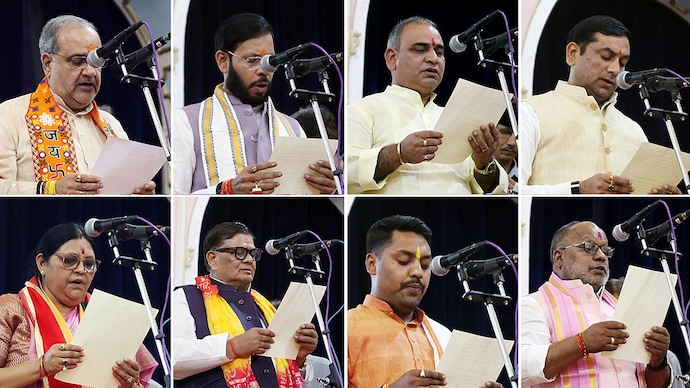

 Less than a year from the mega assembly election battle in Uttar Pradesh, the ruling BJP has gone for a politically significant expansion of the Yogi Adityanath cabinet. Six leaders have been inducted while two existing ministers were elevated.
Former BJP state president Bhupendra Chaudhary and party leader Manoj Pandey got berths while ministers of state Ajit Pal Singh and Somendra Tomar were elevated with independent charge. At the same time, Krishna Paswan, Surendra Diler, Hansraj Vishwakarma and Kailash Rajput were brought in as ministers of state.
The expansion has largely focused on social balancing, with the new faces including three leaders from OBC communities, two Scheduled Caste representatives, including one woman, and a prominent Brahmin face.
The expansion has taken the number of ministers to 60, the maximum allowed for the 403-member legislative assembly. It is also the second major reshuffle in the current term of the BJP government. The previous expansion took place before the 2024 Lok Sabha elections.
This time, the focus appears more clearly political. The BJP has tried to send simultaneous signals to multiple social groups, particularly non-Yadav OBCs, Dalits and upper-caste voters, while also balancing regional representation between western UP, Purvanchal and central UP. The exercise is widely being viewed as part of the BJP’s effort to counter the Samajwadi Party’s aggressive PDA (Pichada, Dalit, Alpasankhyak) pitch.
The biggest message came from the return of Bhupendra Chaudhary into the cabinet. A prominent Jat face from western UP, he has long been considered one of the BJP’s key organisational leaders in the region. His political journey goes back to the Ram Temple movement. Over time, Chaudhary built his reputation more as a cadre manager. He had previously served as panchayati raj minister before being moved to organisational responsibilities and appointed the BJP’s Uttar Pradesh president in 2022.
Chaudhary’s re-entry into the cabinet comes at a time when the BJP is trying to strengthen its hold in western UP after facing a difficult Lok Sabha election in several pockets of the region. The party also appears keen to keep influential Jat leadership visibly accommodated within both the government and the organisation.
Another crucial inclusion is of Manoj Pandey, the former Samajwadi Party MLA who gradually shifted closer to the BJP after cross-voting during the 2024 Rajya Sabha elections. Once considered close to Samajwadi Party chief Akhilesh Yadav and among the party’s key Brahmin faces, Pandey’s induction is being interpreted as a direct outreach to Brahmin voters, sections of whom are reportedly dissatisfied with the BJP government.
Pandey had served as minister and chief whip during the Samajwadi Party government of 2012-17. His induction allows the BJP to not only project Brahmin representation but showcase defections from the Opposition camp ahead of the 2027 polls.
The cabinet expansion also strongly reflects the BJP’s continuing emphasis on non-Yadav OBC and Dalit communities, which have become central to the party’s electoral strategy in UP over the past decade. Krishna Paswan, a four-time MLA from Fatehpur district, has been brought in as the only woman face in the expansion. A Pasi (Dalit) leader who rose through local politics and panchayat-level work, her induction helps the BJP combine two narratives at once: representation for women and recognition for grassroots workers. Her political career spans multiple electoral victories, including the Khaga assembly seat in Fatehpur in 2012, 2017 and 2022.
Surendra Diler’s induction is also socially significant. The BJP MLA from Khair belongs to the Valmiki community and comes from a politically influential Dalit family in western UP. With the BJP trying to deepen its outreach among Dalit sub-castes beyond its traditional support base, his inclusion is being seen as part of a broader caste recalibration.
From eastern UP, Hansraj Vishwakarma’s induction carries its own political signal. A long-time BJP organisational figure from Varanasi and a trusted cadre leader in Prime Minister Narendra Modi’s parliamentary constituency, he represents the OBC Vishwakarma community. His elevation comes amidst increasing Opposition attempts to accuse the BJP of neglecting artisan and backward caste groups.
Similarly, Kailash Rajput’s inclusion is being viewed through the lens of the BJP’s continuing effort to retain support among the Lodh community. A two-time MLA from Kannauj, Rajput has consistently held the ground for the BJP in a politically sensitive region closely identified with Akhilesh.
Beyond caste equations, the expansion also appears aimed at improving coordination between the party organisation and the government. Several of the new entrants have strong organisational backgrounds rather than purely ministerial experience. BJP leaders suggest that after the Lok Sabha results, the party has been trying to rebuild tighter political messaging at the grassroots level.
The reshuffle also reflects the BJP’s attempt to ensure that no major social bloc feels politically ignored before 2027. With the Samajwadi Party aggressively pushing social justice politics and the Congress trying to revive its own presence, the BJP appears to be relying once again on a broad caste coalition backed by organisational discipline and visible representation in power.
The Opposition, meanwhile, has begun questioning whether the expansion is driven more by electoral compulsions than governance priorities. Akhilesh said the BJP government had failed to address the concerns of people over the past nine years and questioned what the new ministers could achieve in the remaining time.
He alleged that corruption, inflation and unemployment had increased under the BJP government and claimed that “injustice” was being done to PDA communities. “The public is distressed. Development work is stalled. On the one hand, the BJP government is looting the government budget and on the other hand, it is looting the public's pockets,” he said.
Akhilesh also alleged that the cabinet expansion decision was taken by the BJP’s central leadership to clip the powers of the chief minister. “Has the slip arrived from Delhi? I have heard the cabinet in Uttar Pradesh is being expanded, or rather, the chief minister's power is being ‘reduced’. Someone should ask those in the cabinet. We demand that women be given a reservation in the UP-cabinet expansion,” he posted on X.
Akhilesh also questioned the BJP’s larger political calculations behind the exercise, particularly the accommodation of leaders who joined the party from other political formations. He asked what criteria were being used to select leaders from different communities and whether all defectors could eventually expect ministerial positions despite limited vacancies in the cabinet.
Subscribe to India Today Magazine