
NEET leak: As 2.2 million aspirants wait, India's exam system faces the trust test
Anxiety and emotional exhaustion are evident everywhere—in coaching centres, on social media and in student-parent conversations in homes
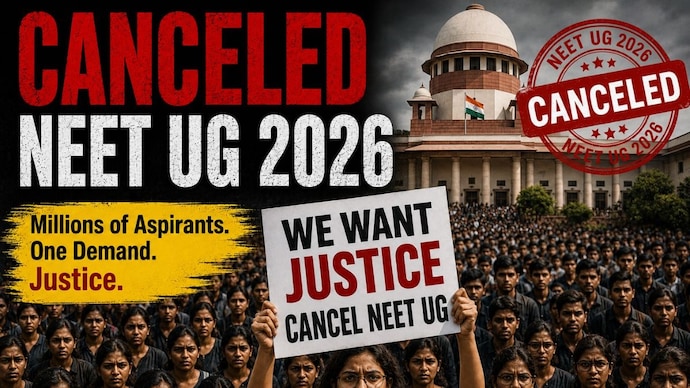

 For millions of Indian families, the national medical entrance examination is a years-long emotional and financial investment, a household mission, and often a defining milestone around which their children’s future is shaped. That is why the cancellation of the National Eligibility cum Entrance Test-Undergraduate (NEET-UG) 2026, following allegations of large-scale irregularities and paper leak, has triggered not just outrage but a deeper anxiety about the very credibility of the country’s entrance examination system.
Parents who spent years planning around one exam are struggling to explain to their children what happens next. Students who believed having appeared for NEET meant the hardest part was finally over are suddenly being told to start afresh.
By one estimate, around 118,000 medical education seats are up for grabs under NEET-UG. With over 2.2 million competitors for them affected by the cancellation, the controversy has once again exposed the enormous pressure, vulnerability and uncertainty that has creeped into India’s high-stakes examination system.
For scores of aspirants, NEET is not just a test. It is two or three years of missed birthdays, dormant social media accounts, stay in hostels in the coaching hub of Kota in Rajasthan, early morning preparatory classes and sacrificed hobbies. For their families, it is about repurposing their lives around a single, determined goal: securing a medical seat.
“This (NEET cancellation) is not just about one paper leak,” says Tushar Patel, a physics educator and academic innovation head at Infinity Learn, an online coaching platform for medical and engineering entrances. “It exposes how vulnerable India’s examination system has become in the digital era.”
Patel points out that exam controversies have surfaced repeatedly over the past decade. “When 2.2 million students depend on one exam, one paper, and thousands of distribution points, even a single breach can shatter the trust of the entire country,” he emphasises.
Clearing a medical entrance exam is rarely an individual battle. Entire households live through it together. Parents cut expenses to pay for coaching fees. Some families move cities. Others take loans. Many students spend four or five years preparing, making repeated attempts. “In India, it is never just one student giving an exam. The entire family gives the exam together,” says Patel. “So, when an exam gets cancelled, students do not just lose a test date. They feel like they are losing years of their life.”
That emotional exhaustion is now visible everywhere—in coaching centres, on social media groups, and in anxious conversations between parents and children in homes. For some students, the NEET cancellation may feel like an unexpected second chance. And yet, for those who walked out of the exam centre on May 3 believing they had performed good enough to secure a government medical college seat, the emotional blow is far deeper.
“These students trusted the system completely,” says Dr Anand Mani, founder of the Dr Anand Mani Residential Coaching and Mentorbox.ai, a platform for NEET preparation. “Now, they are being asked to prove themselves again because the system failed to protect their first attempt.”
Dr Mani describes the feeling as nothing short of betrayal. “Students had mentally moved into the counselling phase. Suddenly, pushing them back into preparation mode affects confidence and emotional stability,” he says. “The most painful part is that students are suffering while accountability still feels missing.”
Fear and anxiety have replaced confidence. What worries educators the most is not the NEET cancellation but the growing question mark over credibility of the exam process. “Earlier, students feared the difficulty level of NEET,” says Patel. “Now, many students fear whether the process itself will remain reliable till the final results are out. That shift is very serious.”
Also, the repeated controversies surrounding the National Testing Agency (NTA), which conducts NEET and other higher education entrances, have gradually altered the emotive quotient around competitive exams in India. Students are no longer only worried about ranks and cut-offs. They are worried about paper leaks, irregularities and whether hard work alone is enough anymore.
That uncertainty creates a dangerous form of cynicism, caution experts. For decades, exams like NEET represented hope for middle-class India that discipline and education could change the future of an entire generation. But repeated disruptions risk weakening that belief. As Kunwar Shekhar Vijendra, chairperson of the ASSOCHAM National Council on Education, puts it: “When faith in fairness weakens, motivation slowly turns into frustration.” Nothing could be more dangerous for India’s young and aspirational generation.
Many experts believe the current model itself may be outdated. “Managing a single paper-based exam for more than 2.2 million students across thousands of centres has become increasingly risky in a hyper-connected digital world,” says Vijendra.
Patel seconds the thought, adding: “One small breach can create nationwide panic within minutes.”
Following the NEET 2024 controversy (allegations of paper leaks and irregularities leading to a CBI inquiry), the K. Radhakrishnan Committee set up in the aftermath of the fiasco recommended stronger digital security systems, encrypted question papers, AI-based monitoring and gradual reforms in entrance exams.
Experts believe computer-based testing (CBT) may eventually become unavoidable. “JEE Main (engineering entrance) is already being conducted in CBT mode and is considered to be more secure,” says Dr Mani. “The questions can be randomised, which reduces the chances of a mass paper leak.”
Still, the transition won’t be simple. India currently lacks infrastructure to conduct a computer-based medical entrance examination for over 2.2 million students in one sitting, especially in the rural and remote regions. That is why experts are pushing for gradual reforms rather than any overnight change. Their suggestions include multiple exam sessions, tighter cybersecurity, AI-based surveillance, encrypted digital paper delivery, stronger centre audits, and mock CBT exposure for rural students before full implementation.
Yet many believe technology alone cannot solve the deeper issues. “The bigger question is structural,” says Vijendra. “Can one exam on one day continue deciding the future of millions?”
Beyond the immediate outrage also lies a larger question: what happens when young people stop trusting the system meant to reward merit? Experts are already seeing increased emotional fatigue among students preparing for competitive exams. Dr Mani says: “There is constant fear now—will there be another leak? Will the cut-offs suddenly spike? Will the system remain fair?”
Some experts worry that repeated controversies could slowly push talented students away from traditional higher education pathways in India altogether. But at the heart of the crisis is something more human than policy reform or examination logistics. It is the story of students who did everything—studied harder, sacrificed more, stayed disciplined—and still found themselves trapped in uncertainty created by the system itself.
“Students do not expect perfection,” says Patel. “But they do expect fairness, seriousness and accountability.” Right now, for millions of young Indians, that trust feels totally shaken.
Subscribe to India Today Magazine