
On BJP's Tamil chessboard, why Vijay's neo-Dravidianism, AIADMK implosion are big assets
Vijay has shown no aversion to Hindi or appetite for DMK-era battles with the Centre. That frees the BJP to pursue expansion at the cost of a fragmenting AIADMK
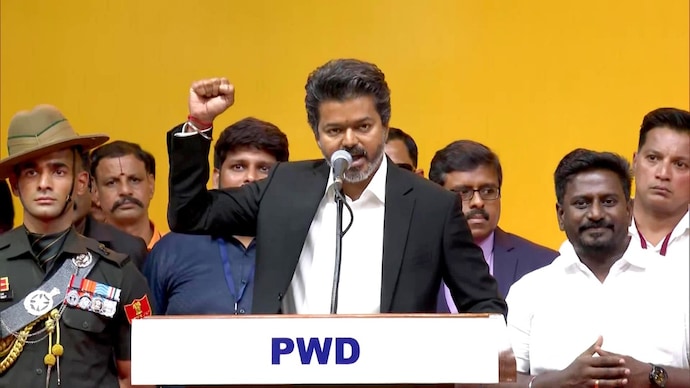

 In the Tamil Nadu election, the BJP won just one seat in the 234-member legislative assembly—a result that might, in any other context, be dismissed as the party’s electoral irrelevance in the state. Yet, on May 10, at the swearing-in ceremony of chief minister C. Joseph Vijay, who has declared the BJP as an ideological enemy, Vande Mataram was played before the state’s song Tamil Thai Vazhthu (invocation of Mother Tamil). Nobody from the new government apologised for it.
In Tamil Nadu, where language, Dravidian pride and cultural identity have defined politics for generations, that sequencing was a signal. And the BJP, with its lone MLA and a bruised alliance, watched it all from the sidelines with great interest.
At Vijay’s swearing-in, Vande Mataram was played first, followed by the national anthem Jana Gana Mana, and then the Tamil state song. The CPI, one of the parties backing the government, formally objected, with state secretary M. Veerapandian pointing out that Tamil Thai Vazhthu should have been accorded the foremost position. The BJP did not comment. It didn’t need to.
This ‘ideological overlap’ aside, the election campaign had seen Vijay and his Tamilaga Vettri Kazhagam (TVK) categorically demarcate their differences with the BJP as ideological. Vijay even remarked that the BJP “may sow seeds of poison elsewhere but not in Tamil Nadu”.
Yet, for the BJP-RSS, the TVK’s openness to a broader national cultural framework would have been noteworthy. Vijay has also sprung a surprise by not donning the traditional veshti—common among Tamil Nadu politicians—but rather blazer with trouser.
Banuchandar Nagarajan, non-resident fellow at the Delhi-based think-tank Council for International Economic Understanding, argues that Vijay represents neo-Dravidian thinking and is trying to cater to the younger generations with his selective use of traditional Tamil symbols.
Vijay’s five guiding lights in politics blend Periyar E.V. Ramasamy’s “social justice”, Kamaraj’s “honest administration”, B.R. Ambedkar’s “equal justice and equal opportunities”, Velu Nachiyar’s “social inclusivity and communal harmony” and Anjalai Ammal’s “fighting for water resources”.
Unlike the traditional DMK-AIADMK Dravidian model centred on rationalism, anti-caste mobilisation and welfare politics, Vijay broadens the narrative towards inclusive Tamil pride, nationalism and women-led symbolism. The shift is from ideological Dravidianism to a softer, aspirational and emotionally resonant Tamil identity politics for a new generation.
The preceding chief minister and DMK supremo M.K. Stalin took hard policy and ideological stances against the BJP-led Union government. The BJP-Sangh would be attentive as to what path Vijay takes. He is expected to be less combative on issues such as the National Education Policy (NEP) 2020 and Hindi as a medium of instruction in schools alongside Tamil.
Talking of Hindi, Vijay has included S. Keerthana, his party’s Hindi-speaking MLA from Sivakasi, in his cabinet, indicating he is not abrasive to the language like his predecessors have been. DMK and AIADMK leaders, when in government, used either English or Tamil as the medium for communication.
The BJP doesn’t need a formal alliance to benefit from a TVK government that does not wage the DMK’s cultural wars against the Centre; that tolerates rather than resists the BJP’s agenda on education, language and religious conversions; and that represents a structural shift in Tamil Nadu politics.
In some ways, the decade of sustained confrontation between the previous DMK government and the Centre on federalism, language policy and cultural nationalism, may be over. Vijay so far has shown no appetite for that kind of conflict. The Vande Mataram moment confirmed it more loudly than any policy statement could have.
A cold but working peace is arguably in place. This frees the BJP to pursue its opportunity in Tamil Nadu, which lies within the wreckage of the AIADMK, a party now torn over post-election support to Vijay. In a development politically improbable just weeks earlier, 24 of the 144 MLAs who supported Vijay during his first trust vote in the legislative assembly were AIADMK legislators. They had defied the party’s directive to vote against the TVK government. The open rebellion pushed the AIADMK to probably its deepest internal crisis since the death of J. Jayalalithaa in December 2016.
The AIADMK’s trajectory is a story of its own. From 136 seats in 2016, the party fell to 66 seats in 2021 and now to 47 in this election. Half of these 47 MLAs defied the party whip on the trust vote on May 13. The AIADMK’s organisational identity remains heavily tied to a legacy leadership model that younger voters appear increasingly detached from.
For the BJP, this is both an inheritance and a temptation. The party’s Tamil Nadu strategy until now rested on a predictable formula: ally with the AIADMK, build gradually in urban and western belts, and wait for anti-DMK sentiment to accumulate. Under K. Annamalai, the BJP expanded its visibility after 2021, particularly in the Kongu region and among younger urban voters. The sidelining of Annamalai ahead of the 2026 polls and the BJP’s renewed alignment with a weakening AIADMK is now widely seen as having cost the alliance the momentum.
The question the BJP faces is whether it absorbs the AIADMK’s collapsing ecosystem, inheriting leaders, cadre networks and regional vote pockets, particularly in western Tamil Nadu, or should it attempt to build an independent political identity from the ground up. The first path offers short-term gains. The second is the only one that leads to anything durable.
Vijay’s stupendous rise complicates that BJP calculation but does not necessarily obstruct it. The TVK now occupies much of the aspirational political space the BJP had hoped to expand into: first-time voters, digitally engaged youth, urban middle classes and politically non-aligned sections seeking an alternative to the old Dravidian formations. At the same time, Vijay’s emergence also breaks up the anti-BJP consolidation that historically unified large sections of Tamil politics. A fragmented, multi-cornered assembly gives the BJP operational room that it has simply never had before.
The deeper challenge is cultural. The BJP continues to face resistance rooted in language politics, federal sensitivities and perceptions of North Indian centralisation. Tamil Nadu’s electorate has historically rewarded parties seen as genuinely embedded within the state’s own political vocabulary. That is precisely why Annamalai mattered, and why his removal is still regarded by many as a strategic error. He had begun building something in western Tamil Nadu that looked, at least in outline, like an independent political identity for the BJP.
But Tamil Nadu is not the BJP’s only southern disappointment. In Kerala, the Congress-led United Democratic Front marched to a commanding 102-seat victory, ending a decade of Left Democratic Front rule and leaving the BJP with just three assembly seats despite a concerted campaign. Nationally, the National Democratic Alliance (NDA) governs 21 states, a dominance not seen since Indira Gandhi’s Congress. But the South continues to resist it.
In Tamil Nadu, especially, the old Dravidian system is visibly weakening but no stable replacement has yet consolidated itself. The BJP did not cause that transition. It did not engineer the AIADMK’s collapse, Vijay’s rise or the oath ceremony’s curious foregrounding of Vande Mataram. Yet, the BJP remains carefully observant, and perhaps for the first time in a long time, it has reason—valid or otherwise—to believe that Tamil Nadu could be moving, however slowly and indirectly, in its direction.
Subscribe to India Today Magazine