
The catch in Telangana's Maoist-free claim: Where are Ganapathi and comrades?
With 42 surrenders on April 10, Telangana declared itself free of Maoist armed formations. Neighbouring Andhra had announced victory less than a fortnight ago
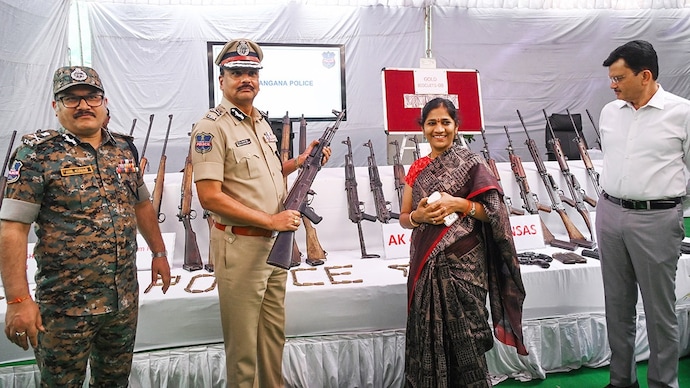

 Telangana is now “totally free of Maoist armed formations”, announced director general of police B. Shivadhar Reddy on April 10 as the state police presented before the media 42 surrendered cadre of the banned CPI (Maoist). They included 11 members of the Maoists’ Telangana State Committee.
Since January 2024, when the countrywide offensive against Maoists went into mission mode, 761 insurgents have laid down arms before Telangana authorities. They include four CPI (Maoist) central committee and 21 state committee members. Top police officials say that adding up the members who surrendered or were eliminated, the Telangana state committee of the CPI (Maoist) no longer existed.
Days before the announcement that Telangana is Maoist-free, Reddy had visited the Karreguttalu Hills, a Maoist stronghold till recently, near the Chhattisgarh border and set up a police outpost—a symbol of official reclamation of the ground from the insurgents.
At the time of its birth in 2014, Telangana had around 147 underground CPI (Maoist) cadre. Once intensely affected by Maoist violence, the state has been largely free of such incidents for several years now, even though natives of the state have helmed the insurgency in Chhattisgarh, Jharkhand and Maharashtra.
“A prompt and successful implementation of the state’s comprehensive surrender and rehabilitation policy resulted in the [Maoist] numbers being reduced to zero,” said B. Sumathi, inspector general, Telangana Special Intelligence Branch, in a conversation with INDIA TODAY.
Officials, though, acknowledge that five underground leaders of Telangana origin remained a part of various Maoist formations outside the state. The most prominent among them is Muppalla Lakshmana Rao alias Ganapathi (72), former general secretary of the CPI (Maoist) who hails from Jagitial in Telangana. He is battling deteriorating health. While his whereabouts are not confirmed, Special Intelligence Branch officials say Ganapathi is still a Maoist central committee and politburo member.
The other Maoist figure is Pusunuri Narahari alias Santosh (57), from Hanumakonda. The central committee member reportedly operates in Jharkhand.
The Telangana government and police have been in pursuit of these Maoists. While chief minister A. Revanth Reddy had made a special appeal to Ganapathi in March during the surrender of 130 Maoists, DGP Reddy has assured him state-facilitated advanced medical care in Hyderabad.
Neighbouring Andhra Pradesh claimed itself to be Maoism-free on March 30, just a day before the Centre’s deadline to eradicate Left Wing Extremism. To claim this status, the Andhra police presented the surrender of Chelluri Narayana Rao alias Somanna, a central committee member of the CPI (Maoist) and secretary of its Andhra-Odisha border special zonal committee, along with eight others.
Chelluri was allegedly involved in the 2018 killing of then Araku MLA Kidari Sarveswara Rao and Siveri Soma, a former legislator of the same constituency, along the Andhra-Odisha border. He is also accused of killing a circle inspector and his security officer in 2001 and a head constable in 1997 at the height of Maoist violence in Andhra Pradesh, besides participation in several ambushes, raids and gunbattles in Odisha and Chhattisgarh. These incidents claimed the lives of several police personnel besides the looting of hundreds of firearms.
Chelluri hails from Srikakulam district in the backward Uttarandhra region, also the native place of Nambala Keshava Rao, alias Basavaraju, one of the highest-ranked leaders of the movement. He was killed by security forces in Chhattisgarh’s Narayanpur last May.
Srikakulam, Andhra’s northern-most district, was the epicentre of tribal and peasant movements in the seventies and Maoism over the next two decades.
Giving up arms in the presence of Andhra DGP Harish Kumar Gupta in Vijayawada, Chelluri ended his 35-year-long insurgent life and declared that the Maoist movement and ideology had “become obsolete”.
“Unlike in the past, government welfare and developmental activities are reaching the people in remote areas too, thus disconnecting tribal people from the Maoists. On the other side, the party failed to adapt to the changing circumstances and update its political ideology,” Chelluri said while taking questions from the media.
“The Maoist movement is facing extinction not because of encounters and surrenders but the rigid refusal to assess the factual situation,” Chelluri said, claiming that the killings he was involved in were CPI(Maoist) decisions that he was merely following. As per Andhra’s surrender and rehabilitation policy, he will receive an amount of Rs 25 lakh.
Gupta, on the occasion, announced that Andhra was practically free of Maoists. “After a sustained counterinsurgency effort, we have successfully reduced the strength of underground cadre moving in Andhra Pradesh to zero. We can say that Left Wing Extremism has come to an end in the state,” said the DGP, showering praise on the state’s Special Intelligence Branch, Greyhounds and District Police for their efforts.
Over the past one year, Andhra reported seven gunbattles in which 18 Maoists were killed, including central committee members Madavi Hidma, Gajarla Ravi alias Uday and Metturi Jogarao alias Tech Sankar, and state zonal committee members Venkata Ravi Chaithanya alias Aruna, Kakuri Pandanna alias Jagan and Madakam Raje.
The biggest accomplishment, police claim, was the elimination of Hidma, one of the most-dreaded Maoists in the country, along with his wife Madakam Raje, a state zonal committee member, on November 18 in the Maredumilli forests close to the Chhattisgarh border.
Hidma had allegedly plotted some of ?he deadliest Maoist attacks, such as the April 2010 strike in Chhattisgarh’s Dantewada in which 76 paramilitary personnel were killed, and the May 2013 Bastar massacre in which 27 people, including some senior Congress leaders, died.
Days after Hidma’s encounter, the Andhra police claimed to have foiled a major Maoist conspiracy to unleash violence by arresting 50 operatives who had fled Chhattisgarh and taken shelter in urban areas of five north Andhra districts. The Andhra police show 18 killings, 81 arrests and 106 surrenders as their strike record against Maoists in the past one year or so.
Subscribe to India Today Magazine