

Siddu's long shadow will make Shivakumar rule uneasy. Here's why
The Congress high command has successfully averted an immediate crisis by crowning DK Shivakumar the Chief Minister of Karnataka, requesting Siddaramiah to step aside. But, Siddu has support from a majority of the MLAs and powerful community leaders. This is why keeping the CM's job could be a real challenge for DKS.
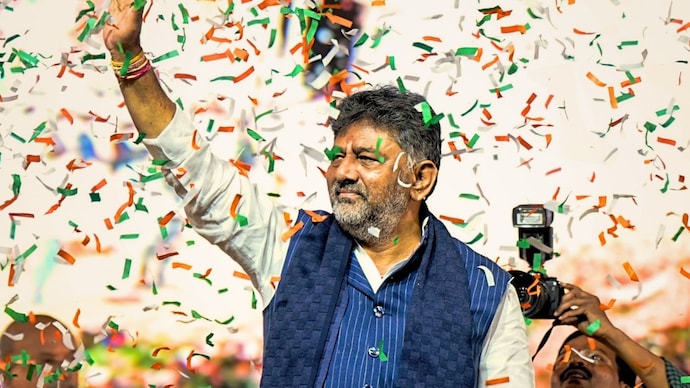


The position he had long set his sights on is finally his. DK Shivakumar took oath as Karnataka Chief Minister on Wednesday in the Lok Bhavan's Glass House. DKS, as he is popularly known, had been longing for the CM's chair for years. Getting the CM's chair might have been difficult for DKS, given his predecessor Siddaramiah's influence and power in the state and the party, but keeping it might be the biggest challenge for him.
Shivakumar, has on multiple occasions, staked claim to the CM's post. But it was Siddaramaiah's pull that made the party high command choose him as the Chief Minister, as the Congress returned to power in Karnataka in 2023.
Leaders of the Shivakumar faction had been repeatedly claiming that there was a "50-50 power-sharing deal" that the Congress brass had promised to make Shivakumar the CM after 2.5 years of the Congress's rule. But after 2.5 years, the power transition did not happen, and Siddaramaiah became the longest-serving chief minister of Karnataka, surpassing the feat of Devraj Urs.
Time and again the DKS-Siddu power tussle resulted in leaders from Karnataka rushing to Delhi. And finally, on May 26, Siddaramiah announced that he would be stepping aside for Shivakumar.
The Congress high command might have resolved the biggest headache, but the real political test for Shivakumar begins now as he takes the oath as the 34th Chief Minister of Karnataka.
WILL A NEW PHASE OF SIDDU-DKS POWER STRUGGLE BEGIN?
The power transition between Siddaramaiah and Shivakumar is unlikely to end the Congress's balancing act. Instead, it could trigger a fresh phase of factional bargaining within the Karnataka Congress unit, where caste equations, regional representation, and leadership ambitions have historically shaped power as much as electoral victories have.
For the last three years, Shivakumar and his supporters repeatedly pushed the Congress high command to honour the alleged rotational chief ministership understanding.
Yet the Congress leadership, especially Rahul Gandhi, backed Siddaramaiah to continue in office, despite mounting pressure from the Shivakumar camp. Rahul Gandhi's position changed, and he himself asked Siddaramaiah to step down as CM and make way for Shivakumar at a high-level meeting in New Delhi.
The larger question, however, is whether Siddaramaiah-backed MLAs and leaders will fully accept Shivakumar's leadership without resistance. This is more crucial because Siddaramaiah still holds the backing of the majority of the MLAs of the Congress.
Siddaramiah, who was offered a Rajya Sabha seat by the Congress brass, refused a national role, showing that he was more interested in remaining a power centre in Karnataka politics.
That he will have his say was reflected in the number of ministers from his camp who were sworn in along with Shivakumar on Wednesday. DKS might have got the CM's chair; Siddu gets to keep the CM's bungalow. The former CM has also been given a seat on the Congress's Central Working Committee (CWC), considered the party's "high command".
Siddaramiah built the Congress organisation with his AHINDA social coalition. He is a mass leader. A bigger question is if Shivakumar can build the same state-wide social and political coalition that Siddaramaiah has cultivated over decades.
WHY SIDDARAHMAIAH, NOT SHIVAKUMAR, IS IMPORTANT TO CONGRESS' KARNATAKA HOLD
The Congress came to power in Karnataka in 2023 with one of its biggest mandates in decades, winning 135 of the 224 Assembly seats with nearly 43% vote share. The victory was built on a broad coalition across regions and communities, with Siddaramaiah's AHINDA strategy — an alliance of backward classes, minorities, and Dalits — playing a central role. Political analysts noted that the Congress made major gains not just in the Old Mysuru region, but also in Kittur Karnataka (northwestern Karnataka) and Kalyana Karnataka (northeastern Karnataka).
That social coalition is precisely why Siddaramaiah remains a towering force within the Karnataka Congress, even as he has now stepped down and has been appointed as a member of the Congress Working Committee (CWC).
Unlike Shivakumar, whose influence is concentrated in Bengaluru and the Vokkaliga-dominated Old Mysuru belt, Siddaramaiah commands support across backward caste groups and among MLAs from both northern and southern Karnataka.
In the 2023 elections, the Congress swept large parts of Old Mysuru, winning around 37 to 39 seats in the region, a performance widely attributed to the combined influence of Siddaramaiah and Shivakumar. But while DKS consolidated Vokkaliga support and strengthened the party organisation, Siddaramaiah remained the Congress’s most expansive social coalition-builder.
This asymmetry in political influence could become the central challenge for Shivakumar as Chief Minister.
Significantly, just a day ahead of submitting his resignation, Siddaramaiah moved swiftly to accept the Backward Classes Commission survey report. The report was submitted by Commission Chairman Madhusudan Nayak after the Chief Minister fast-tracked the process amid rapidly evolving political developments in the state — a move many see as a final assertion of Siddaramaiah's AHINDA-driven political legacy before exiting office. This was also viewed as a quiet revenge by Siddaramaiah against Shivakumar and Rahul Gandhi.
POWER-SHARING IN KARNATAKA TO BE HEADACHE FOR CONGRESS?
The sharing of berths is becoming a new headache for the Congress leadership in New Delhi. Even before the leadership transition was completely done, Siddaramaiah's faction had reportedly begun bargaining for key organisational and cabinet positions. xxxx Congress leaders took oath as Cabinet ministers along with Shivakumar, and the majority of them are from Siddaramaiah's camp.
The message from the Siddaramaiah camp appears clear that while the chief minister's chair is going to Shivakumar, control over the Karnataka Cabinet and the broader political structure of the Congress should be dominated by them.
Several senior Congress leaders aligned with Siddaramaiah are also expected to seek a stronger say in the new power structure because of their regional influence and caste appeal.
Among them is the new Deputy CM of Karnataka, G Parameshwara, one of the tallest Dalit leaders in Karnataka, and Satish Jarkiholi, a powerful backward caste leader with influence in northern Karnataka.
Both leaders had earlier been said to be potential compromise candidates during the CM tussle if the Congress leadership wanted a middle path between Siddaramaiah and Shivakumar.
Another key figure is MB Patil, a prominent Lingayat face and a known Siddaramaiah loyalist. Lingayats account for roughly 14% of Karnataka's electorate, while Vokkaligas make up around 12%. It is the Lingayats and Vokkaligas who play a major role in shaping Karnataka's electoral results.
It was the Congress's strong performance among Lingayat candidates in 2023 that was seen as a major reason behind the BJP's defeat in 2023. The Congress currently has 37 Lingayat MLAs in the Assembly.
For Shivakumar, therefore, the challenge will not simply be administrative governance as the CM. It will involve preserving the Congress's delicate caste arithmetic while ensuring that leaders from Siddaramaiah's AHINDA bloc, and his north Karnataka base, do not feel sidelined under a leadership perceived to be centred around the Vokkaligas.
As Siddaramaiah loyalists take the deputy CM post and the majority of the Cabinet berths in the Shivakumar-led administration. They can spell trouble for Shivakumar, much like the sustained pressure he put on Siddaramaiah while he was the Karnataka CM for the last three years.
The pressure politics that helped Shivakumar to propose himself as the CM could now play a part against him by the Siddaramaiah loyalists.
For the Congress high command, replacing Siddaramaiah with Shivakumar might solve an immediate crisis. But managing a government led by Shivakumar, while balancing the ambitions of Siddaramaiah's loyalists and acolytes, aspiring chief ministers and deputy chief ministers, and competing caste blocs, might prove to be an equally tough test. For Shivakumar, the real challenge begins now.