

Restore traditional rituals, consider Goswamis' suggestions: SC to Vrindavan temple
A bench led by Chief Justice Surya Kant directed the inclusion of four Goswami representatives — two each from the Shayan Bhog and Raj Bhog groups — in the temple management committee.
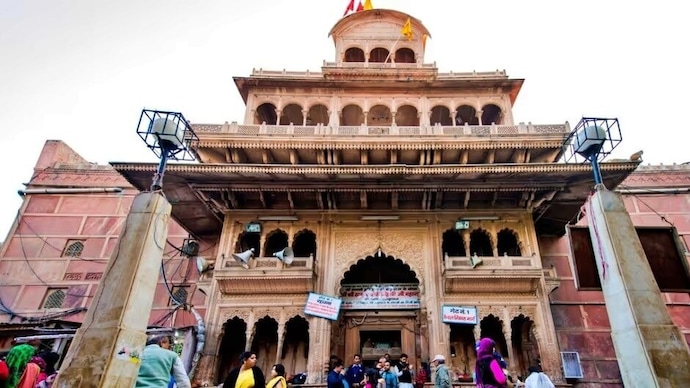


The Supreme Court on Tuesday introduced a major shift in the administration of the historic Banke Bihari Temple in Vrindavan by directing that members of the Goswami community on the temple’s High-Powered Committee must now be chosen through an internal democratic process rather than by officials. The ruling aims to ensure genuine representation of the community in decisions concerning temple affairs.
The top court also urged the committee to safeguard long-standing religious customs and rituals while simultaneously strengthening crowd regulation, visitor management and overall temple administration in consultation with representatives from the Goswami groups.
A bench comprising Chief Justice of India Surya Kant and Justice Joymalya Bagchi directed that two representatives each from the Shayan Bhog and Raj Bhog Goswami groups be included in the committee overseeing temple administration.
The Court ordered the inclusion of Gopesh Goswami and Himanshu Goswami from the Shayan Bhog group, and Rajat Goswami and Shailendra Goswami from the Raj Bhog group.
"With a view to ensuring that the suggestions with respect to allowing the traditional religious practices to the extent possible, without any exploitation of visitors and other day-to-day rituals, we have recommended that among the two groups of Goswamis should be nominated to the committee," the bench observed.
"All of them shall jointly give suggestions for improvement of traditional and religious practices and the day-to-day functioning of the temple. We have no reason to doubt that such suggestions shall be given due consideration by the committee constituted by this Court," it added.
The Court said suggestions could also be made regarding temple timings and rituals.
The Goswami representatives are expected to advise the committee on temple traditions, seva practices and administrative functioning.
THE TEMPLE MANAGEMENT COMMITTEE
The High-Powered Committee, headed by former Allahabad High Court judge Justice Ashok Kumar, had been constituted by the top court in August last year after staying the Uttar Pradesh government's Banke Bihari Temple Trust Ordinance, 2025.
The committee included district officials and four Goswami representatives, but the earlier selection process had triggered opposition from the Goswami community, which alleged arbitrary appointments by officials.
Senior advocate Shyam Divan, appearing for the Goswami Samaj, argued that several changes introduced by the committee had interfered with centuries-old customs and rituals of the temple.
He submitted that practices relating to Rajbhog, Shayan Bhog, Dehri Pujan, Vishram Kaal and Phool Bangla Seva were deeply embedded in tradition and should not be altered for administrative convenience.
"This is deeply engrained in the rituals, there should not be any change in timings," Divan submitted.
He also objected to the imposition of a fee of Rs 1 lakh for certain summer rituals and raised concerns over bright halogen lighting used for live telecasts inside the temple, saying devotees regard the deity in child form.
Appearing for the state and the committee, Additional Solicitor General KM Nataraj informed the Court that a comprehensive Master Plan for Vrindavan, including a proposed corridor project, was being prepared.
He said land acquisition for infrastructure expansion was progressing rapidly, with 14 sale deeds already executed.
The state also assured the Court that it was willing to reimburse temple funds currently being used for acquisitions.
CALL FOR BETTER CROWD CONTROL
The bench expressed serious concern over the narrow and congested lanes leading to the temple, observing that traditional crowd-control methods were no longer adequate.
"Crowd management cannot be done in the conventional sense. You have to deploy some modern technology and advanced systems," the Chief Justice observed.
The Court directed the Uttar Pradesh government and the committee to prepare a broader development plan for the temple precinct and surrounding areas, including road widening, regulation of commercial activity, hospitals, drinking water facilities, restrooms, emergency exits, waiting areas, public transport and battery-operated vehicles for senior citizens.
At the same time, the Court made it clear that traditional religious practices should be preserved as far as possible, provided there is no exploitation in the name of donations or preferential treatment for devotees.
The matter is expected to be taken up again after the committee and the state place their development and management proposals before the Court.