

China opposes creation of exclusive 'small cliques' after Quad meet in India
China accused the Quad of bloc confrontation after the grouping criticised coercive actions in disputed waters. The exchange came as the four countries widened cooperation on critical minerals, port infrastructure and shipping security.
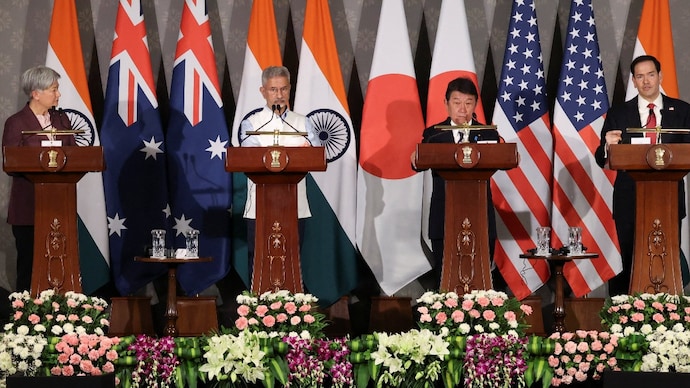


Hours after Quad foreign ministers meeting in New Delhi issued a joint statement criticising coercive actions in the South China Sea and unveiled fresh cooperation on critical minerals, maritime security and Indo-Pacific infrastructure, China accused the grouping of promoting "bloc confrontation" and forming exclusive small cliques aimed at targeting third countries.
"Cooperation between nations should be conducive to promoting regional peace, stability, and prosperity, and should not target any third party," Chinese Foreign Ministry spokesperson Mao Ning said during a press briefing.
"We oppose the creation of exclusive small cliques and oppose bloc confrontation," she added.
The sharp response came after the Quad ministers voiced direct concern over the East China Sea and South China Sea, where Beijing has steadily expanded its military and maritime presence in recent years.
QUAD'S CLEAR MESSAGE ON CHINA'S ACTIONS
The Quad foreign ministers -- India's S. Jaishankar, US Secretary of State Marco Rubio, Australian Foreign Minister Penny Wong and Japanese Foreign Minister Toshimitsu Motegi -- met in New Delhi on Tuesday for the latest Quad Foreign Ministers' Meeting hosted by India.
In their joint statement, the four countries said they remained "seriously concerned" about developments in disputed waters across the Indo-Pacific.
"We reiterate our strong opposition to any destabilising or unilateral actions, including by force or coercion, that threaten peace and stability in the region," the ministers said.
The statement also criticised dangerous military manoeuvres, interference in offshore resource development, obstruction of freedom of navigation and the "militarisation of disputed features" in the South China Sea.
While China was not named directly, the language left little doubt about who the statement was aimed at.
Beijing claims almost the entire South China Sea despite overlapping claims from several Southeast Asian countries and has built military infrastructure across disputed islands and reefs. China and Japan also remain locked in a separate territorial dispute in the East China Sea.
Despite Beijing portraying the Quad as an anti-China alliance, officials from India insisted the grouping was far broader than a military or strategic bloc. Addressing reporters after the meeting, Ministry of External Affairs Additional Secretary Nagaraj Naidu said the Quad had evolved steadily over the years around practical development projects and regional cooperation.
"The Quad's existence is not because we need to address a particular geography's concerns," Naidu said. He pointed to the grouping's vaccine coordination efforts during the COVID-19 pandemic as an example of practical cooperation.
"As we always keep saying, our focus within the Quad has been to deliver practical projects," he added.
The Quad also announced its first major joint infrastructure project, a plan to help develop port facilities in Fiji as part of efforts to expand its presence across the Indo-Pacific.
"We are going to be partnering on issues of port infrastructure," Rubio said.
CRITICAL MINERALS AND SHIPPING SECURITY TAKE CENTRE STAGE
One of the biggest outcomes of the meeting was the launch of a new critical minerals framework designed to strengthen supply chains for materials essential to modern industries such as semiconductors, defence systems and renewable energy.
The initiative carries particular importance for countries like Japan after China previously restricted exports of key minerals during diplomatic disputes.
Rubio described the Quad as a central pillar of Washington's Indo-Pacific strategy.
"We are beginning to show real achievements and real accomplishments," he said.
"We are deeply committed to this partnership. It is a linchpin and a cornerstone of our global strategy as a nation in the United States."
The Quad ministers also discussed shipping security amid rising tensions in West Asia.