

After Garib Nagar demolition, Mumbai's train-window gaze turns towards more slums
The Garib Nagar demolition in Mumbai's Bandra suburb has triggered calls to clear more slums across the city, with viral videos shot from local train windows fuelling demands for similar drives in Wadala, Kurla, Dadar and beyond. But these settlements also house the workers Mumbai depends on.
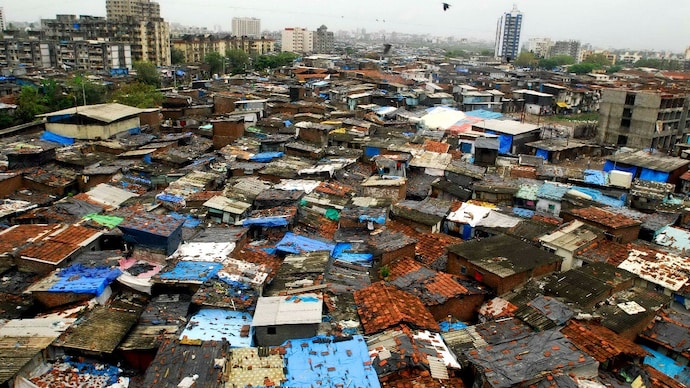


Days after bulldozers tore through Garib Nagar in Mumbai's Bandra East, calls for more slum demolitions across Mumbai have only grown louder. As Western Railway carried out another demolition drive between Goregaon and Malad on Monday to reclaim illegally occupied railway land under Bombay High Court directions, social media was flooded with videos shot from local train windows — of stretches of blue tarpaulin roofs in Wadala, Kurla, Dadar, Govandi and beyond.
Many users tagged authorities and demanded that similar drives be carried out across the city, not just on railway land but also on BMC and government-owned plots.
Barely a week after authorities evicted over 1,500 people from Garib Nagar from over 400 two-three storey shanties, Western Railways has reclaimed approximately 1,500 square metres of vital Railway land in the northern suburbs of Goregaon and Malad. A total of 36 hard encroachments and 24 soft encroachments were cleared through a coordinated operation.
When it comes to "urban clean-up" drives, there is always a contradiction at play. The videos from Garib Nagar struck a nerve not just because many saw the demolition as inevitable, but because they also laid bare the human cost behind Mumbai's idea of "order" — a city where slums and skyscrapers have long co-existed, often uneasily, but dependently.
As the earthmovers reduced homes to rubble under a Bombay High Court-backed eviction drive by the Western Railway, the demolition of hundreds of homes also unleashed something else across Mumbai. It was anger for many, and a moment of applause for the rest.
But perhaps the most revealing videos were shaky phone clips shot from local trains, zooming into slum clusters along tracks in Wadala, Dadar and Kurla. "Next please", the captions read.
An X user, Satish Pandita, said, "Mumbai, a world city, is reduced to City of Slums. Have a look at this video [a video taken from a local train], it is just a fraction [pointing at the slums in Wadala]. When will Mumbai be free from slums?"
Referring to Mumbai as "Slumbai", another person commented on a video shared by Indian Tech and Infra that showed sprawling slum clusters across Mumbai. "When I went to Mumbai, I was under the impression that slums were confined to Dharavi and that the rest of the city was modern. But slums are everywhere. I still can't believe the scale of it. And the sheer size of these settlements means they cannot simply be cleared overnight. It would take decades."
The calls for demolition have since expanded beyond railway land, with several local train commuters now demanding that the government clear slum clusters not just from railway property, but also from BMC and other government-owned land across the city.
For a section of Mumbai's upper and upper-middle classes, the demolition of Garib Nagar slums was a long-awaited "clean-up" of the city. The demolition of the slums in Dharavi has also been lauded by the same section of society.
But there is a contradiction here that Mumbaikars confront every day, and yet sometimes forget. The city needs the labour, but its administration and the governments over the years have been unwilling to accommodate it.
Slums occupy nearly 24% of Mumbai's land while housing more than half its population, according to Maharashtra's Slum Rehabilitation Authority (SRA).
Mumbai-based architect PK Das, on his website, estimates that roughly 7.5 million people live in these slums. That alone explains why Mumbai's slum debate can never be reduced to aesthetics.
Almost every second Mumbaikar lives in informal housing, compressed into barely a quarter of the city's geography.
People invest in houses worth crores of rupees, and the view is slums. This is true for the majority of real estate markets in Mumbai and its northern suburbs. Even in a place as posh as Colaba Causeway, there are slums.
More importantly, the people being pushed out of these settlements are not peripheral to the city's economy. They are the city's economy.
They drive the delivery bikes that keep Mumbai's app economy alive. They clean homes in gated towers overlooking the Arabian Sea. They pour concrete into luxury skyscrapers they will never live in. They run roadside eateries, work as security guards, tailors, plumbers, electricians, nurses, drivers, mechanics, loaders and sanitation workers.
Mumbai's pace survives on the backs of workers who often cannot afford formal housing within the same city they sustain.
MAHARASHTRA GOVTS, BMC, RAILWAYS HAVE FAILED TO CREATED SPACE FOR MIGRANTS
A Mumbai-based senior journalist, who has lived in the city since childhood and has covered the city's civic issues for over 15 years, described the current situation as a failure of urban imagination as much as governance.
"What Mumbai, Maharashtra, the BMC, the Railways, everyone in authority, failed to do was create space for the millions of migrant workers who came here and took up the jobs many others didn't want to do," the journalist said, requesting anonymity.
The journalist pointed out that migrants from Uttar Pradesh, Bihar and southern states have long filled the city's labour vacuum, often performing physically demanding work with little security or dignity in return.
"And now, when it is inconvenient, we are simply throwing them away," the journalist added.
The emotional charge around Garib Nagar also reflects a shift in the city's social mood. In older "Bombay", class divides certainly existed, but there was still a performative idea of coexistence — a belief, however imperfect, that the city belonged to everyone who worked in it. The mill workers were a great example of this, who lived in places that now house the most expensive real estate in India.
The journalist argued that this social compact now appears to be eroding.
"There was at least a social expectation that you should behave with some humanity. Now even that pretence is disappearing," the journalist told India Today Digital.
The remarks come at a time when public spaces themselves are increasingly becoming sites of class conflict.
In Bandra, debates have erupted over access to gardens, promenades and open spaces, with residents in some affluent pockets complaining about "outsiders", street vendors, dog-walkers and children from "poorer neighbourhoods" using public amenities.
The Garib Nagar demolition, therefore, did not happen in isolation. It has tapped into a wider aspiration among sections of the city who view slums less as housing crises and more as visual blight.
MEGACITIES AROUND THE WORLD HAVE DEPENDED ON INFORMAL, LOW-INCOME SETTLEMENTS
Urban historians have pointed out that megacities across the world have always depended on informal or low-income settlements.
Paris has its banlieues. New York had immigrant tenements. Los Angeles, which has Skid Row, struggles with homelessness. Most global cities absorb migrants faster than formal housing systems can accommodate them.
Mumbai's challenge is more extreme and acute. Its geography constrains expansion, while one of the world's most expensive property markets has made affordable housing scarce even for many middle-class residents. The market has paralysed affordable housing even for the top 1% of this country.
The city has effectively become a place where luxury towers and informal settlements exist wall-to-wall, and that is not because of accident. Each has economically sustained the other.
And that is perhaps the central paradox of Mumbai. The same city that markets itself as India's financial capital often relies on invisible housing economies to function.
Everybody in Mumbai knows this, even if the city rarely says it aloud.
Soon after the demolitions in Garib Nagar, videos of chaos at Mumbai's Lokmanya Tilak Terminus (LTT) went viral. Sources that India Today Digital spoke to could not confirm whether the people leaving were migrants displaced from Garib Nagar returning home. But on social media, there was hostility. "Send them back," some wrote. "Kick them out," said others.
If such displacement continues without affordable rehabilitation, as the senior Mumbai journalist put it, "One day, these workers will simply go elsewhere. And then the same people living in high-rises will complain about labour shortages and rising costs."
Mumbai's mythology is built on the idea that anyone could arrive with little and still carve out a life in the city of dreams. Mumbai seemingly doesn't believe in that mythology any more.