

Mass exodus at Hakimpur border as 3D policy pushes illegal immigrants to return
Following the change in government, authorities have moved swiftly to address long-standing border security concerns by implementing a strict "3D Policy" — Detect, Detain and Deport. Under the policy, every district has been directed to establish specialized "Holding Centres" where undocumented immigrants will be kept pending lawful repatriation.
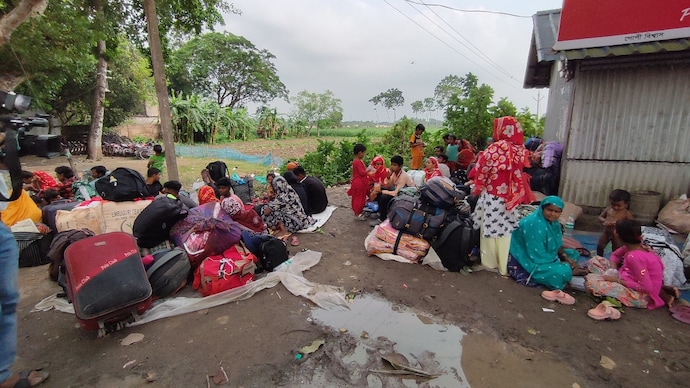


In less than a year, the Hakimpur Border in North 24 Parganas has once again become the center of national attention. Just last August, ahead of the implementation of the Special Intensive Revision (SIR), thousands of undocumented immigrants had gathered at this very checkpost. Today, hundreds are lining up once more — this time to return to Bangladesh — driven by a new political and administrative reality.
Following the change in government, authorities have moved swiftly to address long-standing border security concerns by implementing a strict “3D Policy” — Detect, Detain and Deport. Under the policy, every district has been directed to establish specialized “Holding Centres” where undocumented immigrants will be kept pending lawful repatriation.
The impact of the policy was immediate. Fearing detention and legal action, thousands of illegal immigrants living across the Greater Kolkata region have started heading voluntarily toward the Hakimpur Border in hopes of avoiding legal complications and returning to Bangladesh on their own.
TIGHT SECURITY AND MULTI-LAYER VERIFICATION
Despite the sudden surge, Indian security agencies have maintained strict order at the border, turning what could have become chaos into a tightly controlled processing operation.
The repatriation process follows a multi-layer verification system:
Individuals are first divided into groups and their credentials verified by the Border Security Force (BSF).
Those cleared then undergo fingerprint and biometric registration to create a permanent digital record and prevent future unauthorized entry.
After Indian authorities complete verification, the Border Guard Bangladesh (BGB) cross-checks the documents with its own records before allowing entry into Bangladesh.
According to officials, the process is moving efficiently. Around 50 individuals were repatriated yesterday, while another larger batch is currently awaiting final clearance at the checkpoint.
HUMAN STORIES BEHIND THE BORDER CRISIS
Even as the government pushes ahead with its “3D Policy” for border security and law enforcement, the scenes at Hakimpur underscore the human cost of illegal immigration.
CASE STUDY 1: THE FAMILY RETURNING AFTER CANCER TREATMENT
For Rozina Bibi, the border marks the end of a long and uncertain stay in India.
“We came to India seven years ago for my husband Saidul’s cancer treatment,” she said. As the treatment stretched on, the family continued living in India illegally. But after the new policy came into force, their landlord allegedly asked them to vacate the house, leaving them with no option but to return.
CASE STUDY 2: A FAMILY TORN APART
Thirty-six-year-old Sabina Khatoon sat near the checkpoint holding her two young children.
Years ago, she had crossed into India illegally with the help of touts and later married an Indian citizen. She said both her children were born at RG Kar Hospital using her husband’s documents.
Now, the new policy has left the family divided. Her husband, being an Indian citizen, cannot accompany them to Bangladesh.
“I do have family in Satkhira, but I don’t know how we will reunite,” Sabina said tearfully while looking at her children. “Will my children ever get to see their father again?”
CASE STUDY 3: DREAMS WASHED AWAY
For 25-year-old Akhruzamman, the dream of building a better life in India lasted barely two months.
“I swam across the Sonai river at night to reach India,” he admitted. Coming from a financially struggling family in Khulna, he risked everything hoping for work and stability.
Now, he waits at the border for clearance from both BSF and BGB officials.
“I have no other option left,” he said quietly.
A BORDER FILLED WITH RELIEF AND GRIEF
As evening falls over the Hakimpur checkpost, the atmosphere remains heavy with both relief and sorrow. While the government machinery continues to function with precision in enforcing border laws, the cries of children and silent grief of separated families echo across the checkpoint.
For many standing in the long queues, returning to Bangladesh is no longer a choice but a legal necessity — one that comes with broken families, abandoned dreams and the painful uncertainty of whether loved ones left behind will ever be seen again.