

AAP's Punjab architects now powering BJP's 2027 poll push
The BJP is stepping up its Punjab campaign ahead of the 2027 Assembly polls, banking in part on former AAP leaders Raghav Chadha and Sandeep Pathak, who played a key role in the party's rise in the state. The BJP is also placing organisational expansion and the drug crisis at the centre of its strategy.
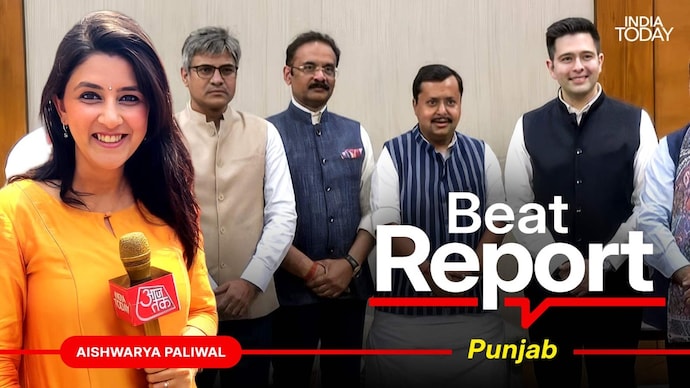


For years, Punjab remained on the fringes of the BJP's expansion plans. Not any more. The party has now fixed its gaze firmly on the border state, spotting an opportunity where others see a difficult political landscape. Its objective is straightforward: strengthen the organisation, make the drug crisis a central political issue and position itself as a serious contender for power in the 2027 Assembly polls.
The signs are already visible. Home Minister Amit Shah's visits to Punjab have become increasingly frequent and party insiders say the outreach will only intensify in the months ahead. Within BJP circles, the message is clear: Punjab is no longer an occasional stop on the political map; it is emerging as one of the party's most closely watched battlegrounds.
This time, the BJP is also determined to go it alone. The era of depending on allies to remain politically relevant in Punjab appears to be over. Buoyed by recent political gains and growing confidence within the organisation, BJP leaders believe Punjab is no longer a distant dream if the party is willing to invest the necessary effort and resources.
THE MEN WHO BUILT AAP'S PUNJAB VICTORY IN 2022
What makes this political story particularly striking is the role of two leaders who were instrumental in creating AAP's biggest success outside Delhi – Sandeep Pathak and Raghav Chadha – who switched to the BJP earlier this year.
Long before AAP swept the 2022 polls, Pathak was quietly building the party's foundation in the state. Within the organisation, he earned a reputation as a strategist who preferred results over visibility. He is a Cambridge-trained physicist who later taught at IIT Delhi, Pathak approached politics with the mindset of a researcher.
Surveys, data collection, booth-level mapping, volunteer networks and organisational discipline became the pillars of Pathak's strategy. His method was rarely glamorous. He spent years understanding local realities, strengthening the cadre and identifying pockets of support long before campaign slogans appeared on billboards.
Party leaders often described him as the "silent mastermind" behind AAP's Punjab model.
Alongside him was Raghav Chadha, who emerged as the public face of the campaign. As Punjab co-in-charge, Chadha became the bridge between the Delhi leadership and the state unit, handling political messaging, managing key stakeholders and helping translate strategy into electoral momentum.
One worked largely behind the scenes. The other occupied centre stage. Together, they helped engineer one of the most remarkable electoral victories in Punjab's recent history.
Now, according to sources, it is precisely that experience which the BJP hopes to leverage. Party leaders believe the immediate task is to build the organisation from the ground up, and both Pathak and Chadha's understanding of Punjab's political landscape could prove valuable. Sources told India Today TV that both leaders are likely to be assigned responsibilities in the coming months aimed at strengthening the BJP's footprint in the state.
THE ORGANISATIONAL GAP
Politics is often won through narratives, but sustained success usually depends on organisation.
Many observers believe Pathak's reduced role within AAP has had consequences. The systems he helped create – from surveys and worker engagement to micro-level planning and booth management – were central to the party's rise in Punjab.
As AAP grapples with anti-incumbency pressures and governance challenges, questions are increasingly being raised about whether the organisational machinery that powered its rise remains as effective as it once was.
For the BJP, that uncertainty represents an opportunity.
At the same time, party leaders acknowledge a significant challenge: acceptability. Despite recent gains, sections of Punjab continue to view the BJP with distrust. Addressing that perception gap has become a major focus of the party's strategy.
SEVEN MPS AND A FRESH OPENING
The BJP's calculations have been strengthened further by the arrival of seven Rajya Sabha MPs previously associated with AAP.
Within the party, these leaders are viewed as more than symbolic additions. They bring political experience, organisational networks and regional visibility that could help the BJP expand its presence in areas where it has traditionally struggled.
From district units to booth-level structures, the party is attempting to use these new entrants to accelerate organisational growth. In a state where political networks often matter as much as political messaging, every new face carries strategic value.
DRUGS AT CENTRE OF BJP'S PITCH
The BJP has also decided to place Punjab's drug problem at the centre of its political campaign. The party is preparing statewide outreach programmes and yatras focused on the issue, hoping to frame the fight against drugs not merely as an electoral promise but as a broader social mission.
For Amit Shah, the theme is neither new nor incidental. Party leaders view it as a long-term governance challenge capable of cutting across caste, regional and political divides.
Whether the strategy resonates with voters remains to be seen, but there is little doubt that the BJP intends to make it one of the defining themes of the 2027 election.
BJP NO LONGER A JUNIOR PARTNER
Perhaps the biggest change is psychological. For decades, the BJP operated in Punjab largely through its alliance with the Shiromani Akali Dal (SAD). That equation has changed dramatically.
The party now believes its growing vote share gives it the space to emerge as an independent political force. Its vote percentage nearly doubled between 2019 and 2024, and although seats remained elusive, BJP leaders drew encouragement from the party's performance across several Assembly segments.
Party strategists argue that Punjab's political landscape is more fluid than it has been in years. AAP faces the burden of governance and growing anti-incumbency. Congress continues to wrestle with internal divisions. The Akali Dal is still searching for a path back to relevance.
The BJP believes this combination has created a rare opening.
THE ROAD TO 2027
Punjab remains one of the toughest states for the BJP to crack, and party leaders know that slogans alone will not be enough. That is why organisation-building, cadre expansion and sustained political engagement have become central to the strategy.
And that is where the irony lies.
Many of the methods that helped AAP build a winning machine in Punjab – meticulous planning, booth-level organisation, data-backed decision-making and relentless grassroots engagement – were shaped by Pathak and amplified by Chadha.
As the BJP prepares for its most ambitious push in Punjab, it is hoping to tap into the very political space that those efforts once helped create. Punjab's 2027 battle may still be some distance away, but the battlelines are already being drawn.