
Jamdani saree guide: How to pick the best weave and spot a real one
Jamdani sarees are celebrated for their delicate handwoven motifs and lightweight texture, making them one of the most admired handloom traditions from Bengal even today.
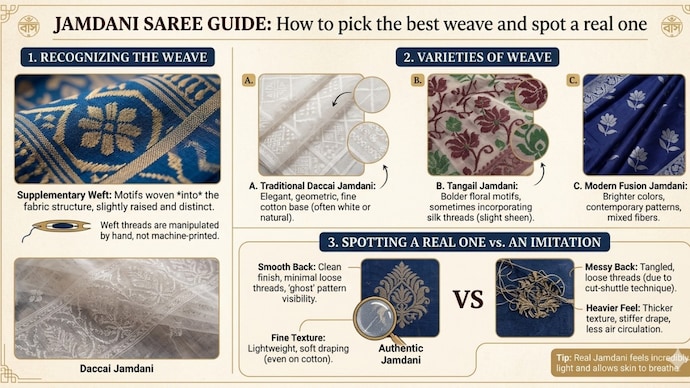

A Jamdani saree is one of the most admired handwoven textiles from Bengal, loved for its airy fabric, detailed motifs and timeless elegance. The weave traces its roots to the famous muslin traditions of Dhaka and remains deeply connected to the cultural identity of Bengal even today.
What makes Jamdani stand out is the craftsmanship behind it. Every motif is woven by hand into the fabric instead of being printed or embroidered later. The process is slow, detailed and often takes weeks or even months to complete.
Today, Jamdani sarees are popular not only for festivals and weddings but also for everyday elegant dressing and modern handloom fashion.
WHAT MAKES A JAMDANI SAREE SPECIAL?
The defining feature of a Jamdani saree is its intricate weaving style. Artisans use an extra-weft technique to create motifs directly on the loom, giving the patterns a floating appearance on the fabric.
Traditional motifs often include flowers, paisleys, geometric shapes and nature-inspired patterns. The sarees are usually woven using fine cotton or muslin yarns, although silk-blend versions are also available today.
Because every design is created manually, no two authentic Jamdani sarees look exactly the same.
HOW TO IDENTIFY AN AUTHENTIC JAMDANI
One of the easiest ways to identify a real Jamdani saree is by examining the motifs closely. In authentic handwoven pieces, the patterns are part of the weave itself and can usually be seen clearly on both sides of the saree.
The fabric should feel soft, breathable and lightweight rather than stiff or overly glossy.
Small irregularities in motifs or weaving are also common signs of handmade work. Machine-made copies often appear too uniform and perfect.
Another clue is the time and labour involved. Genuine Jamdani sarees are rarely produced quickly because the weaving process is highly detailed.
HOW TO PICK THE BEST JAMDANI SAREE
When choosing a Jamdani saree, focus first on the weave quality rather than heavy decoration. A finer weave usually means better craftsmanship and a smoother drape.
Look for balanced motifs that are neatly woven into the body without loose threads. Lightweight cotton Jamdani works well for summer and daily elegance, while silk-blend versions are preferred for festive wear.
Colour choice also matters. Traditional white-and-red, pastel shades and monochrome Jamdanis remain timeless, while contemporary versions now come in bolder colours for younger buyers.
It is also important to check the border and pallu detailing, as these often show the skill level of the artisan.
WHERE TO BUY AUTHENTIC JAMDANI
Authentic Jamdani sarees are usually best purchased from trusted handloom exhibitions, government-supported handloom fairs, artisan collectives and reputed weaving clusters in Bengal and Bangladesh.
Buyers should ask whether the saree is handwoven or machine-made before purchasing.
Checking the fabric texture, weaving quality and motif detailing in person is often more reliable than buying solely based on photographs online.
Despite changing fashion trends, Jamdani sarees continue to stay relevant because they combine heritage with comfort and versatility.
They work equally well for formal events, cultural celebrations and modern minimal styling. Many younger buyers are also choosing handloom textiles again as interest in slow fashion and artisan-made clothing continues to grow.
More than just a saree, Jamdani remains a woven piece of history that carries generations of craftsmanship in every thread.