
Tier-1 vs Tier-2 cities: Which saves you more money in India?
Cost of living in India varies widely between Tier-1 and Tier-2 cities. While metro salaries are higher, lower rent, food, and daily expenses in smaller cities often lead to better savings overall.
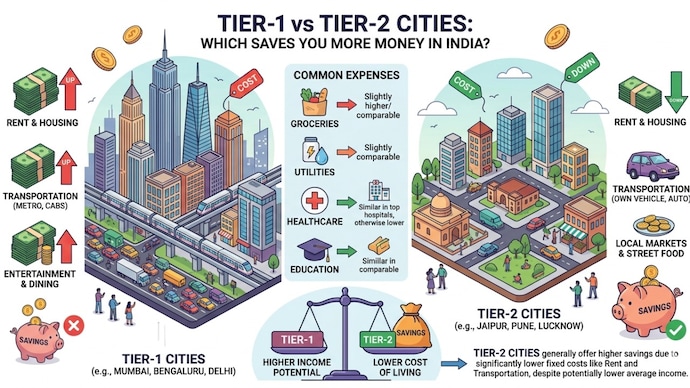

If you’ve ever wondered about the cost of living in India and where your money goes further, the Tier-1 vs Tier-2 cities debate is worth a closer look.
Metro cities promise higher salaries and faster career growth, but they also come with steep rents and daily expenses.
On the other hand, Tier-2 cities offer a more affordable lifestyle. So the real question is simple: which city type helps you save more money? Let’s break it down in a practical, no-nonsense way.
Cost of living in India 2026: City-wise expenses and monthly costs
COST OF LIVING: TIER-1 VS TIER-2
Housing and rent
This is where the biggest gap shows up.
- In Tier-1 cities like Mumbai, Delhi, or Bengaluru, a 1BHK or 2BHK can cost Rs 25,000–Rs 50,000+ per month. Buying a home often runs into crores.
- In Tier-2 cities such as Indore, Nagpur, Surat, or Jaipur, similar homes rent for Rs 8,000–Rs 20,000 per month. Property prices are also far lower.
Food, dining, and groceries
Eating out in a mid-range restaurant in metros can cost Rs 600-Rs 1,000 per person.
In Tier-2 cities, the same meal usually costs Rs 300-Rs 600.
Groceries and daily essentials are also 20-40% more expensive in Tier-1 cities, which quickly adds up over a month.
COST OF LIVING COMPARISON: TIER-1 VS TIER-2 CITIES IN INDIA
Utilities and lifestyle
Electricity in metros can go up to Rs 10 per unit, while Tier-2 cities often stay between Rs 5–Rs 7.
Transport, services, and day-to-day costs are generally cheaper in smaller cities.
SALARY VS SAVINGS: WHAT REALLY MATTERS
It’s true that salaries in Tier-1 cities are 30–50% higher, especially in IT, finance, and corporate jobs.
But here’s the catch: higher income doesn’t always mean higher savings. Once you subtract rent, food, commuting, and lifestyle expenses, many people find their savings shrinking.
Studies and cost-of-living comparisons in 2026 suggest that Tier-2 cities leave a larger portion of income unspent. In simple terms, your money stretches further.
QUALITY OF LIFE TRADE-OFFS
Tier-1 cities
- Better job options and career growth
- Stronger infrastructure and connectivity
- Access to top schools and hospitals
- Downsides: traffic, crowding, higher monthly spend
Tier-2 cities
- Lower cost of living and more affordable housing
- Less congestion and slower pace of life
- Fewer high-end services and niche job roles
SO, WHICH CITY SAVES YOU MORE?
If your goal is saving money, Tier-2 cities usually come out ahead. Lower rent and daily costs mean you keep more of what you earn.
If your focus is career growth and higher salaries, Tier-1 cities still offer better opportunities, even if savings take a hit.